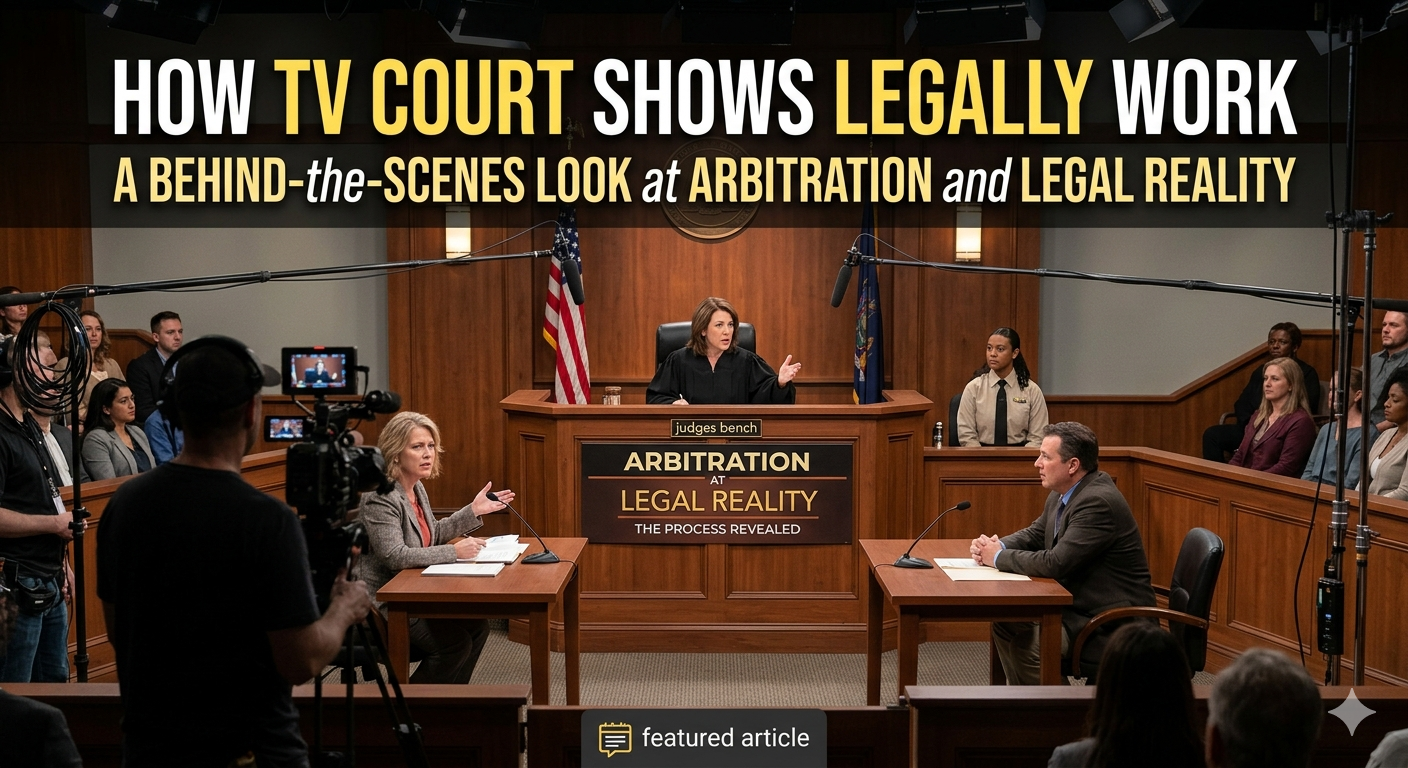
How TV Court Shows Legally Work: A Behind-the-Scenes Look at Arbitration and Legal Reality
For decades, television court shows have captivated audiences with dramatic disputes, sharp-witted judges, emotional confrontations, and seemingly quick resolutions. Programs such as Judge Judy, The People’s Court, and many others have turned legal disagreements into popular entertainment. To many viewers, these shows appear to be real courtrooms where judges hear cases and issue legally binding decisions.
But what actually happens behind the scenes? Are these genuine court proceedings, or are they simply television productions dressed up as legal institutions?
The answer lies in a fascinating legal process known as arbitration. Understanding how TV court shows operate reveals the unique intersection of law, entertainment, and dispute resolution.
The Illusion of a Traditional Courtroom
At first glance, TV court shows look remarkably similar to actual court proceedings. Participants present evidence, witnesses testify, and a judge renders a decision. The courtroom setting, legal terminology, and formal procedures all contribute to the appearance of a genuine judicial process.
However, most television court shows are not part of the official court system. The judges seen on television are often retired judges, former prosecutors, or experienced attorneys, but they are not acting as state court judges when hearing these cases. Instead, they serve as private arbitrators.
This distinction is crucial because it changes the legal framework under which the cases are resolved.
What Is Arbitration?
Arbitration is a form of alternative dispute resolution (ADR) that allows parties to settle disagreements outside of traditional courts. Rather than having a case heard by a government-appointed judge, both parties agree to present their dispute to a neutral third party known as an arbitrator.
The arbitrator reviews evidence, hears arguments, and issues a decision that is typically binding on both sides.
Arbitration is widely used in business disputes, employment matters, consumer agreements, and many other legal contexts because it is often faster and less expensive than traditional litigation.
TV court shows essentially transform this legal process into an entertainment format.
How Cases End Up on TV
The participants featured on television court programs are usually real people involved in actual disputes. Many have already filed claims in small claims court or were considering legal action before being contacted by a show’s producers.
The show’s legal team reviews potential cases and selects those likely to be interesting, understandable, and engaging for viewers. Once chosen, both parties must agree to appear on the program.
Before filming begins, participants sign legal agreements consenting to arbitration. These agreements generally include provisions stating that the arbitrator’s decision will be final and legally binding.
By signing these contracts, the parties voluntarily waive their right to pursue the same claim through a traditional court proceeding.
Who Pays the Judgment?
One of the most surprising aspects of television court shows is how judgments are handled.
In many programs, the production company—not the losing party—pays the awarded judgment. This means that if a plaintiff wins a $5,000 claim, the television show often covers the payment rather than requiring the defendant to pay directly.
Additionally, participants commonly receive appearance fees, travel expenses, and accommodations for taking part in the show.
This arrangement benefits everyone involved. The show gains entertaining content, while participants receive an opportunity to resolve their dispute without incurring legal expenses or collection difficulties.
Are the Decisions Legally Binding?
In most cases, yes.
Because both parties agree to arbitration before appearing on the show, the arbitrator’s ruling carries legal weight. Courts generally recognize and enforce arbitration awards, provided the arbitration process follows applicable legal standards.
As a result, participants cannot simply reject the outcome because they are unhappy with the decision.
However, the legal authority comes from the arbitration agreement rather than from the televised courtroom itself.
How TV Court Differs from Real Court
While television court shows are based on legitimate legal principles, they differ significantly from traditional court proceedings.
1. Speed
Real lawsuits can take months or even years to resolve. Television cases are often concluded within a single filming session lasting less than an hour.
2. Entertainment Value
Producers select cases that are likely to generate audience interest. Ordinary legal disputes lacking dramatic or emotional elements are less likely to be featured.
3. Simplified Procedures
Actual courtrooms operate under complex procedural and evidentiary rules. TV arbitration proceedings are typically streamlined to fit broadcasting schedules and maintain viewer engagement.
4. Editing
What viewers see is a carefully edited version of events. Hours of discussion may be condensed into a short segment, highlighting the most compelling moments.
5. Limited Stakes
Most television court shows focus on relatively small monetary disputes. Serious criminal matters, major civil lawsuits, and highly complex legal controversies generally remain within the traditional judicial system.
Why Arbitration Makes TV Court Possible
Without arbitration, television court shows would face significant legal and logistical challenges. Traditional courtrooms cannot simply be transformed into entertainment productions, and judges cannot conduct official proceedings for television in the same manner.
Arbitration provides a flexible legal framework that allows disputes to be resolved efficiently while maintaining a degree of legal legitimacy. It creates a system where participants receive binding resolutions and producers obtain compelling content suitable for broadcast.
In many ways, arbitration serves as the bridge between authentic dispute resolution and television entertainment.
Common Misconceptions
Many viewers mistakenly believe that television judges are exercising governmental judicial authority. In reality, their authority comes from contracts signed by the participants.
Another common misconception is that the courtroom audience influences outcomes. Unlike jury trials, arbitration decisions are made solely by the arbitrator.
Some also assume that participants are actors. While television editing may heighten drama, the disputes themselves are generally genuine, involving real disagreements between real people.
The Broader Impact of TV Court Shows
Beyond entertainment, television court programs have introduced millions of viewers to basic legal concepts. They have helped educate the public about contracts, property disputes, consumer issues, negligence claims, and the importance of evidence.
At the same time, critics argue that these programs sometimes oversimplify legal processes and create unrealistic expectations about how quickly disputes are resolved.
Nevertheless, their popularity demonstrates the public’s enduring fascination with justice, conflict resolution, and the law.
Conclusion
TV court shows occupy a unique space between law and entertainment. While they may resemble traditional courtrooms, most operate through arbitration agreements that allow disputes to be resolved outside the formal judicial system. The judges function as arbitrators, participants voluntarily consent to the process, and decisions are often legally binding.
Understanding the role of arbitration reveals that these programs are neither completely fictional nor entirely representative of real courtroom litigation. Instead, they are a carefully structured blend of legal procedure and television storytelling—designed to deliver justice, education, and entertainment in a format audiences can enjoy.
The next time you watch a television judge deliver a rapid-fire ruling, remember that behind the dramatic exchanges lies a sophisticated legal mechanism that makes the entire show possible.