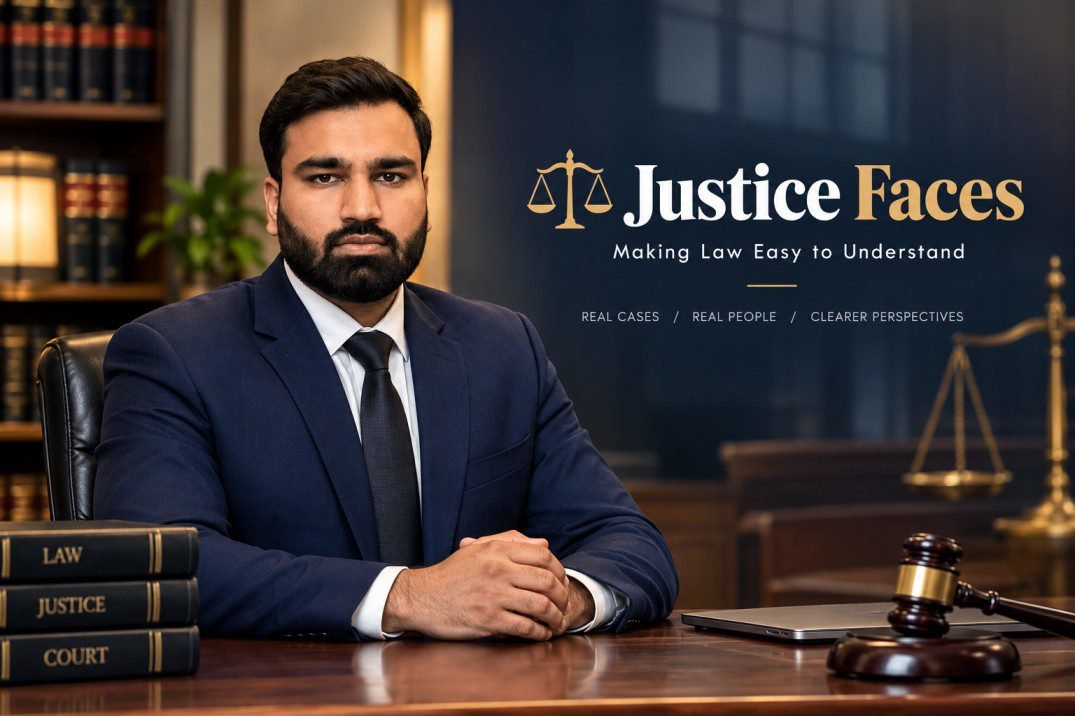
A short courtroom clip can make a case look simple. A headline can make it look settled. Most of the time, neither tells the full story.
Justice Faces is a legal journalism and educational blog about judges, trials, and the courtroom moments people end up talking about. We try to fill in what a clip leaves out: who the people are, what was argued, what the evidence showed, what the court decided, and what is still unresolved. The short version is our tagline: Making Law Easy to Understand.
Who is behind the site
Justice Faces was founded by Saran Afzaal, who serves as Founder and Editor-in-Chief. Saran follows courtroom proceedings and the judges who run them, and enjoys the work of taking a tangled case and laying it out so a curious reader can follow it from beginning to end.
That is the idea behind the whole site. It is a publication, not a law firm, a court, or a government body, and nothing on it is legal advice. Our Disclaimer explains this in more detail.
What you will find here
Judges and courtroom personalities. Our biographies look at backgrounds, careers, and public work. The range is wide on purpose. You will find Ruth Bader Ginsburg, who spent twenty-seven years on the Supreme Court, Judge Frank Caprio, who spent decades in a Providence municipal courtroom, and Texas trial judge Stephanie Boyd. We also write about television judges, and we try to be clear about who sits on a government bench and who does not.
Trials and verdicts. We follow criminal cases through testimony, evidence, closing arguments, verdicts, and sentencing, as in our coverage of the Caylen Deller murder trial and the Timothy Hauschultz trial. When a judge’s decisions are the story, as with Judge Jeannine Pratt’s rulings in the Caleb Flynn case, we explain what was decided and why it mattered.
Plain-English explainers. Some articles are about the law itself, such as your rights during a traffic stop or how TV court shows legally work, including why a television judge is usually acting as a private arbitrator rather than a state court judge. Our Legal Resources page gathers court system basics and points to official sources for readers who want to go further.
Mostly American courts. Our focus is the United States, so you will mostly read about American judges, courts, and law. Rules differ from state to state, and we try to say which state we mean.
Why we write this way
Legal stories get distorted when they shrink. A clip shows one moment. A headline picks one fact. We try to restore the rest: what is actually known, what each side argued, what the court decided, and what remains open.
We cannot decide guilt, and we do not try to. Courts do that, often on evidence the public never sees in full. Our job is to help you follow how a case reached its outcome, not to hurry you toward a conclusion. For official records, go to the court itself. For advice about your own situation, talk to a licensed attorney.
How we approach our work
Our articles draw on public records and published reporting, and we name our sources where we can. When a statute or court document matters, we point to it. We keep allegations separate from findings, so a prosecutor’s theory is never presented as a verdict and a defense argument is never presented as a fact. When something is unconfirmed or we could not find it, we say so.
Cases keep moving, so some articles carry dated status notes. Mistakes happen too. If you spot an error or an outdated detail, please let us know.
Get in touch
Questions, corrections, and suggestions for judges or cases you would like us to cover are welcome through our Contact Us page.
Thank you for reading.
Saran Afzaal
Founder and Editor-in-Chief, Justice Faces