
Yes, police can sometimes search without a warrant, but only under specific legal exceptions defined by U.S. constitutional law. The Fourth Amendment generally requires a warrant for searches, but courts have created several exceptions such as consent, probable cause, exigent circumstances, and searches during arrest.
Understanding these exceptions is critical to protecting your rights during police encounters.
Quick Facts Warrant less Police Searches
| Legal Principle | Explanation |
|---|---|
| Governing Law | Fourth Amendment of the U.S. Constitution |
| Default Rule | Police need a warrant issued by a judge |
| Common Exceptions | Consent, probable cause, search incident to arrest |
| Vehicle Searches | Often allowed without warrant under “automobile exception” |
| Emergency Situations | Allowed if immediate danger exists |
| Key Court Case | Carroll v. United States (1925) |
Source:
Cornell Law School – https://www.law.cornell.edu/wex/fourth_amendment
U.S. Courts – https://www.uscourts.gov
When Police Can Search Without a Warrant
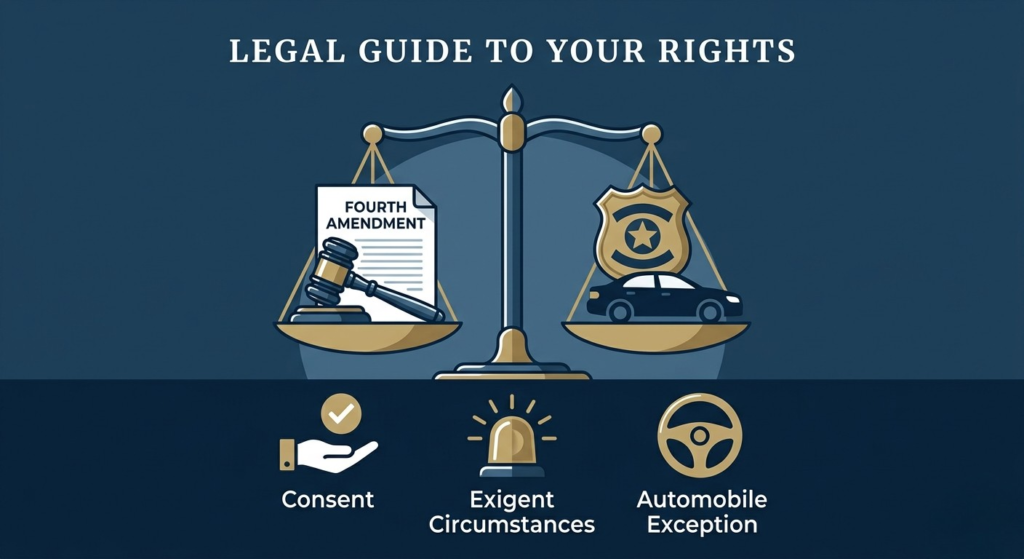
Below are the most common legal exceptions recognized by courts.
1. Consent Searches
One of the most common warrantless searches happens when a person voluntarily gives permission.
If you tell police they can search your car, home, or bag, they do not need a warrant.
Important detail:
Consent must be voluntary and not forced.
For example, if an officer asks:
“Do you mind if I look inside your car?”
You legally have the right to say no.
Many people don’t realize that once consent is given, anything officers find can be used as evidence.
2. Search Incident to Arrest
When police make a lawful arrest, they can search the person being arrested and the area within their immediate reach.
This rule exists primarily for safety reasons:
• Officers need to ensure the suspect has no weapons
• Evidence cannot be destroyed
For example:
If someone is arrested during a traffic stop, officers may search their pockets or nearby belongings.
This exception was reinforced in several Supreme Court decisions, including Chimel v. California (1969).
3. Probable Cause and the Automobile Exception
Cars are treated differently under U.S. law.
If police have probable cause to believe a vehicle contains evidence of a crime, they can search it without a warrant.
This is known as the Automobile Exception.
The reasoning behind this rule is practical:
vehicles can quickly leave the scene, making it difficult to obtain a warrant in time.
Example scenario:
If officers smell illegal drugs coming from a vehicle, courts have ruled that this may provide probable cause for a search.
More details:
https://www.law.cornell.edu/wex/automobile_exception
4. Exigent Circumstances
Sometimes police cannot wait for a warrant because someone could be in danger or evidence might disappear.
These situations are called exigent circumstances.
Examples include:
• Hearing screams inside a house
• Chasing a fleeing suspect
• Risk that evidence may be destroyed
In such emergencies, courts generally allow immediate entry or search.
5. Plain View Doctrine
If police are legally present somewhere and they clearly see illegal evidence, they may seize it without a warrant.
For example:
If officers respond to a noise complaint and see illegal drugs sitting on a table through an open door, the evidence may be seized.
This principle is known as the Plain View Doctrine.
Situations Where Police Usually Need a Warrant
Despite these exceptions, warrants are still required in many situations
Police generally need a warrant to:
• search a private home without consent
• search digital devices in many cases
• conduct surveillance inside a residence
Courts tend to give strong privacy protection to homes.
This is why most police investigations still rely on judicially approved warrants.
What You Should Do If Police Ask to Search

Understanding your rights can help you respond calmly.
Legal experts often suggest:
• Stay calm and respectful
• Ask if you are free to leave
• Clearly state if you do not consent to a search
• Do not physically resist officers
Even if you believe a search is illegal, the safest approach is to challenge it later through the court system.
Why These Rules Matter
Warrantless search rules exist because courts must balance two important goals:
- Protecting citizens from government intrusion
- Allowing police to act quickly when public safety is at risk
Over time, Supreme Court decisions have shaped this balance, creating a legal framework that both protects civil liberties and enables law enforcement.
FAQ
Can police search your car without a warrant?
Yes. Under the automobile exception, police may search a vehicle if they have probable cause to believe it contains evidence of a crime.
Can police search your phone without a warrant?
Usually no. The Supreme Court ruled in Riley v. California (2014) that digital phone searches generally require a warrant.
Can police enter your home without permission?
In most cases, no. Officers usually need a warrant unless there is an emergency, consent, or a suspect fleeing into the home.
Do you have to answer police questions during a search?
No. You have the right to remain silent under the Fifth Amendment.
Related Articles on JusticeFaces
Judge Judy Biography (2026)https://justicefaces.com/judge-judy-biography/
Know your rights https://justicefaces.com/what-are-my-rights-during-a-traffic-stop/