
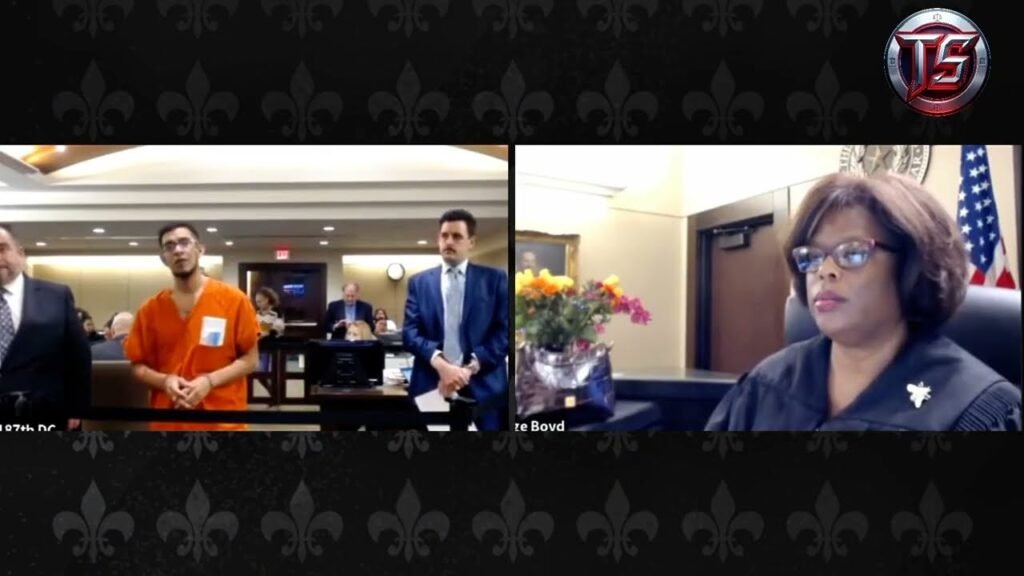
Inside the San Antonio courtroom where Jonathan Rodriguez pleaded guilty to indecency with a child, then asked to go home — and Judge Stephanie Boyd made sure he didn’t.
A Courtroom Moment That Stopped People Cold
When a man who had already admitted to sexually assaulting a six-year-old child walked into a San Antonio courtroom and asked to be placed on probation, the audacity of the request was hard to process. It wasn’t subtle. It wasn’t buried in legal language. It was a convicted child predator standing before a judge and asking to walk free.
Judge Stephanie R. Boyd of the 187th Criminal District Court in Bexar County, Texas, had spent nearly three decades inside the criminal justice system. She had heard every argument for leniency. She had read every pre-sentence report. And on this particular day, she was not moved.
The defendant was Jonathan Rodriguez. He had already pleaded guilty to indecency with a child, a serious Texas felony. The only question left was punishment. His defense asked for probation. Judge Boyd answered with fifteen years in state prison.
Who Is Jonathan Rodriguez and What Did He Do?
The Charge: Indecency with a Child Under Texas Law
Jonathan Rodriguez was charged in the 187th Criminal District Court in Bexar County, Texas, with indecency with a child — a felony-level offense under Texas Penal Code Section 21.11. The victim was six years old at the time of the offense.
Texas law defines indecency with a child as any sexual contact or exposure involving a person under the age of 17. When the offense involves direct physical contact of a sexual nature, it is a second-degree felony, punishable by two to twenty years in prison and a fine of up to ten thousand dollars.
Rodriguez entered a guilty plea, meaning there was no trial, no disputed facts, no jury deliberation. He admitted to what he did. What remained was for the court to decide what his punishment would be.
Why the Guilty Plea Didn’t Mean the Case Was Simple
A guilty plea does not automatically resolve a criminal case in Texas. It eliminates the question of guilt, but the question of punishment still belongs to the court. Both the prosecution and the defense present arguments, evidence, and recommendations before the judge decides.
Defense attorneys in cases like Rodriguez’s often argue for probation — formally called community supervision in Texas — even after a guilty plea to a serious offense. That argument has a legal basis: Texas statutes do permit community supervision in some second-degree felony cases. The defense leaned on that possibility. Judge Boyd declined it entirely.
What Happened Inside the 187th District Court

How Texas Sentencing Hearings Work
In Texas, a sentencing hearing after a guilty plea gives both sides one final opportunity to speak before the judge imposes punishment. The prosecution argues for a sentence proportionate to the crime. The defense argues for the lightest sentence the law allows, typically presenting mitigating factors like the defendant’s background, family ties, employment history, or lack of a prior criminal record.
In Rodriguez’s case, the defense presented its argument for probation. They characterized Rodriguez as someone who could be managed in the community rather than incarcerated. In a case involving the sexual assault of a child not yet old enough for first grade, that argument required remarkable optimism about what the judge would accept.
Judge Boyd’s Response
Judge Boyd listened to the defense’s sentencing arguments. She weighed the evidence. She applied the law. And then she handed down a sentence that required no interpretation: fifteen years in the Texas Department of Criminal Justice.
No probation. No community supervision. No ankle monitor, no check-ins with a probation officer, no halfway compromise. Rodriguez would serve his sentence in a state prison, not in his neighborhood.
The ruling was firm, clear, and consistent with how Texas courts are expected to treat offenders who prey on young children. Boyd’s response from the bench reflected something beyond procedural correctness — it reflected the moral weight of what had been done to a six-year-old.
VERDICT: Jonathan Rodriguez — guilty plea, indecency with a child. Sentence imposed by Judge Stephanie Boyd: 15 years in the Texas Department of Criminal Justice. Probation denied. Sex offender registration required for life.
Why Probation Was Never Going to Work Here
Texas Law on Child Sex Crimes and Probation Eligibility
Texas has some of the strictest laws in the country governing sexual offenses against children. In 2007, following the national momentum of what became known as Jessica’s Law — named after Jessica Lunsford, a nine-year-old Florida girl murdered by a convicted sex offender — Texas passed legislation dramatically stiffening penalties for child sex crimes and restricting when probation is even legally available.
For aggravated sexual assault of a child — the most severe category — Texas law mandates a minimum of twenty-five years in prison when the victim is younger than six, with no possibility of probation and no parole eligibility until seventy-five percent of the sentence is served. Indecency with a child by contact, the charge Rodriguez faced, carries a statutory range of two to twenty years as a second-degree felony.
Technically, community supervision exists in the statutory framework for second-degree felonies. But the age of the victim, the nature of the offense, and the totality of the circumstances made probation an extraordinarily difficult case to make before any experienced Texas judge — let alone one with Boyd’s background in child abuse prosecution.
What “Second-Degree Felony” Actually Means for a Defendant
When a Texas defendant is convicted of a second-degree felony, the punishment range runs from two years to twenty years in the Texas Department of Criminal Justice. The judge has discretion within that range, and can also impose a fine of up to ten thousand dollars. Community supervision is available in some second-degree felony cases, but courts have broad discretion to deny it when the circumstances warrant.
Rodriguez’s fifteen-year sentence fell solidly within the statutory range — firm, proportionate, and consistent with how Texas courts have handled similar cases involving very young victims. He will be eligible for parole consideration after serving one-quarter of his sentence, but parole boards in child sex crime cases take the nature of the offense seriously, and release is never guaranteed.
Sex Offender Registration: A Lifetime Consequence
Beyond the prison sentence, Rodriguez faces lifetime registration as a sex offender under Texas law. That registration affects where he can live, where he can work, which public spaces he can access, and how law enforcement monitors him upon any release. It is a consequence that follows a conviction for indecency with a child regardless of the length of the prison sentence itself.
Texas law requires sex offenders to update their registration annually, and in some cases more frequently. Failure to comply is itself a felony offense. The registry is public, searchable, and permanent.
The Victim: A Six-Year-Old Who Could Not Speak for Herself in Court
Why Child Victims Rarely Testify at Sentencing
The six-year-old girl at the center of this case does not appear by name in public records. Texas law protects the identities of child victims in sexual offense cases, and that protection is appropriate. Her privacy should be guarded. Her identity should not become a matter of public record because of what was done to her.
Very young victims typically do not testify at sentencing hearings in cases that resolve through guilty pleas. The plea itself eliminates the need for the child to face her abuser in open court and describe what happened to her. The Villamil case mentioned earlier was specifically resolved with a plea partly because, as the prosecutor explained to Boyd, the victim’s family wanted closure without retraumatizing the child. That dynamic is common and reflects the genuine tension between prosecutorial accountability and victim welfare.
What Research Says About Sexual Abuse of Young Children
Decades of psychological and clinical research have documented the long-term consequences of sexual abuse in early childhood. Children who experience sexual trauma before the age of ten face elevated risks of anxiety, depression, post-traumatic stress disorder, and difficulty forming healthy relationships in adulthood. The damage is frequently invisible in the immediate aftermath — young children often lack the cognitive and emotional vocabulary to process what has happened to them — but it accumulates over time.
A six-year-old cannot file a victim impact statement. She cannot stand before a judge and explain, in her own words, what she lost. She depends entirely on the adults around her — investigators, prosecutors, and ultimately the court — to carry the weight of accountability on her behalf. When Judge Boyd sentenced Rodriguez to fifteen years in prison, she was carrying that weight.
Why Child Predators Routinely Ask for Probation
Understanding the Defense Strategy
It is worth pausing to understand why a defense attorney representing Jonathan Rodriguez would ask for probation in a case involving the sexual assault of a six-year-old. The answer is simpler than it might seem: defense attorneys are obligated by law and by professional ethics to advocate for the best possible outcome for their clients. Asking for the minimum available punishment — or for community supervision — is not unusual. It is, in fact, expected.
Sometimes defense attorneys genuinely believe their client presents a low risk of reoffending. They may point to treatment programs, mental health evaluations, community support networks, or first-time offender status. The legal system is designed to hear these arguments, even in difficult cases. The judge then decides how much weight they deserve.
In Rodriguez’s case, the court decided they deserved very little.
How Texas Courts Weigh Leniency Against Public Safety
Texas judges weighing punishment in child sex crime cases must balance several considerations: the severity of the offense, the age and vulnerability of the victim, the defendant’s criminal history, and the risk of future harm to the community. When a victim is six years old, the vulnerability factor alone pushes the analysis heavily toward incarceration.
There is no risk-assessment tool, no treatment program, and no character reference that changes the fundamental reality of what was done to a child that young. Courts across Texas have consistently treated the sexual abuse of very young children as among the most serious offenses the system processes. Boyd’s sentence in the Rodriguez case is consistent with that legal culture.
Texas’s Legal Framework for Child Sexual Offense Cases
Key Statutes That Govern These Cases
Texas Penal Code Section 21.11 — Indecency with a Child
This is the core statute under which Rodriguez was convicted. It prohibits sexual contact or sexual exposure involving any person under 17. Contact offenses — involving physical touching — are second-degree felonies. Exposure offenses without contact are third-degree felonies. Both require sex offender registration upon conviction.
Texas Penal Code Section 22.021 — Aggravated Sexual Assault of a Child
The most serious category of child sex offense in Texas, aggravated sexual assault of a child carries a mandatory minimum of twenty-five years in prison when the victim is under six. There is no parole eligibility until seventy-five percent of the sentence is served, and probation is categorically unavailable for this offense under Texas law.
Jessica’s Law Provisions in Texas
Texas enacted its version of Jessica’s Law during the 80th Legislative Session. The law added mandatory minimums, restricted probation eligibility for offenses against children under 14, and authorized lifetime electronic monitoring for certain sex offenders upon parole. It reflects the legislature’s explicit determination that crimes against the youngest children warrant the most severe legal responses available.
The Verdict, the Sentence, and What Comes Next
Fifteen Years: What That Sentence Means in Practice
Jonathan Rodriguez was sentenced to fifteen years in the Texas Department of Criminal Justice. He will be processed into the state prison system, assigned to a facility, and begin serving his sentence. Under Texas parole law, he becomes eligible for consideration after serving one-quarter of his sentence — approximately three years and nine months. But eligibility for parole consideration is not the same as parole itself.
The Texas Board of Pardons and Paroles weighs the nature of the offense, the victim’s age, the defendant’s conduct in prison, risk assessment results, and a range of other factors. In cases involving the sexual assault of young children, release at the earliest eligibility date is far from automatic. Rodriguez could serve a substantially longer portion of his sentence than the minimum required before any parole board gives serious consideration to his release.
The Sex Offender Registry: What Rodriguez Faces for Life
Upon any eventual release from prison, Rodriguez will be required to register as a sex offender in Texas — and in any state where he subsequently lives or works. That registration is public, accessible online, and carries significant restrictions. He will be prohibited from living near schools, daycares, or parks. His photograph, address, and offense information will be permanently searchable by the public and by law enforcement.
The registry is not punishment in the traditional legal sense — it is classified as a regulatory requirement, not a criminal penalty. But its practical consequences are substantial and lifelong. It represents the permanent mark the legal system places on those convicted of sexual offenses against children.
What This Case Reveals About the American Justice System
When a Judge Refuses to Let Leniency Override Accountability
The Rodriguez sentencing is significant not because it is unusual, but because it is visible. Most child sex crime sentencing hearings in Texas happen without public attention. The defendant appears, the arguments are made, the sentence is imposed, and the case moves out of the public’s awareness almost immediately. The courtroom YouTube livestream — whatever its complications — created a record that a large audience could actually see.
What that audience saw was a judge who treated the crime for what it was. Not a case to be managed. Not an offense to be calibrated into a community supervision arrangement. A serious felony involving a six-year-old child, sentenced accordingly.
The Question of Courtroom Transparency
The Rodriguez case raises — without fully answering — a question that courts, legal scholars, and journalists are actively debating: what does it mean to make criminal proceedings genuinely public in the digital age? Judge Boyd’s YouTube experiment was motivated by legitimate democratic values. Transparency in the justice system is not a trivial goal. Courts that operate invisibly, behind closed doors, are courts that are harder to hold accountable.
But the Texas Commission on Judicial Conduct’s public warning identified real limits to how far that transparency experiment could go before it started affecting the integrity of proceedings. The line between opening the courthouse doors and turning a courtroom into a content channel is not always clear. The Villamil case — where thousands of viewers posted comments in real time while a plea hearing was underway — illustrated what can go wrong when those boundaries are not carefully managed.
These are questions the American justice system will continue working through as technology changes what transparency looks like in practice.
What Child Victims Deserve from the Courts
Courts cannot undo what was done to a six-year-old girl in San Antonio. They cannot restore what was taken from her. They cannot guarantee that the legal outcome will translate into healing, or that fifteen years in prison will make the trauma any less real for the child who survived it.
What courts can do — what Judge Boyd did in the Rodriguez case — is refuse to treat that harm as something negotiable. Refuse to accept that the community supervision of a convicted child predator is an adequate response to the sexual abuse of a kindergartner. Refuse, in other words, to let the system’s tolerance for process become an excuse for something that looks, from the outside, like mercy toward the wrong person.
That refusal matters. It matters to victims. It matters to families. It matters to every community that expects its courts to hold accountable the people who harm the most vulnerable among them. And it matters, perhaps most of all, to a six-year-old girl whose name will never appear in this story — because the law, at least in this moment, tried to protect her.
Frequently Asked Questions About This Case
What was Jonathan Rodriguez convicted of?
Jonathan Rodriguez pleaded guilty to indecency with a child — a second-degree felony under Texas Penal Code Section 21.11. The victim was six years old. The case was heard in the 187th Criminal District Court in Bexar County, Texas, before Judge Stephanie Boyd.
Why did Jonathan Rodriguez ask for probation?
Rodriguez’s defense team requested community supervision — probation — arguing it was a legally available option under the sentencing range for a second-degree felony in Texas. Defense attorneys in serious criminal cases are ethically required to advocate for the best possible outcome for their clients, which often includes requesting the minimum available punishment. Judge Boyd denied the request and sentenced Rodriguez to fifteen years in state prison.
How long will Jonathan Rodriguez be in prison?
Rodriguez was sentenced to fifteen years in the Texas Department of Criminal Justice. He becomes eligible for parole consideration after serving approximately one-quarter of his sentence. However, parole is not guaranteed, particularly in child sex offense cases. He is also required to register as a sex offender for life.
Who is Judge Stephanie Boyd?
Judge Stephanie R. Boyd is the presiding judge of the 187th Criminal District Court in San Antonio, Bexar County, Texas. She made history in 2018 as the first African American woman elected to that court. She has twenty-nine years of legal experience, including years as a first-chair prosecutor in Bexar County’s Special Crimes Unit handling child abuse and domestic violence cases. She gained widespread public attention for livestreaming court proceedings on YouTube, and received a formal public warning from the Texas State Commission on Judicial Conduct in June 2026 related to her conduct in two separate cases and her management of the YouTube channel. She lost her 2026 primary and her term ends at the close of that year.
Is probation possible for child sex crimes in Texas?
Probation eligibility in Texas child sex crime cases depends on the specific charge and the circumstances of the offense. For aggravated sexual assault of a child, probation is categorically prohibited by law. For indecency with a child by contact, probation exists within the statutory framework as a possibility, but courts routinely deny it when the victim is very young. Texas’s version of Jessica’s Law further restricted probation availability for offenses against children under 14.