
The Gum That Opened a Hearing
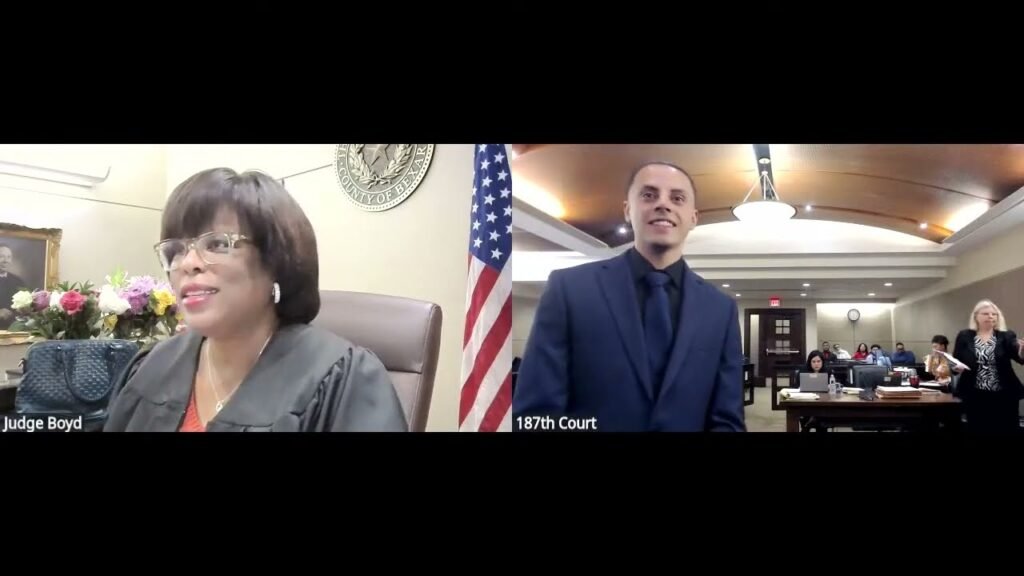
The moment Mr. Smith stepped up to the podium inside the 187th District Court of Bexar County, Judge Stephanie Boyd was already watching. Not for legal infractions. For character.
“You’re chewing like a cow in the field,” she said, her tone firm but carrying the faint warmth of someone who already knew this young man’s file by heart. “Why are you chewing gum up here?”
Smith apologized immediately. Disposed of the gum. And without missing a beat, Judge Boyd softened: “That’s okay… nobody knows unless somebody tells them.” The hearing had begun — and it would not follow a predictable path.
San Antonio’s 187th District Court and the Judge Who Runs It Differently
The 187th District Court sits in the heart of Bexar County, Texas, processing a relentless volume of felony cases that cycle through San Antonio’s criminal justice system every year. Inside that courtroom, Judge Stephanie Boyd has developed a reputation that attorneys and probation officers discuss openly: direct, demanding, and genuinely invested in outcomes beyond the docket.
Her judicial philosophy does not stop at punishment. It extends into rehabilitation, accountability, and what she has called the real test of structural change. Boyd does not grant early termination of probation as a routine procedural courtesy. She treats it as a milestone that has to be earned, demonstrated, and proven — in some cases, in real time.
This hearing would become one of the clearest illustrations of that philosophy on record.
Five Years Earlier: A Young Man at the Edge of Prison
In early 2020, Mr. Smith stood before Judge Boyd in a very different position. He was facing significant state prison time. He had no prior criminal history — not a single prior contact with the justice system — but the offense before the court carried consequences serious enough to put him behind bars for years.
Boyd made a different call. Rather than a prison sentence, she offered deferred adjudication — a structured, demanding probation agreement that would keep him in the community under strict supervision for five full years.
The terms were not light. An 11:00 PM nightly curfew. Two hundred hours of mandatory community service. Full payment of all court-assessed fines and supervision fees. Regular, random urinalysis drug testing. And because the original offense involved a specific online component, the probation order included explicit social media stipulations — particularly governing what Smith could and could not post on Facebook.
Boyd’s message at that 2020 sentencing was pointed. She told him directly: many people leave jail claiming a renewed faith in God, but then return. She had seen it too many times to be impressed by words alone. She wanted to see what he did with the five years in front of him.
The November Roadblock: A Premature Push for Freedom
By the time 2024 arrived, the defense attorney representing Smith had accumulated a performance record that looked, by any metric, exceptional. She submitted a status report to the court in November requesting early dismissal and discharge.
The attempt stalled.
ADA Gahan, representing the State of Texas, opposed the motion — not based on any compliance failure, but on the nature of the original offense itself. Boyd agreed the request was premature on procedural grounds. Smith had not yet hit the exact five-year mark of his probation term. She denied the early dismissal at that stage and gave the defense specific, unmistakable instructions: reapply at the precise five-year milestone. And when they did, she wanted Smith standing in front of her, face to face.
The defense complied to the letter.
The Re-Submission: Standing at the Exact Five-Year Line
When the application came back before the court, it arrived at the exact five-year mark. No shortcuts, no rounding. The precision was deliberate — both the defense and the defendant understood what Boyd had said and what it required.
Smith arrived at the 187th District Court dressed for the proceeding, carrying a handwritten letter he had composed himself. He did not know yet exactly what the next hour would bring.
What followed was not a formality.
The Live Drug Test: No Room for Preparation
One of the most striking procedural moments of the hearing came before any testimony or formal argument.
Judge Boyd stopped the proceedings and looked directly at Smith.
“When you’re drug tested today, what are the results going to be?”
Smith answered without hesitation. He would pass.
Boyd did not take his word for it. She ordered an immediate, same-day urinalysis — right then, before any ruling would be made. Smith was sent directly to the Bexar County Felony Drug Court for a live UA, with the hearing effectively paused pending those results.
The test was not scheduled. There was no window to prepare. It was the judicial equivalent of pulling back the curtain without warning.
The Facebook Audit: A Public Compliance Check in Open Court
The original offense had carried specific Facebook-related stipulations. That history made the social media audit not just relevant — it made it necessary.
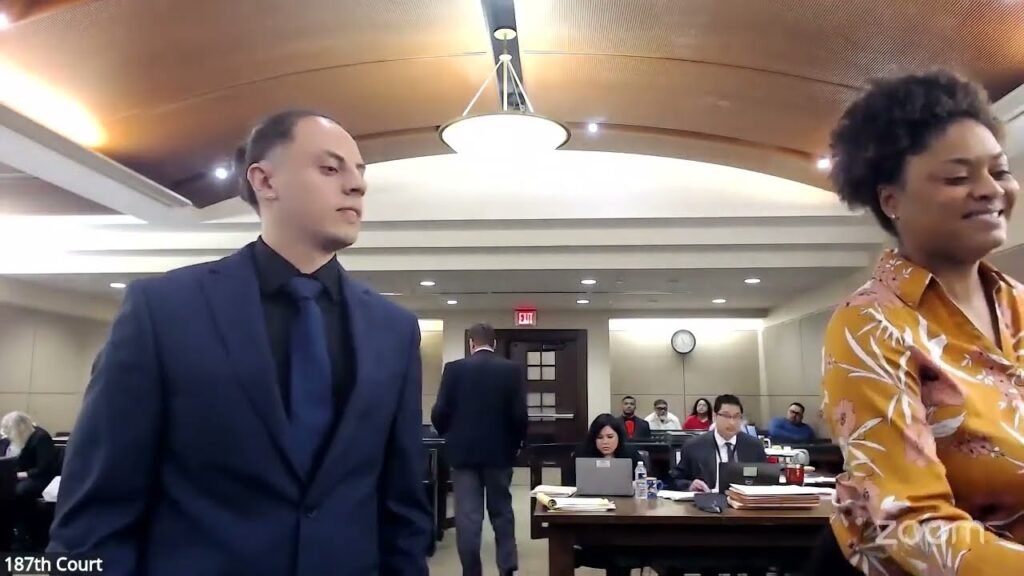
Judge Boyd ordered ADA Gahan to pull up Smith’s active Facebook profile in the courtroom. Not a printout. Not a summary from a probation report. A live audit, in real time, with Smith standing at the podium.
Smith told the court plainly: he no longer posted anything on the platform. ADA Gahan conducted the review and reported back. His assessment was direct — zero policy violations. No content of concern. Nothing that intersected with the original offense stipulations in any way.
The digital trail that once defined the risk had gone completely quiet.
The Results Return: A Clean Sheet Across Two Fronts
After a brief recess, the court reconvened. The defense presented the drug test result: 100% negative.
The probation compliance record, reviewed against five full years of supervision data, told the same story. Two hundred community service hours completed exactly. All financial obligations paid in full. The 11:00 PM curfew had held without a single documented violation across field visits. Drug testing across the full sixty-month period was clean, with the only technical notation being a small number of diluted samples in 2022 — a common and medically unremarkable occurrence — and absolutely zero positive results.
By every measurable standard, Mr. Smith had fulfilled his obligations without exception.
The Letter: What Five Years Actually Produced
When Judge Boyd gave Smith the opportunity to speak, he stepped forward with a handwritten letter and read from it directly.
He thanked her for the probation offer in 2020 — for choosing rehabilitation over a prison cell when she had the legal authority to do otherwise. He did not minimize what he had done. He acknowledged past mistakes, the people affected by them, and asked plainly for forgiveness.
“I took things for granted and I made bad mistakes that hurt people, and I ask for your forgiveness and the forgiveness of those people.”
He told the court that his time in the Bexar County Jail had changed the direction of his life. He credited that experience with connecting him to faith — specifically to Cornerstone Church in San Antonio — and described it as the point where he chose a different path.
He did not stop with spiritual reflection. He enrolled in higher education at St. Philip’s College and graduated in May 2024 with an Associate Degree of Applied Science in Automotive Technology. He had worked continuously across multiple automotive shops during his probation years to earn industry certifications alongside his coursework.
Since January 2024, he had been fully employed at Freedom Chevrolet. He had moved into his own residence, learned to manage rent and household utilities independently, and built a daily life that required no supervision to sustain.
Judge Boyd’s Ruling and the Harder Warning
Judge Boyd had seen the compliance data. She had reviewed the live drug test. She had heard the letter.
She signed the order.
Mr. Smith’s five-year probation was officially terminated early. His full citizenship rights were restored. He walked out of the 187th District Court as a free man — no supervision, no stipulations, no officer checking in.
But before he left the podium, Boyd gave him something the paperwork could not contain.
“The discipline you needed to successfully complete this probation, you’re still going to need that discipline in real life. Because… you’re not going to have a probation officer looking over your shoulder… You’re going to have to do that on your own.”
She was not celebrating the end of supervision. She was telling him the harder part starts now. The structure of probation had been scaffolding. What he built inside that structure was now his to carry without external enforcement.
She extended an open-door policy — an unusual gesture from the bench. If he ever faced an obstacle he felt overwhelmed by, he was welcome to come back to her courtroom for guidance. Not as a defendant. As a person who had earned a relationship with the court through five years of kept promises.
Smith’s Final Words: Proving the Doubters Wrong
Before stepping away from the podium, Smith turned back to Judge Boyd and reminded her of something she had said to him in 2020.
He told her he remembered exactly what she said when she first granted his probation — that many people leave jail claiming faith, then go straight back. He had carried those words for five years.
“I wanted to prove everyone that thought that wrong… and I wanted to prove the people that thought I was going to go back to jail wrong.”
He had done exactly that. Not with a speech. With sixty months of documented, consistent, verifiable action.
What This Case Reveals About the 187th District Court
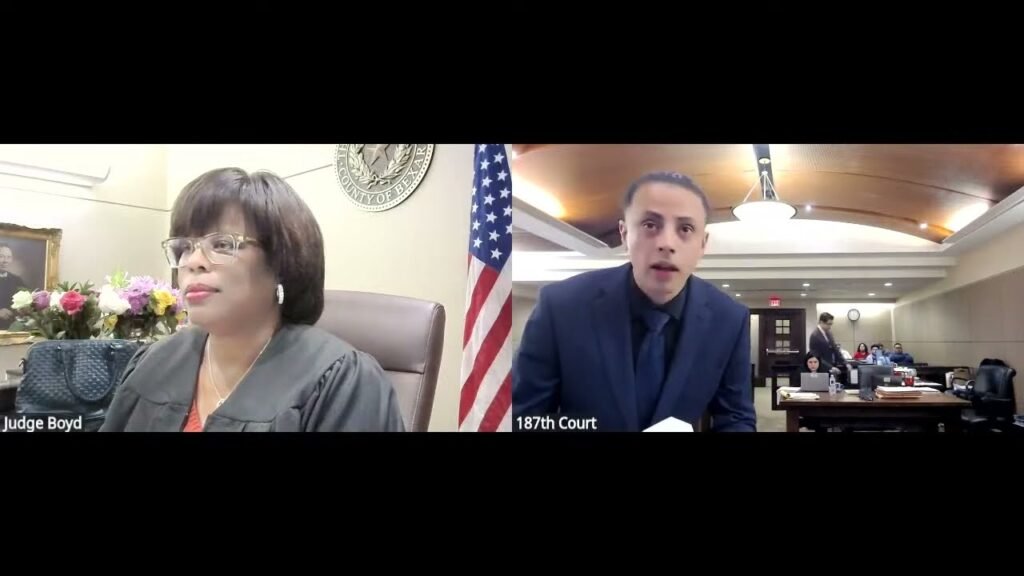
The Judge Stephanie Boyd probation termination hearing involving Mr. Smith is a procedurally uncommon case study in what genuine judicial oversight looks like at the individual level.
Boyd did not approve the early termination in November because the conditions for it — by her own standard — had not yet been met. She set a precise re-entry requirement and held to it. When the defense returned at the exact five-year mark, she did not simply review paperwork. She ordered live verification: a same-day drug test, a real-time social media audit, and a face-to-face reckoning with the person whose trajectory she had shaped five years earlier.
Available court records do not clarify what the original offense involved beyond its non-violent classification and social media component, and public trial dockets from the 2020 proceeding leave a gap regarding the full sentencing range Smith originally faced.
What the record does show is a young man who entered the criminal justice system at twenty-something with no prior history, received a supervised second chance under conditions that required real sacrifice, and emerged five years later with a degree, a career, a home, and a clean record.
Judge Boyd, for her part, demonstrated something the system does not always allow space for: the capacity to track an individual outcome, hold it to a high standard, and recognize when that standard has genuinely been met.
This article is based on publicly observable court proceedings from the 187th District Court of Bexar County, San Antonio, Texas. Individual names have been reported as identified in open court. Details regarding the specific nature of the original 2020 offense have not been fully disclosed in available public records, and this article does not speculate beyond what has been formally stated on the record.