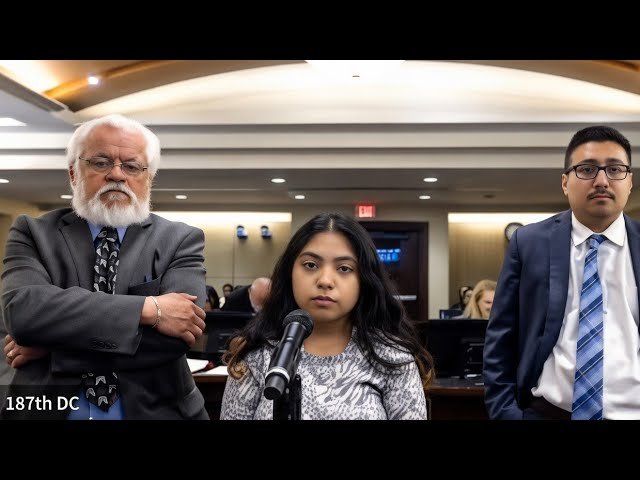
A San Antonio courtroom fell silent when the name Gabriella Sanchez was called back to the bench.
She had walked out of that same courtroom just minutes earlier — relieved, presumably grateful, carrying a ten-year deferred adjudication agreement in her hands. Judge Stephanie Boyd had extended a rare and deliberate act of judicial mercy. She had spoken to Sanchez not just as a defendant, but as a young woman standing at a crossroads.
Then the drug test results arrived.
What unfolded next — in front of attorneys, court officers, and a gallery of onlookers — was one of the most striking reversals of fortune seen in Bexar County Court in recent memory. A case that began as a story of cautious second chances became, within the span of a single morning, a masterclass in the unforgiving precision of the American legal process.
This is that story.
A Second-Degree Felony in a San Antonio Courtroom
The State of Texas vs. Gabriella Sanchez, filed under case number 2023CR3050A, was entered on the docket of the Bexar County Court, San Antonio, Texas.
The charge was Aggravated Assault with a Deadly Weapon — a second-degree felony under the Texas Penal Code. It is not a minor offense. Under Texas law, this classification carries a statutory sentencing range of two to twenty years in the Texas Department of Criminal Justice state prison facility, alongside an optional fine of up to ten thousand dollars.
An associated case, 2023CR3051B, was also taken into consideration during proceedings.
Three individuals were named as complainants and victims entitled to restitution: Jose Caceres, Miguel Rosas, and Ashley Almeida. Their presence — even if only on paper — framed the weight of what the court was being asked to handle that morning.
Who Is Gabriella Sanchez? The Defendant Behind the Docket Number
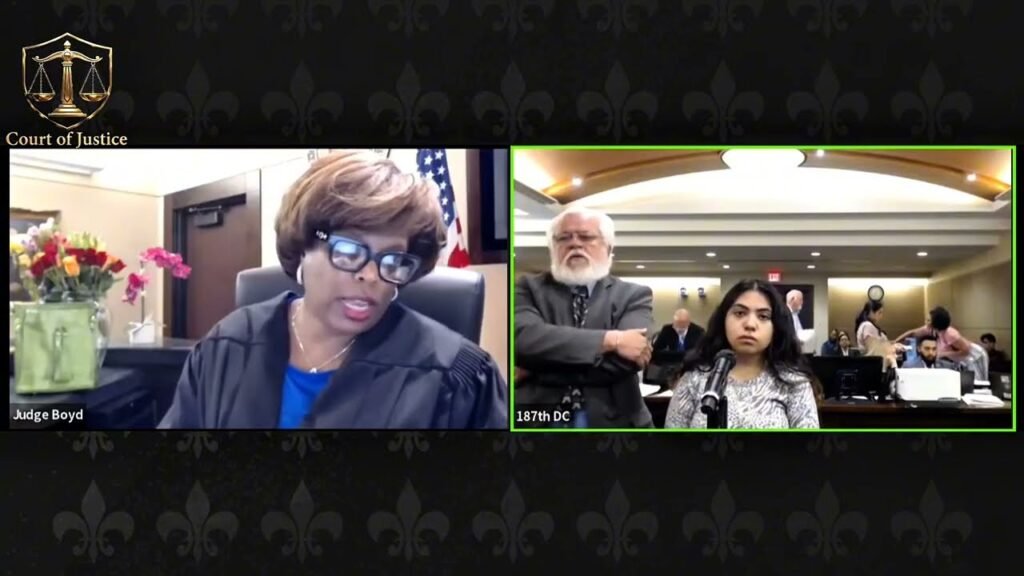
Gabriella Sanchez was nineteen years old when she appeared before Judge Stephanie Boyd.
On paper, she was a high school graduate with no visible employment, financially dependent on her boyfriend, and estranged from her parents — who, the court would learn, were waiting in the hallway outside the courtroom throughout the proceedings. Sanchez stated directly that she had been mistreated by her father, a disclosure that added a quiet layer of complexity to the portrait emerging before the bench.
She was not, by any stretch of the imagination, a hardened criminal.
Sanchez told the court she had dreams. She wanted to pursue performing arts and theater. She mentioned she had college savings already set aside. In that narrow window of personal disclosure — the kind that only happens between a judge and a defendant in an open courtroom — something human flickered through the procedural machinery.
Attorney Mick Aguilera appeared on her behalf that morning, standing in for lead defense counsel Lorraine Efron. Prosecuting for the State of Texas was Casey Green.
What the exact circumstances of the underlying assault were — the specific location, the nature of the weapon, the full sequence of events that led to the injuries suffered by Caceres, Rosas, and Almeida — is not fully enumerated in available court records from this hearing stage. Available records leave a gap regarding the complete investigative file presented at the time of arraignment.
What is clear is that the State had gathered sufficient evidence to pursue a second-degree felony charge, and that Sanchez had agreed, through her counsel, to a negotiated resolution.
Texas Aggravated Assault with a Deadly Weapon: What the Law Actually Says
To understand the gravity of what Gabriella Sanchez had been charged with, it is worth pausing on the statute itself.
Under the Texas Penal Code, Aggravated Assault with a Deadly Weapon occurs when a person intentionally, knowingly, or recklessly causes serious bodily injury to another person — or uses or exhibits a deadly weapon during the commission of an assault. The word “recklessly” carries its own legal weight here. Prosecutors are not required to prove cold, premeditated intent. They need only establish that the defendant acted with conscious disregard for a substantial and unjustifiable risk.
A “deadly weapon” under Texas law is defined broadly. It includes firearms, knives, and any object that, in the manner of its use or intended use, is capable of causing death or serious bodily injury. That definition has, in Texas courtrooms, been applied to everything from automobiles to broken bottles.
The distinction between a first-degree and second-degree felony in the context of aggravated assault often hinges on the identity of the victim and the specific nature of the weapon. For Sanchez, the second-degree classification meant the lower end of the sentencing range was two years — but the upper end remained a full twenty.
Three named victims and an associated companion case filing indicated the scope of the alleged conduct extended beyond a single isolated incident.
The Plea Agreement: Deferred Adjudication and What It Really Means
On the morning of the hearing, Gabriella Sanchez entered a plea of No Contest — known in legal terminology as Nolo Contendere.
This is a critically misunderstood plea by the general public. A no contest plea carries the same legal effect as a guilty plea inside a criminal courtroom. The defendant is not explicitly admitting guilt; they are, however, acknowledging that the state possesses sufficient evidence to obtain a conviction. For sentencing purposes, the distinction is largely academic.
The State’s recommendation was ten years of Deferred Adjudication Community Supervision — commonly referred to as probation, though legally it is something more precisely defined than that term implies.
Deferred adjudication is a specific mechanism under Texas law. Under this arrangement, the court does not immediately enter a formal finding of guilt. Instead, the judge defers that determination and places the defendant on supervised probation. If the defendant successfully completes every condition of that supervision over the full term, the charges are dismissed. No permanent felony conviction enters the record.
The risk embedded in this arrangement, however, is significant.
If the defendant violates any condition of probation — even once — the judge retains the authority to adjudicate guilt at that point and impose a sentence anywhere within the statutory range. For a second-degree felony, that upper boundary is twenty years in TDCJ state prison.
The State’s offer of ten years of deferred adjudication was, by any legal measure, a generous one.
The agreed financial terms included a fifteen hundred dollar fine, mandatory restitution to all three named victims, and an affirmative finding of a deadly weapon — a notation that carries its own collateral consequences under Texas law, including restrictions on early parole eligibility in the event of a future revocation.
The mandatory probationary conditions were substantial. Sanchez was required to complete two hundred and fifty hours of community service, undergo a comprehensive Substance Abuse Treatment evaluation, attend mandatory anger management classes, comply with a strict no-contact order with all three victims, and submit to random monthly urinalysis testing throughout the duration of her supervision.
Judge Stephanie Boyd Opens the Hearing: Admonishments and Rights Waivers
Judge Stephanie Boyd opened the proceedings with methodical precision.
She walked Gabriella Sanchez through the court admonishments — a legally required process in which the defendant is formally advised of the rights she is surrendering by entering a plea and the consequences of the agreement she is accepting. Sanchez confirmed she understood each advisement as it was presented.
She confirmed she was a United States citizen — a material fact in plea proceedings, as non-citizens face distinct immigration consequences from criminal convictions. She waived her right to a jury trial, placing the outcome of her case entirely in the hands of the court.
These moments, routine on the surface, carry enormous constitutional weight. A defendant waiving jury trial is surrendering one of the most fundamental protections the American legal system provides.
Judge Boyd moved through each item with the practiced fluency of an experienced jurist — thorough, unhurried, and deliberate.
The Personal History: A Young Woman at a Legal and Personal Crossroads
When Judge Stephanie Boyd shifted from procedural formality to personal inquiry, the courtroom entered a different register entirely.
Sanchez disclosed she was unemployed and entirely financially supported by her boyfriend. Her parents, she said, were estranged — present in the building but waiting in the hallway outside, unable to sit with her. She described her father as having mistreated her.
Judge Boyd listened.
Then, when Sanchez mentioned her aspirations in performing arts and theater — and the college savings she had accumulated — the judge responded in a way that few defendants in her position might have expected.
Boyd offered to consider waiving the required two hundred and fifty hours of community service entirely — on one condition. If Sanchez enrolled in a trade school or college full-time, carrying a minimum of nine credit hours per semester, the judge would view that commitment as a meaningful substitute for the community service obligation.
It was a judicial gesture that went beyond the requirements of the plea agreement. Boyd was, in that moment, actively trying to architect a path forward for a nineteen-year-old woman whose life had not yet been irrevocably defined by the charge in front of her.
The gallery, the attorneys, and everyone present in that courtroom witnessed what judicial discretion, exercised with genuine human intent, looks like in practice.
The Drug Disclosure That Should Have Been a Warning Sign
Before the agreement could be fully ratified, Judge Stephanie Boyd asked Sanchez a direct and pointed question.
If a drug test were administered right now, what would the results show?
The question is standard judicial practice during plea proceedings in cases involving substance abuse conditions. It is also, for defendants who have not prepared for honesty, a moment of reckoning.
Gabriella Sanchez did not hesitate. She admitted freely that she would test positive for marijuana. She offered no elaborate excuse — only that she used it casually, in her own words, “just to use it.”
Judge Boyd’s response was firm and unambiguous. Marijuana is illegal under the laws of the State of Texas. It is specifically and categorically prohibited while on community supervision. Probation and marijuana use cannot coexist in a Texas courtroom, and the judge made that explicit.
Sanchez confirmed she understood.
She then assured the court that she did not use any other substances.
That assurance would return to define the rest of the morning.
The Plea Agreement Is Signed — and the Baseline Test Is Ordered
Judge Stephanie Boyd signed the ten-year deferred adjudication agreement.
The paperwork was complete. The deal was sealed. Gabriella Sanchez had, at that moment, received one of the most favorable outcomes available to a defendant facing a second-degree felony in the State of Texas.
Before releasing her, Judge Boyd ordered what is standard procedure in these circumstances: an immediate baseline drug test, administered before Sanchez left the building. The purpose of a baseline test is administrative — it establishes an initial chemical profile at the start of supervision and ensures the court has an accurate starting point before the monthly urinalysis requirements take effect.
The court moved on. Another matter was called — a separate case involving a defendant named Jose De Jesus Gallegos. Proceedings continued at their normal pace.
No one in that courtroom, at that particular moment, appeared to anticipate what was coming.
The Recall: Judge Boyd’s Tone Changes Completely
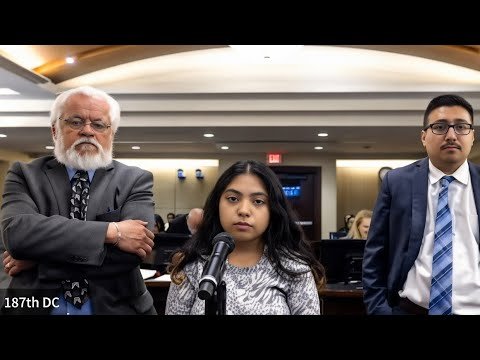
Gabriella Sanchez was called back to the bench.
The baseline drug test, sent to an on-site laboratory, had returned results far sooner than anyone might have expected. The timing — just minutes after Sanchez had left the immediate proceedings — made the recall abrupt, almost cinematic in its compression of consequence.
Judge Stephanie Boyd’s demeanor underwent a transformation that everyone present would have noticed immediately. The measured, mentoring tone she had adopted throughout the morning — the careful, deliberate warmth with which she had spoken about performing arts and college enrollment — was gone.
What replaced it was the controlled, exacting voice of a judge who had been lied to inside her own courtroom.
She addressed two violations simultaneously, both requiring immediate judicial response.
The Dress Code Violation: Courtroom Decorum as Legal Expectation
The first issue Judge Boyd raised was Sanchez’s appearance in court.
Sanchez had arrived at a formal proceeding in Bexar County Court dressed, by the judge’s assessment, completely inappropriately for the setting. While public trial dockets do not clarify the precise clothing items in question, the significance of the judicial observation extends beyond fashion commentary.
When a defendant appears before the bench on a felony matter — particularly one as consequential as this — how they present themselves communicates something about how seriously they are taking the proceedings. Judges notice. Juries notice, when juries are present. Court officers notice.
For Sanchez, appearing informally dressed on the morning she was entering a ten-year probation agreement on a second-degree felony charge was a signal — inadvertent or otherwise — that the gravity of the situation had not fully registered.
Judge Boyd named it directly. That directness, before she turned to the far more serious matter at hand, established the register for what followed.
The Cocaine Result: The Moment Everything Collapsed
The laboratory results did not merely confirm the marijuana Sanchez had already disclosed.
They showed she had also tested positive for cocaine.
This was not a borderline reading or a procedural ambiguity. This was a positive test result for cocaine, returned within minutes of the defendant leaving the bench after expressly telling Judge Stephanie Boyd — under the formal weight of open court — that she used no substances other than marijuana.
The sequence of events is worth sitting with. Within the same hearing, in the same room, before the ink on the plea agreement had time to dry, Gabriella Sanchez had directly contradicted her own sworn court disclosure with chemical evidence.
“I Don’t Use Any Other Drug Besides Marijuana in My Life”
Sanchez’s response, when confronted with the positive cocaine result, was immediate and unequivocal.
“I don’t use any other drug besides marijuana in my life.”
The denial was direct. It was also, standing against a laboratory result, legally untenable.
Judge Boyd did not raise her voice. She did not need to. The architecture of her response — calm, precise, methodically constructed — was far more effective than any display of judicial theatrics would have been.
The Judicial Dismantling: Forensic Logic and Street Drug Reality
What Judge Stephanie Boyd explained next demonstrated the kind of practical, evidence-grounded reasoning that distinguishes an experienced judge from one simply reading from a procedural script.
She did not accuse Sanchez of being a cocaine addict. She did not claim the defendant was lying in bad faith about her full knowledge of what she had consumed. Instead, she deployed a logical framework rooted in how illicit drug markets actually operate.
Street-level marijuana has no regulatory labels. It carries no inspection certificates. It is not produced in a monitored facility with quality control standards. The individual who supplied it to Sanchez — through what the defendant herself had described as informal social channels — had no obligation, legal or otherwise, to disclose its contents.
Lacing — the practice of mixing a primary street drug with a secondary substance, sometimes to extend product volume, sometimes to heighten immediate effect, sometimes as a result of cross-contamination in a shared supply chain — is not theoretical. It is documented. It has been the subject of law enforcement advisories, medical emergency reporting, and public health campaigns across the United States.
Judge Boyd’s position was not that Sanchez was a deliberate cocaine user. Her position was that Sanchez’s ignorance of what she was consuming did not alter the chemical reality of what the test had found. The result was the result.
And the result had legal consequences that could not be suspended by a claim of unawareness.
The Legal Fallout: Probation in Jeopardy Before It Began
By testing positive for cocaine and making a materially false disclosure to the court — even if that falseness stemmed from genuine personal unawareness rather than deliberate deception — Gabriella Sanchez had placed her deferred adjudication agreement in immediate legal jeopardy.
The mechanism is clearly established under Texas law.
Deferred adjudication probation is a conditional grant. Its survival depends entirely on the defendant’s compliance with every term from the moment it is ordered. A positive drug test for a substance the defendant had just explicitly denied using, obtained on the same day the agreement was signed, constitutes a condition violation.
The State of Texas now had legal grounds to move for revocation before Sanchez’s probation had formally cleared its first calendar day.
If revocation proceedings were pursued and adjudication entered, the sentencing exposure would no longer be limited to the negotiated framework. Judge Boyd would hold the authority to impose any sentence within the full statutory range — from a minimum of two years to a maximum of twenty years in the Texas Department of Criminal Justice.
The college savings. The performing arts aspirations. The waived community service hours, contingent on enrollment. The carefully constructed pathway toward a future without a permanent felony record on it.
All of it was now in question.
Deferred Adjudication Under Pressure: How Texas Law Handles Violations
Texas courts take probation violations seriously, and deferred adjudication violations carry consequences that are frequently misunderstood by defendants entering these agreements.
Unlike a regular probation revocation in a traditional conviction scenario, a deferred adjudication revocation does not require proof beyond a reasonable doubt. The standard for the State to pursue revocation is a preponderance of the evidence — in plain terms, more likely than not. A positive drug test result satisfies that standard with significant margin.
Once a judge enters a finding of guilt following a revocation, the defendant loses the opportunity for the eventual dismissal that deferred adjudication was designed to provide. The case is no longer deferred. It is adjudicated. The conviction becomes part of the record. The sentence is imposed.
For Sanchez, this meant the most consequential drug test of her life was administered not after months of noncompliance — but on the very day she signed her agreement.
What This Hearing Reveals About Judicial Discretion and Its Limits
Judge Stephanie Boyd’s conduct throughout this hearing is worth examining as a case study in what judicial discretion looks like when it is exercised responsibly.
From the moment Sanchez’s personal background emerged, Boyd demonstrated a willingness to see the defendant as more than a docket number. The offer to substitute college enrollment for community service hours was not required by the plea agreement. It was an act of judicial initiative — an attempt to reframe the purpose of supervision from punishment toward rehabilitation.
That impulse is neither naïve nor improper. The Texas system of deferred adjudication exists, at its philosophical core, on exactly that premise: that some defendants — particularly young, first-time or early-stage offenders — can be redirected without the full apparatus of incarceration.
Boyd was operating squarely within that framework when the drug test returned.
What the results revealed, however, was not that the judge’s instinct was wrong. It was that the facts on the ground — the actual chemical composition of what Sanchez had been consuming — had created a legal situation that even the most compassionate judicial intent could not override.
The law does not pause for good intentions. Not on the bench, and not in a laboratory result.
The Broader Pattern: Young Defendants and Substance Disclosures in Plea Hearings
Gabriella Sanchez’s situation is not unique in the architecture of its tragedy.
Across Texas courtrooms — and courts in every state — defendants entering plea agreements are routinely asked to disclose current substance use precisely because that information is material to the conditions being imposed. A defendant who admits to marijuana use triggers immediate advisements about the legal status of that substance under the supervision terms. A defendant who discloses nothing is presumed to be compliant from day one.
When a baseline drug test contradicts a fresh court disclosure, the legal and personal consequences arrive at a collision speed that defendants rarely anticipate.
For Sanchez, that collision happened within minutes. The interval between signing the agreement and being called back to the bench was, by all accounts, extraordinarily brief. In that narrow window, the entire trajectory of the morning — and potentially the next decade of her life — shifted.
Public health researchers and criminal justice reform advocates have documented extensively how illicit drug supply chain contamination has complicated these exactly these kinds of situations. A defendant who genuinely does not know what they have consumed is, under the law, in the same legal position as one who does. The chemical result does not carry a notation for intent.
The Victim Dimension: Caceres, Rosas, and Almeida in the Record
Throughout this hearing, three names appeared in the court record without elaboration: Jose Caceres, Miguel Rosas, and Ashley Almeida.
They were the named complainants. They were the individuals for whom the court had ordered mandatory restitution as part of the plea agreement. Their presence in the documentation is not incidental — it is foundational to the case.
A second-degree felony charge of Aggravated Assault with a Deadly Weapon does not arise in a vacuum. Serious bodily injury, or the use of a deadly weapon during an assault, requires a person on the receiving end of that conduct. For each of the three named victims, the outcome of this hearing — the deferred adjudication agreement, the restitution order, the no-contact provisions — represented the legal system’s attempt to provide a measure of accountability and, where possible, redress.
Their voices, their experiences of the underlying incident, and the impact of the assault on their lives are not captured in the available record from this particular proceeding. That gap is worth acknowledging. A plea hearing focuses, by design, on the defendant. The victims are present in the documents. They are not always present in the room.
What Happens Next: The Legal Road Ahead for Gabriella Sanchez
As of the conclusion of this hearing, the formal legal status of Gabriella Sanchez’s deferred adjudication agreement remained technically active — but the positive cocaine result had introduced an immediate variable that the State of Texas was legally entitled to act upon.
The prosecution held several options.
Casey Green, representing the State, could move to revoke the probation and proceed to adjudication. The evidentiary threshold for that motion — a preponderance standard — was met by the laboratory result alone. A revocation hearing would then be scheduled, and Judge Boyd would have the authority to impose sentence anywhere within the two-to-twenty-year range.
Alternatively, the parties could negotiate again — a second agreement, with modified terms or accelerated substance abuse treatment requirements, acknowledging the cocaine result as part of the baseline profile. Substance Abuse Treatment evaluations had already been mandated. The results of those evaluations could inform whether an amended supervision framework was viable.
The third possibility — that the State chose not to move for revocation at this stage, observing instead whether Sanchez complied with all subsequent testing and conditions — is also within the prosecutorial discretion available to Casey Green’s office.
What is not available, under any of these paths, is the option to simply proceed as if the morning of the plea hearing had gone differently.
A Courtroom Portrait of Consequence
The case of State of Texas vs. Gabriella Sanchez, as heard before Judge Stephanie Boyd in Bexar County Court, distills something essential about the American legal system at its most unsparing and, in certain moments, its most human.
A judge who extended genuine mentorship. A young defendant who accepted a second chance while carrying an undisclosed chemical reality. A drug test that returned in minutes and changed the morning irrevocably.
None of these elements are extraordinary in isolation. Together, they form a portrait of the gap that frequently exists between what defendants understand about the conditions they are accepting and what the testing infrastructure will immediately reveal. They also form a portrait of a judge who, even in the moment of enforcement, had already demonstrated — before the results arrived — the kind of judicial character that extends beyond the minimum requirements of the role.
Judge Stephanie Boyd’s handling of the initial hearing, her mentoring posture, and her unflinching response when the facts required it, reflect the dual obligations that sit at the center of judicial responsibility: the obligation to extend mercy where the law allows it, and the obligation to enforce the law precisely when that mercy has been tested.
Gabriella Sanchez stood at a crossroads. The road she walks from here will be shaped, in large part, by what happened in that Bexar County courtroom on the morning her second chance arrived and was immediately complicated — before she had taken a single step outside the building.
Court records cited in this report are drawn from the publicly documented proceedings in Bexar County Court, San Antonio, Texas. The associated case number is 2023CR3050A (State of Texas vs. Gabriella Sanchez), with companion matter 2023CR3051B taken into consideration at sentencing. Where specific details of the underlying incident are not enumerated in available court records, this report acknowledges those gaps rather than speculating beyond the documented record.