
When the Gavel Falls on a 21-Year-Old
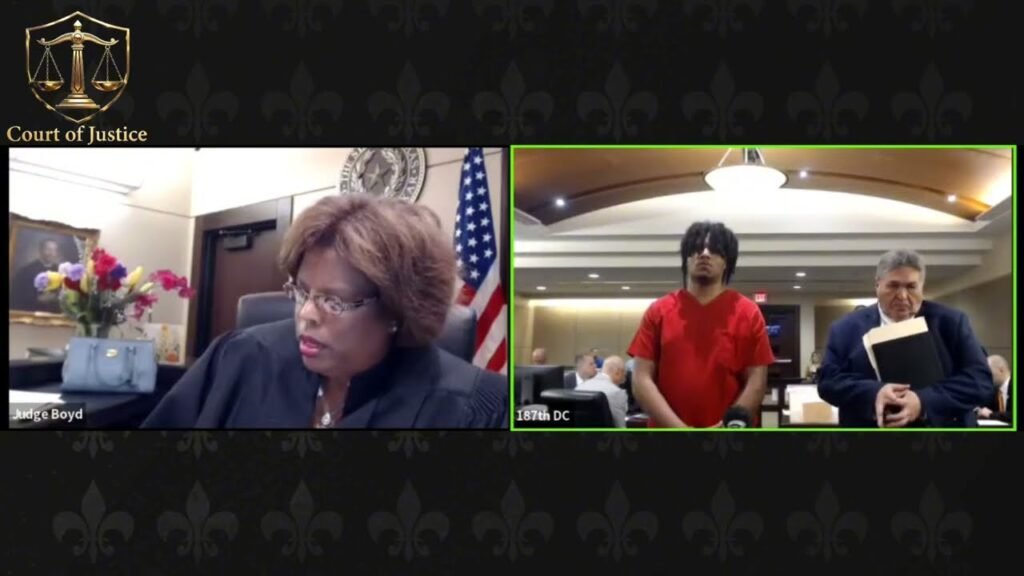
The courtroom inside Bexar County District Court carried the specific kind of silence that only comes before a life-altering decision. Judge Stephanie Boyd surveyed the young man standing before her bench — Tyrone Eads, 21 years old, indicted on some of the most serious charges the State of Texas can bring against a person.
Four first-degree felony counts. Two aggravated robberies. Two counts of aggravated sexual assault.
This was not a close call. This was a reckoning.
Eads had entered a negotiated plea of no contest across three separate active case numbers: 2023CR2703, 2023CR2704, and 2023CR2530. Two companion cases, 2023CR2702 and 2023CR2705, were folded into the agreement and effectively resolved alongside the primary charges. The machinery of the Texas criminal justice system had processed his case, and this morning, it was time for the output.
Judge Boyd did not rush. She has built a reputation in her courtroom for methodical, deliberate judicial conduct — the kind that leaves no procedural door open for a successful appeal. Before accepting any plea from a defendant, she works through every layer: mental competency, awareness of rights, the voluntary nature of the agreement, and the full statutory weight of what the defendant is agreeing to carry.
Eads confirmed he understood the implications. His defense counsel affirmed he was legally sane, mentally competent, and had been provided with every available legal defense. Eads also confirmed his U.S. citizenship and formally waived his right to a jury trial, placing his fate entirely in the hands of the court.
The State of Texas had capped its sentencing recommendation at 30 years in the Texas Department of Criminal Justice, with all three cause numbers running concurrently. For a first-degree felony in Texas, the statutory range stretches from 5 years all the way to 99 years — or life. The prosecution had room to push far harder. They did not.
What happened next, both on and off the record, became a defining moment for everyone present.
The Young Man Behind the Case Numbers
Available public records establish that Tyrone Eads was 21 years old at the time of sentencing, placing his alleged offenses during a period when he was barely of legal adult age.
The specific circumstances that led to his arrest and indictment across five total case numbers — three active, two companion — speak to a pattern of conduct rather than a single impulsive event. Aggravated robbery under Texas Penal Code §29.03 requires proof that a person, in the course of committing theft, either caused serious bodily injury, used or exhibited a deadly weapon, or committed the offense against a person 65 years of age or older.
Both robbery counts carried an affirmative finding of a deadly weapon. That finding is not a technicality. It is a formal judicial determination that will follow Eads throughout his incarceration and affects parole eligibility under Texas law.
The aggravated sexual assault charges under Texas Penal Code §22.021 are among the most heavily prosecuted offenses in the state’s criminal code. The law requires the state to prove that the act was committed without consent and involved specific aggravating factors. Two counts were included in the indictment under case number 2023CR2530.
The named complainants for the robbery cases were Daniel Lara and John Albert Elizondo. A separate female complainant was identified in the sexual assault case. All three were placed under a strict and permanent no-contact order as a condition of Eads’ sentence.
While public trial dockets do not clarify the precise timeline between the alleged incidents and the eventual arrest, the filing of five interconnected case numbers within the same court docket suggests the offenses were investigated as a related cluster of criminal conduct rather than isolated incidents.
How Texas Builds a Felony Case of This Magnitude
First-degree felony prosecutions in Texas are not assembled quickly. Law enforcement and the district attorney’s office invest significant resources in case construction before a grand jury returns an indictment.
For aggravated robbery, the investigative framework typically includes physical evidence from the crime scene, witness and victim statements, surveillance footage where available, and forensic analysis of any weapons involved. The deadly weapon finding that Judge Boyd formally entered suggests that investigators had sufficient evidence to establish the presence and use of a dangerous instrument or firearm — a determination that must withstand judicial scrutiny.
Sexual assault investigations involve a separate and more intensive evidentiary track. Forensic evidence, victim advocacy documentation, medical examination reports, and digital communications often form the backbone of such prosecutions. Available records leave a gap regarding the specific investigative timeline, but the fact that the state secured two counts of aggravated sexual assault within the same indictment framework indicates a high level of prosecutorial confidence in the underlying evidence.
The decision to pursue a negotiated plea rather than proceed to trial is a tactical calculation made jointly by the prosecution and defense. For a 21-year-old defendant facing a theoretical maximum of 99 years or life on each of four first-degree felony counts, the 30-year concurrent offer represented a significant reduction in worst-case exposure.
Defense counsel indicated during the sentencing hearing that Eads had made a deliberate choice to accept personal responsibility. That choice carried weight — and Judge Boyd heard it.
Four Charges That Carry Life-Altering Weight
Understanding exactly what Eads pled no contest to requires a clear breakdown of the charges as they exist under Texas law.
Aggravated Robbery (First-Degree Felony) — Two Counts
Standard robbery in Texas becomes aggravated when a deadly weapon is used or exhibited during the offense. The elevation from second-degree to first-degree felony status reflects the legislature’s judgment that armed robbery represents a qualitatively different level of threat to the public. Each count carried a standalone statutory range of 5 to 99 years or life, plus a fine up to $10,000.
Aggravated Sexual Assault (First-Degree Felony) — Two Counts
This charge represents one of the most serious sexual offense classifications in the Texas Penal Code. Unlike standard sexual assault, the aggravated version involves specific statutory factors that elevate the offense — including the use of a deadly weapon, the infliction of serious bodily injury, or the threat of imminent death. Both counts fell within case number 2023CR2530.
The Deadly Weapon Finding
Judge Boyd entered an affirmative finding of a deadly weapon across all counts at sentencing. This is a formal judicial determination, not simply a prosecutorial allegation. Under Texas Code of Criminal Procedure §42A.054, this finding has direct consequences on parole eligibility — specifically, a defendant with such a finding must serve a higher proportion of the actual sentence before becoming parole-eligible.
Sex Offender Registration
Under Chapter 62 of the Texas Code of Criminal Procedure, Eads was ordered to comply with lifetime sex offender registration requirements. This obligation extends beyond his release from prison and subjects him to ongoing registration, reporting, and residency restrictions for the remainder of his life.
The State’s Position and What It Offered
The prosecution’s recommendation was structured, deliberate, and strategically balanced.
A 30-year cap, with all three active cause numbers running concurrently, meant that Eads would not face stacked, consecutive sentences that could have effectively amounted to a life sentence without the formal designation. The State acknowledged the gravity of the crimes while also crafting an agreement that accounted for the defendant’s age, the evidence in hand, and the interests of the victims.
The concurrent structure is significant. Under a consecutive sentencing arrangement, each 30-year term would follow the previous one — creating a potential 90-year exposure across three causes alone. The prosecution’s agreement to concurrent sentencing reflected a calculation that a guaranteed 30-year commitment provided meaningful justice without requiring a trial that would force the victims to relive the offenses in open court.
The no-contact order protecting all named complainants — Daniel Lara, John Albert Elizondo, and the female sexual assault complainant — was issued as a strict, permanent condition of the sentence. Violation of a no-contact order carries independent criminal consequences under Texas law, and Judge Boyd’s imposition of it ensured that the victims’ safety did not depend on Eads’ voluntary compliance alone.
Available records do not detail the specific terms of any pre-sentencing negotiations regarding the companion cases, 2023CR2702 and 2023CR2705, beyond their resolution as part of the overall plea agreement.
The Defense Argument for Mercy
Defense counsel had a narrow lane to work with, and he used it precisely.
He was not arguing innocence. He was not constructing a theory of reasonable doubt or attacking the state’s evidence. The no-contest plea had already resolved that phase of the proceedings. His task was to present Tyrone Eads as a human being — one who had caused serious harm, but who also possessed some foundation for the court’s acceptance of the negotiated sentence.
He highlighted two primary mitigating factors.
The first was Eads’ acceptance of personal responsibility. In a first-degree felony case of this magnitude, a defendant who stands before the court and genuinely owns the conduct rather than deflecting, minimizing, or blaming external circumstances is presenting the court with something substantive.
The second was more specific and more striking. Eads had written a handwritten letter of apology directly to the female victim in the sexual assault case. Defense counsel presented this to the court, framing it as evidence of genuine remorse rather than performative contrition designed to game the sentencing process.
Whether that letter provided any meaningful comfort to the victim is a question that falls outside the courtroom record. But within the legal framework of a sentencing hearing, it served its purpose: it humanized the defendant without minimizing the severity of what he had done.
Judge Boyd heard all of it. She accepted the plea. And then, after the formal record closed, she said something that no transcript can fully capture.
Judge Boyd’s Off-the-Record Moment
The paperwork was done. The sentence was entered. The official judicial record had closed.
Then Judge Boyd looked directly at Tyrone Eads — not at the court reporter, not at the gallery, not at the camera — and delivered what can only be described as a judicial reckoning for a young man who may not have fully processed the weight of what had just happened to him.
She told him plainly: 30 years is a massive portion of a life. He is 21. He will not walk out of a Texas state prison as a young man.
Her warning was specific and unsentimental.
“Do not go to prison and become institutionalized.”
She told him that one day, if he lives, he will be released. And if he exits those walls the same person he entered as — hardened, unchanged, absorbed into the prison system’s culture — the world outside will destroy him. Not could. Will.
It was not a speech designed to generate sympathy for a man who had terrorized multiple victims, including sexually assaulting a woman. It was a statement of hard reality delivered by a judge who had seen the cycle play out enough times to know how it ends.
The value of that moment lies in what it reveals about Judge Boyd’s approach to sentencing. She does not treat the gavel as the end of her obligation to the people who stand before her bench. For her, formal justice and human accountability are not mutually exclusive. The sentence was severe. The message was direct. Both were necessary.
Across the Courtroom: The Rosado Deception
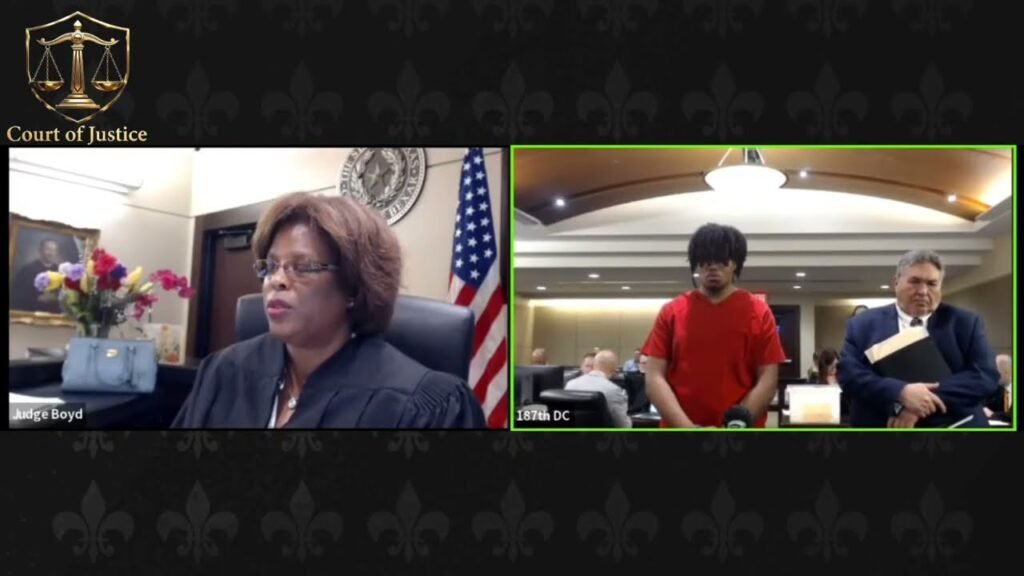
On a separate but connected docket track within the same courthouse proceedings, a very different kind of courtroom confrontation was unfolding — one involving not violence, but a calculated attempt to deceive the court.
Angelo Rosado appeared before Judge Boyd on case number 2024CR1902, charged with possession of a controlled substance under Penalty Group 1, less than one gram — a state jail felony in Texas. The substance involved was cocaine or methamphetamine, carrying a statutory range of 180 days to two years in a Texas state jail facility and a potential fine up to $10,000.
The state’s offer was generous by any objective legal measure: two years of deferred adjudication community supervision, a $1,500 probated fine, a mandatory substance abuse treatment evaluation through the TAP program, and 120 hours of community service. Deferred adjudication means that if Rosado successfully completed probation, no formal conviction would be entered on his record. The state was effectively offering him a path to walk away clean.
All he had to do was be honest.
The Morning the Lie Almost Held
Rosado is a 40-something unemployed subcontractor. He is a father of four children, ages 5, 13, 18, and 19, from whom he is completely estranged. He had not had contact with them in several years and owed back child support at the time of his appearance.
When Judge Boyd asked him directly about his baseline drug test — a standard requirement before the court accepts a probation agreement — Rosado looked at her and said he should be able to pass.
It was a hedge designed to buy time without triggering immediate rejection. He was not saying yes. He was not saying no. He was betting that the court would accept a vague affirmation and move forward.
Judge Boyd did not accept it.
She reminded him of what he was being offered: deferred adjudication on a felony drug charge. A complete exit from formal conviction if he followed the program. She then turned his attention to the female probation officer standing nearby and informed him plainly that she would call a male officer down immediately to conduct an observed urinalysis right then and there.
The offer was not a bluff. It was a choice.
When the Facade Breaks
Rosado’s constructed story collapsed under the weight of the room.
He admitted he would not pass the drug test. He admitted he was positive for cocaine. He told the court he used it casually — approximately once a month.
Judge Boyd asked him directly why he had played games in a courtroom that was actively trying to give him a second chance.
“Honesty is the best policy in this court… They’ve already offered you deferred, there is no excuse or reason to come before me and be dishonest.”
She did not rescind the deferred adjudication offer. She accepted the plea. But she added layers to his probationary terms that reflected both her frustration and her understanding of what a substance abuse problem actually requires.
Rosado was ordered to complete 90 sober recovery meetings within 90 consecutive days — one meeting every single day for three months. His TAP evaluation timeline was placed under immediate tracking. He was assigned to a strict random urinalysis hotline schedule, requiring him to call in regularly and appear for unannounced drug screens. And given that he had admitted to active cocaine use and had minor children among his estranged family, the court placed a zero unsupervised contact with minors condition on his supervision terms.
What These Two Cases Reveal About the Courtroom
The Eads and Rosado cases, handled within the same judicial proceedings, illuminate two distinct pressure points in the Texas criminal justice system.
Eads presented the court with the full weight of violent, predatory crime committed by someone barely out of adolescence. Judge Boyd’s handling of his sentencing reflected the court’s dual mandate: enforce the statutory penalty with full rigor while still acknowledging the human being inside the case number.
Rosado presented the court with something smaller in statutory scale but arguably more corrosive in courtroom terms — a man who believed he could navigate the system through deception rather than accountability. His attempt to mislead the court on something as simple as a drug test, while standing before a judge actively offering him leniency, is a behavioral pattern that Judge Boyd addressed directly and without softening.
Both defendants left the courtroom with more than a sentence. They left with a direct, unambiguous message from the bench — delivered by a judge who has long since stopped pretending that formal judicial language alone is sufficient.
The legal outcomes were entered into the record. The human ones remain to be seen.
This report is based on publicly available case filings and courtroom proceedings from Bexar County District Court, San Antonio, Texas. All case numbers are drawn from the official docket. Victim names are referenced solely where they appear within the formal no-contact provisions of the court record.