Judge Stephanie Boyd built her courtroom into a YouTube destination. She livestreamed daily criminal proceedings from the 187th Criminal District Court in San Antonio, drew tens of thousands of subscribers, and became one of the most recognizable district judges in Texas. On June 3, 2026, the Texas State Commission on Judicial Conduct issued her a formal public warning, finding that the channel and her conduct in two hearings it captured crossed the line from transparency into misconduct.
The warning is now a permanent part of Boyd’s disciplinary record. It does not remove her from the bench, and she continues to preside over cases in Bexar County. Her term, however, is already coming to an end; she lost her bid for another term in the March 2026 Democratic primary, and her successor takes over at the close of 2026.
This piece walks through what the commission found, the two hearings at the center of the case, the recusals that followed her online presence into other courtrooms, and the broader argument now playing out over how far a sitting judge can take “transparency” before it becomes something else entirely.
Who Is Judge Stephanie Boyd
Boyd has served as the elected judge of the 187th Criminal District Court in San Antonio, a felony trial court within the Bexar County judicial system. Like other district judges in Bexar County, her docket covers serious criminal matters, including violent felonies, sexual assault cases, and probation revocation hearings. Before the events described in the commission’s order, Boyd was known publicly mainly through routine local coverage of her courtroom, including a 2020 interview in which she raised concerns about COVID-19 exposure risks tied to courthouse staffing changes.
That changed once her YouTube channel began drawing sustained attention. Unlike a handful of other courts that stream hearings through a fixed camera and a locked, comment-free feed, Boyd’s channel became something closer to an ongoing show, with recurring viewers, a following that numbered in the tens of thousands, and enough engagement that legal commentators and true-crime audiences alike began tracking her rulings in real time. That visibility is precisely what turned an otherwise obscure felony court into the subject of a statewide disciplinary order.
A Courtroom Channel Built for an Audience
Boyd was provided a YouTube channel through the Texas Office of Court Administration, the same kind of public-access tool a number of Texas courts use to stream hearings. Most courts treat the channel as a passive record of proceedings. Boyd went further, turning her channel into an interactive space where viewers could comment in real time while active criminal cases were being heard.
The channel grew fast. Public reporting places her subscriber count above 57,000, a remarkable audience for a felony trial court that most people would never otherwise have reason to watch. Comment sections on her livestreams filled up during plea hearings, sentencings, and revocation proceedings, with viewers weighing in on defendants, attorneys, and the judge’s rulings as they happened.
Defense attorneys began raising alarms well before the commission’s June 2026 order. They argued that live audience commentary during an active case exposed defendants and their lawyers to hostile, prejudicial, and sometimes abusive public reaction in real time. Those complaints eventually formed the backbone of the commission’s investigation.
The Book Club the Commission Called Extrajudicial
One of the more unusual findings in the commission’s order involved something that had nothing to do with a specific criminal case: a recurring book club Boyd hosted directly on the court’s YouTube channel. The commission found that this book club let viewers cross-communicate and leave real-time messages about pending or ongoing litigation and the people involved in it, blurring the line between a judicial proceeding and a fan community.
Boyd told the commission she had since stopped participating in the book club. She also stated in her sworn responses that she never reviewed or responded to viewer comments during any proceeding, and that her rulings were based solely on the evidence and the law. The commission’s order did not dispute that account directly, but it found the practice itself, regardless of whether Boyd personally read the comments, to be inconsistent with a judge’s duty to avoid extrajudicial activities that invite public commentary on pending cases.
That distinction matters for how the case has been covered. The violation the commission identified was not that Boyd was proven to have been influenced by her audience. It was that she created a structure, a livestreamed book club layered on top of a felony docket, that made it possible for the public to weigh in on cases in a way judicial conduct rules are designed to prevent.
The Villamil Case: A Judge Steps Into Plea Negotiations
The commission’s order singled out a July 6, 2023, plea hearing in the case of State of Texas v. Willberth Villamil. Villamil was appearing on aggravated sexual assault charges, and prosecutors and defense counsel had already negotiated a plea agreement before the hearing. According to the commission’s findings, Boyd rejected that agreement on the record.
What happened next is the core of the violation. Rather than simply rejecting the deal and returning the case to negotiation or trial, Boyd asked Villamil directly whether he would instead accept a 20-year prison sentence offered by the court. She was also found to have remarked that the case was, in her words, a “life-sentence worthy case.”
The commission determined this was an improper insertion into the plea bargaining process, a function that belongs to prosecutors and defense counsel, not the presiding judge. Judges are permitted to accept or reject a negotiated plea. They are not supposed to counter-offer a sentence directly to a defendant from the bench, and the commission found that Boyd’s conduct in the Villamil hearing crossed that line while it was being broadcast live to her YouTube audience.
The Henson Case: “Off the Record” but Still Live
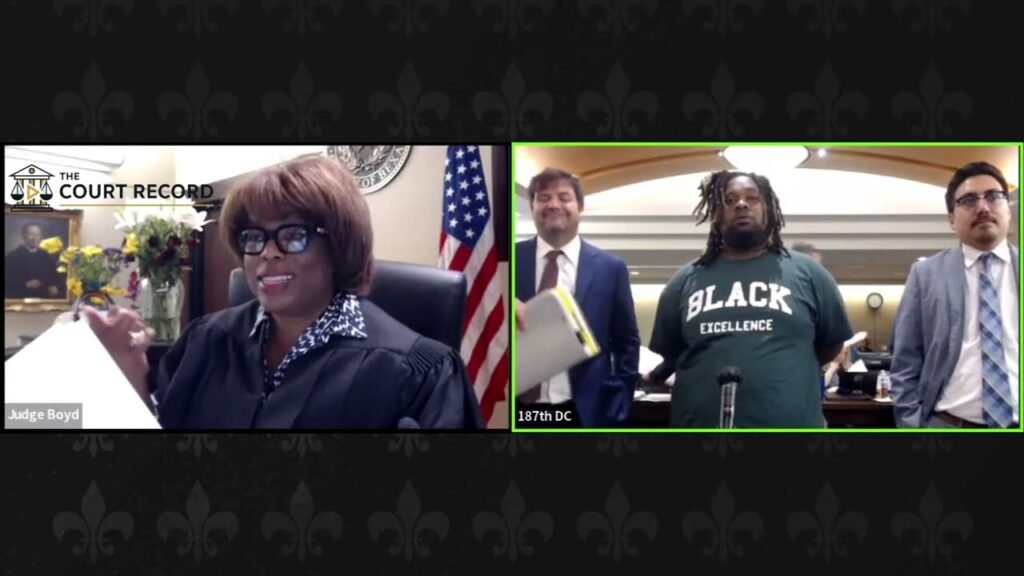
The second hearing cited in the commission’s order came from an October 28, 2024, probation revocation hearing in State of Texas v. Thomas Henson. Boyd had explained to Henson, a young defendant, that he was facing up to 20 years in prison for the violation before the court. At that point, according to the commission’s findings, she directed the court reporter to go off the record.
The livestream, however, kept running. With the official court record paused but the public broadcast still active, Boyd made remarks to Henson that the commission quoted directly in its order, telling him that he appeared to want to go to prison “to be passed around for cigarettes.” The commission found that the comment, along with the broader tone of the exchange, reflected impatience, a lack of dignity toward the defendant, and bias against him.
“So it appears that you want to go to prison to be passed around for cigarettes.”
Boyd later told the commission that she made the remarks because she believed Henson was not taking his charges, or the potential probation before him, seriously. The commission did not accept that explanation as justification. It found the comment itself, made on camera to a young defendant facing a lengthy sentence, was exactly the kind of undignified and prejudicial conduct judicial canons are written to prevent.
The “off the record” instruction is what makes the Henson hearing especially notable from a transparency standpoint. Boyd apparently believed she was speaking outside the official court record when she made the remark. She was still speaking to a live public audience of thousands, which is precisely the gap the commission’s order highlights: a judge’s sense of what counts as “off the record” no longer lines up cleanly with what a livestreamed courtroom actually broadcasts.
Why “Off the Record” Doesn’t Mean What It Used To
Court reporters go “off the record” constantly, usually for scheduling discussions, side conversations between attorneys, or brief moments that don’t need to be preserved in an official transcript. The phrase has always meant that the official written record stops, not that the courtroom itself goes silent or private. Anyone physically present in the gallery that day could still have heard whatever was said.
What’s different about a livestreamed courtroom is scale. A comment made off the record in a courtroom with a dozen observers is heard by a dozen observers. The same comment made off the record in a courtroom broadcasting to a channel with tens of thousands of subscribers reaches an audience several orders of magnitude larger, and it does so permanently, since livestreamed video can be clipped, saved, and recirculated long after the hearing ends. The commission’s order does not suggest Boyd intended for the Henson remark to spread the way it ultimately did. It simply treats the outcome, a demeaning comment to a young defendant reaching a mass audience, as the predictable result of layering a public livestream on top of an “off the record” moment that used to carry a much smaller footprint.
Four Findings, Five Canons
The commission’s June 3, 2026 order laid out its conclusions in specific terms rather than a general rebuke. It found that Boyd failed to maintain professional competence in the law when she inserted herself into the Villamil plea negotiation, and separately that she failed to be patient, dignified, and courteous toward both Villamil and Henson. It further found that she performed her judicial duties with bias or prejudice toward Henson during his revocation hearing.
The fourth finding addressed the YouTube channel directly. The commission concluded that Boyd made public comments through the court’s channel about pending or impending proceedings in a way that would suggest to a reasonable person how she was likely to rule in a particular case, a specific violation tied to comments about active litigation rather than the livestreaming itself. Taken together, the commission found this conduct violated Canons 2A, 3B(2), 3B(4), 3B(5), and 3B(6) of the Texas Code of Judicial Conduct, along with Article V, Section 1-a(6)A of the Texas Constitution.
The commission characterized the pattern as willful and persistent, language that matters in judicial discipline because it signals more than an isolated lapse. A public warning is one of the more serious sanctions the commission can issue short of suspension or removal, and it becomes a permanent part of a judge’s disciplinary file. It does not, on its own, end a judge’s service on the bench, and Boyd has continued to preside over the 187th Criminal District Court since the order was issued.
Where a Public Warning Sits in Texas Judicial Discipline
Texas judicial discipline operates on a tiered scale, and understanding where a public warning falls on it helps explain why this case matters as much as it does. At the lightest end, the commission can issue a private sanction that never becomes public at all. A public admonition is the next step up, a formal but relatively mild rebuke.
A public warning, the sanction Boyd received, sits above that, reserved for conduct the commission views as more serious or more clearly patterned. Beyond a public warning, the commission’s tools include public censure, and in the most serious cases, recommending suspension or removal from the bench to the Texas Supreme Court’s Review Tribunal. Boyd’s order did not reach that level, but the specificity of the four findings against her, tied to two named cases with direct quotations, is unusual even among public warnings, which more often describe a general pattern of behavior without spelling out individual remarks in this much detail.
The Recusals: When the Channel Followed Boyd Out of Her Own Courtroom
The commission’s order was not the first sign of trouble. In November 2023, months before the Villamil hearing was ever cited in a formal complaint, visiting Judge Sid Harle granted recusal motions in three separate felony cases assigned to Boyd’s court. The cases involved a charge of injury to a child causing serious bodily injury and two indecency-with-a-child cases, and the recusals came directly from defense complaints about Boyd allowing real-time public comment during active proceedings.
Those early recusals turned out to be a preview of a much higher-profile fight. In 2024, Boyd was assigned to preside over the trial of three former San Antonio police officers, Eleazar Alejandro, Alfred Flores, and Nathaniel Villalobos, charged in the fatal shooting of Melissa Perez, a 46-year-old woman who was experiencing a mental health crisis at the time officers responded to her apartment. Defense attorneys moved to recuse Boyd from the case before trial, and the motion drew support from an unexpected source.
The lead defense attorney pressing for recusal, Jason Goss, argued that Boyd had treated him unfairly in the run-up to trial, including denying a continuance request tied to the birth of his child, and suggested her conduct was connected to a formal complaint he had previously filed against her with the Commission for Judicial Conduct. The lead prosecutor on the case, Bexar County’s Civil Rights Division Chief Jeff Mulliner, separately raised concerns that proceeding to trial under Boyd could create appellate risk given the unresolved questions about her impartiality. Judge Harle granted the recusal in September 2024, stating plainly that his role was to ensure the fair and efficient administration of justice, and the case was reassigned to Judge Ron Rangel.
The underlying case itself carried its own weight independent of the recusal fight. Melissa Perez, a 46-year-old woman experiencing a mental health crisis, was shot and killed by San Antonio police officers who had responded to her apartment after a neighbor reported that she had tampered with the building’s fire alarm system. According to reporting on the incident, officers initially had a cooperative interaction with Perez before she retreated into her locked apartment, and the shooting occurred after officers say she approached a closed patio door holding a hammer. San Antonio’s police chief at the time stated publicly that Perez did not pose a threat to the officers, since she remained behind a locked glass door, a comment that shaped much of the public reaction to the case well before the recusal dispute began.
Had Boyd remained on the case, the trial of the three former officers would likely have been livestreamed on her channel, the same format that had already drawn recusals in three unrelated felony cases a year earlier. That prospect, a mental-health-crisis police shooting case broadcast to a public audience with an open comment section, was part of what made the defense’s recusal argument land with a prosecutor’s office that might otherwise have opposed it.
What makes the Perez case recusal significant for this story is who was asking for it. It is unusual for both the defense and a chief prosecutor to align in raising concerns about the same judge’s impartiality ahead of a high-profile trial. The defense’s specific objection, that Boyd’s YouTube channel and her handling of scheduling requests raised doubts about a fair trial, echoes almost exactly the concerns the Commission on Judicial Conduct would later formalize in its June 2026 public warning.
How Boyd’s Channel Compared to Other Courtroom Livestreams
Courtroom livestreaming is not unique to Bexar County. High-profile criminal trials around the country have been streamed publicly for years, and some state court systems now stream select proceedings as a matter of routine practice. The common thread across most of those efforts is that the stream functions as a one-way window: a fixed camera feed, no audience commentary layered on top, and no interaction between the bench and the people watching.
Boyd’s channel departed from that model in a specific way. It was not simply that she recorded her courtroom; other judges have done that without drawing a judicial conduct complaint. It was the combination of a persistent, personality-driven channel, an open comment section active during live proceedings, and extrajudicial programming like the book club that gave viewers a reason to treat her courtroom as ongoing content rather than a public record. That distinction is likely why this case has drawn attention well beyond Texas, as court administrators elsewhere weigh whether to expand their own streaming programs and, if so, how to avoid the pitfalls the commission identified here.
The Ethics Question: Transparency or Entertainment?
Boyd has consistently framed her YouTube channel as a transparency tool, a way to let the public see exactly how a criminal courtroom operates without filtering it through news coverage. That argument has real appeal. Public trust in courts is often built on the ability to observe them directly, and livestreaming has become a normal feature of some court systems around the country.
The commission’s order draws a sharper line than “transparency versus secrecy,” though. The problem was never that cameras were present in Boyd’s courtroom. The problem, according to the commission, was what the channel became once it stopped being a passive feed and started functioning as an interactive audience, one that could comment in real time on defendants and attorneys while a case was still pending.
That distinction is the crux of the broader ethics debate playing out around this case. A public livestream of a courtroom is a window. A livestream with an open comment section, cross-viewer messaging, and a judge occasionally speaking directly to that audience, even inadvertently, starts to function more like a production with an audience it is trying to hold. The commission’s findings suggest Boyd’s channel drifted from the first model toward the second, and that the drift is what turned a transparency initiative into judicial misconduct.
The Defendant’s-Eye View: Chat Rooms and the Presumption of Innocence
The commission’s order focuses on judicial canons, but the underlying harm defense attorneys have raised for years is about the people standing in front of Boyd’s bench. A defendant appearing in a criminal proceeding is still presumed innocent, even at a plea hearing, even during a probation revocation. A live chat room filled with viewers reacting in real time to that defendant’s case complicates that presumption in a way a courtroom with a silent gallery simply does not.
Defense attorneys who complained about Boyd’s channel described a specific pattern: viewers using the comment section to insult defendants, demand harsher outcomes, and react to testimony as it happened, all while the case was still legally undecided. That kind of real-time public pressure has no formal role in a criminal proceeding, but it existed anyway, running alongside official arguments and rulings on a public feed with tens of thousands of subscribers.
The Henson hearing captures this dynamic in miniature. A young defendant was told by the presiding judge, on a livestream she believed was technically “off the record,” that he could expect to be sexually victimized in prison. The remark was not made to a courtroom gallery of a few dozen observers. It was broadcast to whoever was watching that day, a detail the commission’s order treats as central to why the comment was disciplinable rather than simply an unfortunate aside.
The Political Fallout
Boyd’s YouTube presence did not stay confined to judicial conduct complaints. It became a defining issue in her own re-election campaign. She lost the March 3, 2026, Democratic primary for the 187th Criminal District Court to challenger Stephanie Franco, a felony prosecutor who built much of her campaign around criticizing Boyd’s use of the courtroom livestream.
Franco’s campaign messaging was direct about what she saw as the problem. She argued that courtrooms should function as places of justice rather than entertainment, and that livestreaming victims’ testimony added an unnecessary burden to people who already found it difficult to testify in the first place. With no Republican candidate in the race, the March primary effectively decided who would hold the seat going forward, and Boyd’s loss means her time on the 187th Criminal District Court bench ends when her term expires on December 31, 2026.
The timing puts Boyd in an unusual position for the remainder of 2026. She remains a sitting felony court judge with a permanent public reprimand on her record, continuing to hear cases in the months before her successor takes over. Whether that reprimand becomes a factor in future appeals or recusal motions in cases she is still presiding over is, as some legal observers have noted, an open question that will likely play out case by case rather than all at once.
Franco’s public messaging went further than a general critique of livestreaming as a concept. In campaign materials, she argued that a courtroom livestream that broadcasts victim testimony to a public audience adds a burden survivors should not have to carry, framing the issue less as a technology debate and more as a question of who bears the cost when a courtroom becomes a public spectacle. That framing appears to have resonated with primary voters, given that Boyd’s YouTube channel had already generated years of local news coverage, defense bar complaints, and by the time voters went to the polls, an active judicial conduct investigation that would culminate in the June 2026 warning just months later.
It is worth noting that the commission’s public warning was issued after the March 2026 primary had already been decided, meaning voters chose Boyd’s successor without the benefit of the commission’s formal findings. The complaints underlying that investigation, however, including the November 2023 recusals and the widely covered Perez trial recusal in 2024, were already public well before Election Day, and Franco’s campaign referenced that history directly.
What the Commission’s Order Does, and Doesn’t, Change
A public warning from the Texas State Commission on Judicial Conduct is a serious sanction, but it is worth being precise about its actual legal effect. It does not remove Boyd from the bench. It does not bar her from presiding over pending criminal cases between now and the end of her term. It does not, on its own, overturn any ruling she has made or automatically trigger new recusal motions in cases already assigned to her courtroom.
What it does is create a permanent public record of misconduct findings tied to her name, one that will follow her professionally regardless of what she does next. It also validates, in a formal legal document, complaints that defense attorneys and at least one lead prosecutor had already been raising informally for more than two years. For a judge whose signature project was public transparency, there is a certain irony in the fact that the most consequential document of her tenure is now a public order describing, in detail, the ways that transparency initiative went wrong.
Boyd, through her attorney, declined to comment on the warning when it was issued, saying she remained focused on her duties to Bexar County. She has not, as of this writing, indicated whether she plans to continue any form of public courtroom broadcasting for the remainder of her term. Given the scrutiny the commission’s order has already drawn, and the fact that her successor’s campaign was built substantially around opposing the practice, it would be a notable decision if she did.
Frequently Asked Questions
Did Judge Stephanie Boyd lose her position on the bench? No. The public warning is a permanent reprimand on her disciplinary record, but it does not remove her from office. She continues to preside over the 187th Criminal District Court and will do so until her term ends on December 31, 2026, following her March 2026 primary loss.
What exactly did the commission find Boyd did wrong? The commission issued four specific findings: improperly inserting herself into plea negotiations in the Villamil case, failing to be patient and dignified toward two defendants, exhibiting bias toward a defendant during a probation revocation hearing, and making public comments about pending cases through her YouTube channel that suggested how she might rule.
Is Judge Boyd still livestreaming her courtroom? As of this writing, Boyd has not publicly stated whether she will continue livestreaming proceedings for the remainder of her term. Her attorney indicated only that she remains focused on her judicial duties following the commission’s order.
Does the public warning affect any of Boyd’s past rulings? Not automatically. A public warning is a disciplinary sanction, not a legal ruling that overturns prior decisions. Any effect on specific cases would have to be raised separately, through an appeal or a recusal motion, on a case-by-case basis.
Who will replace Judge Boyd in 2026? Stephanie Franco, a Bexar County felony prosecutor who defeated Boyd in the March 2026 Democratic primary, is set to take over the 187th Criminal District Court seat when Boyd’s term ends. With no Republican candidate in the race, the primary effectively decided the outcome.
The Bigger Picture
Boyd’s case is likely to be cited well beyond Bexar County. Courts across the country are experimenting with livestreaming as a transparency measure, and few judicial conduct commissions have issued an order this specific about where the practice crosses into misconduct. The four findings in the June 2026 warning, covering plea negotiation interference, undignified conduct, demonstrated bias, and improper public comment on pending cases, effectively function as a checklist for what not to do with a courtroom camera.
For now, the practical outcome is straightforward. Judge Stephanie Boyd carries a permanent public reprimand into the final months of a term she has already lost the right to continue. The cases her channel touched, from Villamil’s rejected plea deal to the Perez murder trial recusal that pulled a high-profile police shooting case out of her courtroom entirely, remain part of the record that will define how this experiment in courtroom transparency is remembered.
There is also a longer-term question the commission’s order raises without fully answering: what should courts do with the public’s genuine appetite to watch criminal proceedings unfold. Boyd’s audience did not appear out of nowhere. True crime content, court-watching communities, and livestreamed trials have become a significant part of how the public engages with the justice system, and Boyd’s channel tapped directly into that demand before it ran into the limits judicial conduct rules impose on judges themselves. Other court systems weighing whether to expand their own streaming programs now have a detailed, case-specific roadmap of what not to do, courtesy of a four-page order out of Bexar County.
Whether Boyd’s successor chooses to end courtroom livestreaming altogether, scale it back to a passive feed without comments, or leave the current format in place will likely be one of the first practical decisions facing the 187th Criminal District Court once the new term begins. Given how central the issue was to the campaign that put her in that seat, it would be a significant surprise if Franco left the channel running unchanged.
This article is based on the Texas State Commission on Judicial Conduct’s public warning of June 3, 2026, and reporting from KSAT, the ABA Journal, Texas Public Radio, Texas Scorecard, and other outlets covering the underlying hearings and recusal proceedings.