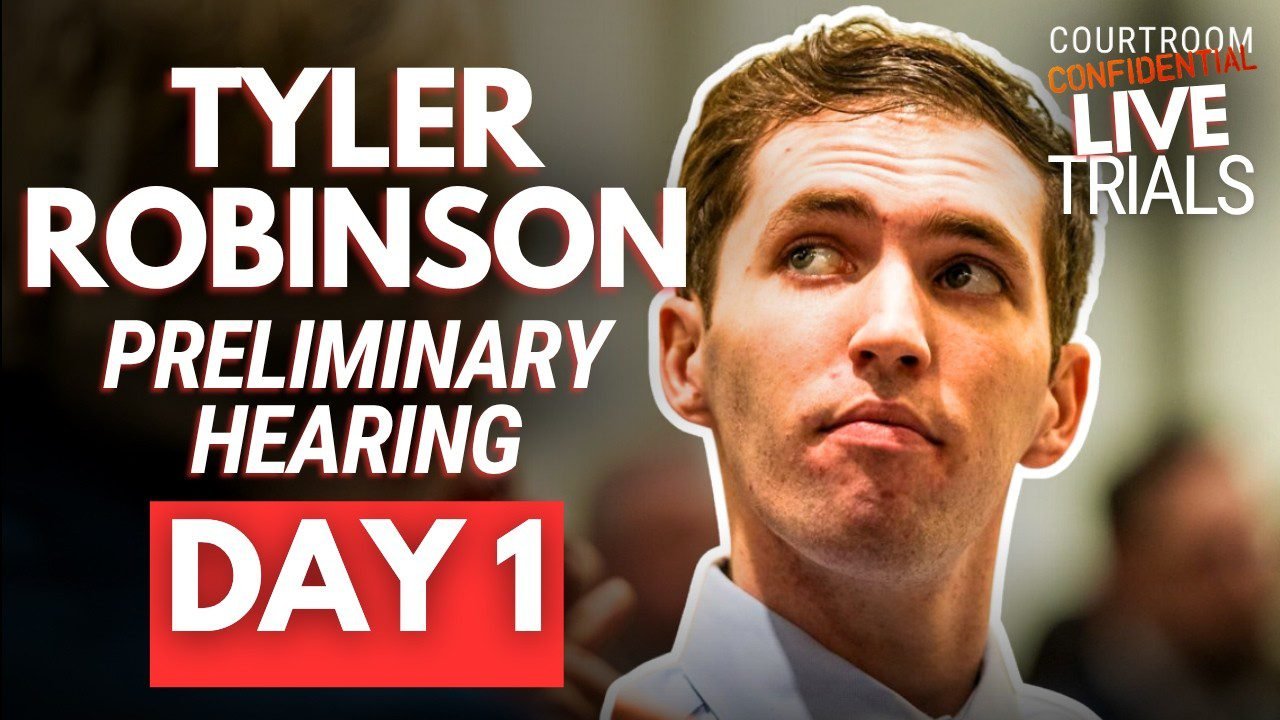
The gavel came down at 9 a.m. sharp inside Provo’s Fourth District Courthouse, and by then the line outside had already been forming for three hours. Reporters, retirees, and strangers who simply wanted a seat in the gallery had been standing on the sidewalk since before sunrise. Inside, under tight security, the Tyler Robinson preliminary hearing Day 1 proceedings were about to begin.
This was not an ordinary Monday in Utah County. For the first time since a single rifle shot ended Charlie Kirk’s life on a UVU courtyard stage last September, his widow and his parents sat in the same room as the man accused of killing him. Donald Trump Jr. sat nearby. Rows away, at the defense table, sat 23-year-old Tyler James Robinson, shackled, facing a charge that carries the possibility of execution.
Judge Tony Graf opened the session by laying out the week’s rules. Cameras would roll, over defense objections. The hearing, prosecutors had already signaled, would stretch across five days and dozens of exhibits. Day one belonged to a former campus police officer and a state investigator, and to a phrase that would follow this case for the rest of the week: the “sniper pad.”
Former Utah Valley University Officer Christopher Bagley took the stand first. He described being on duty in the Fountain Courtyard on September 10, 2025, when Kirk was addressing a crowd of roughly 3,000 people as part of the opening stop of his “American Comeback” tour. Bagley said a single loud pop rang out as Kirk fielded a question from the audience. Kirk clutched his neck and went down. The courtyard, in Bagley’s telling, dissolved into chaos within seconds.
The Rooftop That Changed Everything
Bagley testified that his instincts pulled him toward a nearby building the moment the shot rang out. He said he looked up from the amphitheater and realized the Losee Center rooftop sat in a direct, unobstructed line with the white tent where Kirk had been seated. That instinct sent him climbing to the roof, where he says he found something investigators would spend the next ten months building a case around.
On the gravel surface, Bagley said, he found a red-and-black screwdriver and disturbed patches of stone that looked like the impressions left by someone lying prone. “It looks like a sniper pad,” Bagley told the court, adding that the marks showed “elbows, knees and feet.” It was blunt, plain language from a man who had worked campus security, not homicide investigations, and it landed hard in a courtroom already carrying the weight of Kirk’s family in the front rows.
Under cross-examination from lead defense attorney Kathryn Nester, cracks appeared in how directly Bagley could tie that rooftop to a shooter’s identity. He acknowledged he could not identify the person seen on surveillance footage standing on that roof, nor say for certain what object the figure was holding. Nester also drew out those the impressions themselves had been described to Bagley later, while prosecutors prepared him to testify, rather than something he had fully documented as a body outline in the moment.
Bagley further admitted, under questioning, that an empty pistol holster had been recovered from the courtyard floor amid the stampede of fleeing students. He said he never personally took custody of it and could not confirm whether it was ever processed for fingerprints. It was a small thread left dangling — one Nester clearly intended prosecutors to have to account for later in the week.
Building Robinson Into the Frame
By early afternoon, the state called its second witness: Agent David Hull of the Utah Department of Public Safety, assigned to the State Bureau of Investigation’s major crimes unit. Hull described a case built less on a single smoking-gun moment and more on hundreds of hours of accumulated footage — campus security cameras, private Ring doorbell feeds, and cellphone video submitted by bystanders.
Hull testified that investigators worked to trace a young, slight-statured man across four separate appearances on UVU’s campus that day. Security footage allegedly showed him scouting the area twice that morning, appearing again around the time of the shooting, and then once more that night. Piecing together those four sightings, Hull said, became the SBI’s central task in the days immediately following the assassination.
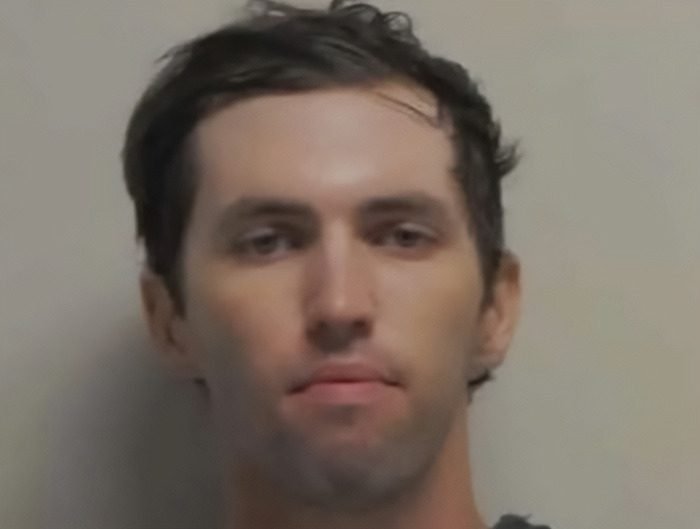
It was during Hull’s testimony that Tyler Robinson’s name first entered the record aloud. Hull told the court that Washington County law enforcement had passed along a name — Robinson — of a man who wanted to turn himself in, and Hull confirmed that the man sitting at the defense table was that same person. For a case that had dominated headlines for ten months, it was a strikingly quiet way for the defendant’s name to formally surface in his own hearing.
What Aggravated Murder Actually Means
Robinson has not yet entered a plea. He faces aggravated murder — Utah’s most severe homicide charge, reserved for killings committed under specific aggravating circumstances, and the only Utah charge that opens the door to a death sentence. Prosecutors have argued that firing a high-powered rifle into a dense campus crowd of thousands satisfies that threshold on its own, independent of who was struck.
Beyond aggravated murder, charging documents show Robinson also faces felony discharge of a firearm causing serious bodily injury, committing a violent offense in the presence of a child, and obstruction of justice. Two additional counts allege witness tampering, tied to accusations that Robinson pressured his roommate to delete incriminating text messages in the hours after the shooting.
A preliminary hearing like this one is not a trial. Utah law only requires prosecutors to show a judge that there is probable cause — reasonable grounds — to believe Robinson committed the crimes charged. It is a far lower bar than the “beyond a reasonable doubt” standard a jury would eventually apply, and it allows prosecutors to lean on hearsay evidence that would be excluded at trial.
The Confession Note and the Text That Followed
The most damning material presented Monday didn’t come from a witness stand at all — it came from documents already filed with the court and referenced throughout the day’s testimony. According to charging papers, Robinson’s roommate found a handwritten note hidden beneath a keyboard after receiving a text instructing them to look there. The note allegedly read: “I had the opportunity to take out Charlie Kirk and I’m going to take it.”
“I had the opportunity to take out Charlie Kirk and I’m going to take it.”
In follow-up messages, prosecutors say, Robinson told his roommate he had “had enough of his hatred” — an alleged explanation for the shooting that has since become one of the most quoted lines in the entire case. Investigators say Robinson also referenced planning the attack for more than a week and discussed retrieving the rifle after fleeing the scene.
Robinson’s roommate, described in court filings as his romantic partner, was granted limited immunity in exchange for a recorded statement given to investigators earlier this year. That roommate is not expected to testify in person during this week’s hearing, but the recorded statement — along with the alleged texts — is expected to be a central pillar of the state’s case as the week continues.
Video Evidence and a Defense Pushing Back
The afternoon session turned almost entirely to a fight over video. Prosecutors sought to introduce a series of clips: university surveillance footage, bystander cellphone recordings, and one video captured by a production crew Turning Point USA had hired to document the event. Some of it was shown only to Judge Graf and the attorneys, kept off the public livestream because of its graphic content.
Nester objected repeatedly, arguing that clips filmed by private citizens amounted to hearsay because those individuals weren’t in court to be cross-examined or to verify the footage hadn’t been altered. Judge Graf largely rejected that argument, ruling that Utah’s preliminary hearing standard allows “reliable hearsay” when the people who submitted the footage did so through official channels and could vouch for its authenticity.
The defense did notch one real win. Graf refused to admit a compilation video after learning investigators had added zoom-ins and colored tracking circles to the raw footage — enhancements made by someone who wasn’t present to testify about how or why they’d altered it. Prosecutors were instructed to return Tuesday with the unedited version instead.
A Family Forced to Watch
Three videos of the shooting itself were eventually played for the courtroom, with audio broadcast throughout the room even though the visuals were shielded from the public feed. The first had been filmed by an audience member’s phone. As the seconds before the gunshot filled the courtroom in sound alone, members of Kirk’s family and friends visibly struggled; one friend rested his forehead on the bench in front of him.
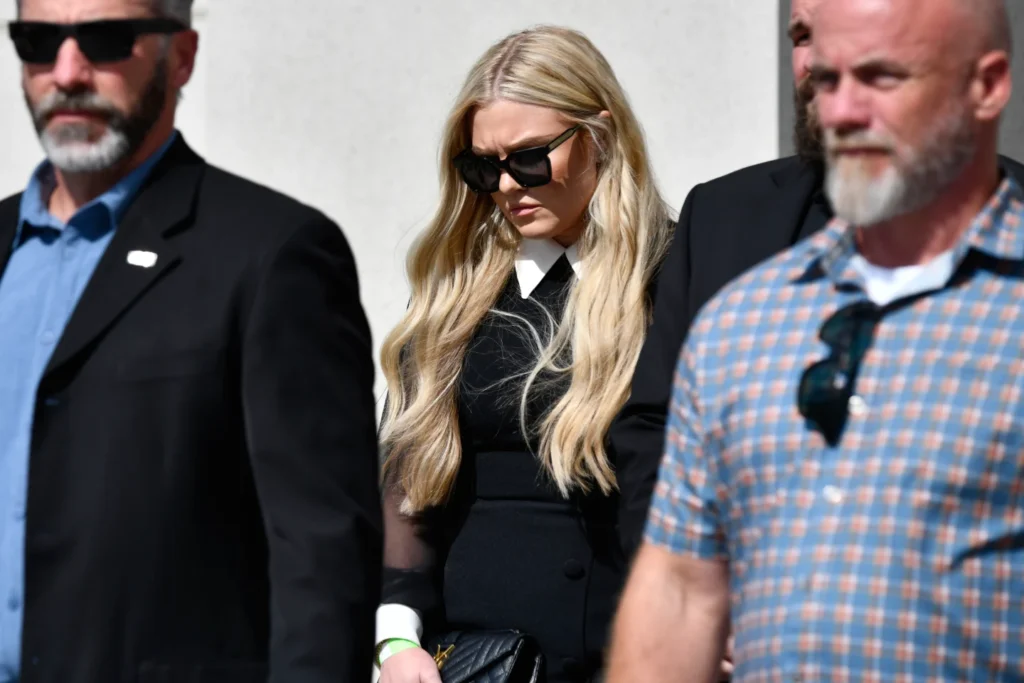
Kirk’s family left the room twice over the course of the day — once during Bagley’s early testimony about the moments leading up to the shot, and again before the third and final video was played. Erika Kirk, seated between her mother and her mother-in-law for most of the day, did not speak publicly during the proceedings, though she had thanked supporters in a statement posted online ahead of the hearing for what she described as sustaining her family through its darkest days.
What Happens Next
Monday’s session ended with Hull’s testimony still unfinished; he is expected to retake the stand Tuesday morning. Court watchers anticipate additional witnesses from Utah’s Bureau of Investigation and Department of Public Safety later in the week, alongside the recorded statement from Robinson’s roommate that prosecutors have signaled will anchor much of their remaining case.
By Friday, Judge Graf must decide only whether prosecutors have cleared the probable-cause bar required to send this case to trial. Given the standard’s low threshold, legal observers in Utah have said the odds of the case not advancing are exceedingly slim. What Friday’s ruling will not resolve is guilt, innocence, or punishment — those questions remain for a trial that, if the case proceeds as expected, is still likely months or longer away.
For now, what Day 1 established was less a verdict than a shape: a rooftop, a note, a text message, and a family forced to relive the worst day of their lives in a room they’d never imagined sharing with the man accused of causing it.