It’s a little after 4:50 p.m. on May 20, 2019, in Midlothian, Virginia. A man walks into the Call Federal Credit Union holding a cell phone to his ear, as if he’s mid-conversation. He isn’t. He’s casing the room.
Moments later, he hands the teller a note: he has her family, he knows where she lives, and he needs at least $100,000. He pulls a gun. He forces the manager into the vault. He walks out with $195,000 in banded bills and vanishes into the Virginia afternoon.
For weeks, Detective Joshua Hylton has nothing. No name, no plate, no face that matches anything in the system. Witnesses and surveillance footage give him one thread to pull: the robber was holding a phone when he walked in.
So Hylton does something almost no one outside law enforcement had heard of in 2019. He asks a magistrate for a “geofence warrant” — a court order compelling Google to identify every single phone that passed within 150 meters of the credit union that afternoon.
That decision would eventually land in front of the Supreme Court of the United States. And on June 29, 2026, the Court answered a question that will affect nearly every smartphone owner in America.
A search is a search — even when the government insists it’s just borrowing your data for a little while.
Decoding the Geofence: How a 17-Acre Digital Dragnet Works
A geofence warrant doesn’t start with a suspect. It starts with a place. Think of it less like a traditional search warrant and more like a digital dragnet dropped over an entire neighborhood, hoping to snag one guilty fish among hundreds of innocent ones.
Here’s how investigators built their case against Okello Chatrie, in three escalating steps:
- Step One — Cast the Net. Google searched its Location History database — known internally as Sensorvault — and pulled every device that had pinged inside a 150-meter circle around the credit union, an area of roughly 17.5 acres that also swallowed up a church, public roads, and nearby homes. The result: 19 anonymized devices, identified only by number.
- Step Two — Narrow the Field. Hylton picked nine of those anonymous devices and asked Google for a wider slice of their movements — location pings both inside and outside the original circle, stretching across a two-hour window.
- Step Three — Unmask the Suspects. From those nine, Hylton narrowed the list to three devices and asked Google to reveal who they actually belonged to: real names, real phone numbers, real lives.
One of those three names was Okello Chatrie.
Here’s the part that should unsettle every phone owner: nobody in that 17.5-acre radius was a suspect when the search began. A person leaving Sunday service at the church next door, a jogger cutting through on a public sidewalk, a neighbor checking their mail — all of them got scooped into the same digital net simply for existing near a crime scene. The warrant didn’t start with probable cause pointed at a person. It started with a place, then went looking for a person to blame.
The Courtroom Battlefront: “You Opted In” vs. Modern Reality
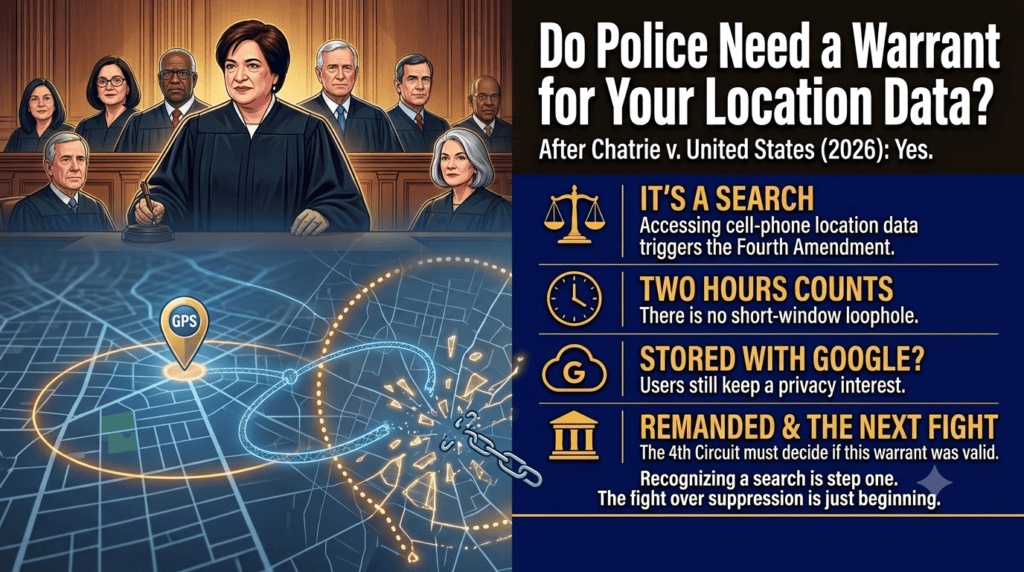
The government’s defense rested on a decades-old legal principle called the third-party doctrine. The theory, born in a 1970s Supreme Court case about phone records, holds that once you voluntarily hand information to a company, you lose your expectation of privacy in it. Chatrie, the government argued, opted into Google’s Location History service. He chose this. He assumed the risk.
Chatrie’s legal team pushed back hard on that framing. A smartphone isn’t a luxury choice anymore, they argued — it’s closer to a modern necessity, and burying consent inside routine setup screens isn’t the same as knowingly surrendering your movements to the government.
And the numbers back up their concern. Location History doesn’t check in on a person once a day. Enabled, it can log a phone’s position roughly every two minutes, accurate to within about 20 meters — sometimes precise enough to guess which floor of a building someone is standing on. That’s not a rough sketch of someone’s life. That’s a functioning map of where they pray, where they see a doctor, whose house they sleep at.
Chatrie’s brief invoked the Founders’ own distrust of “general warrants” — the same kind of unchecked search power that helped spark the Revolution in the first place — as a comparison to the sweep the geofence warrant conducted through Google’s entire user base.
The Landmark 2026 Verdict
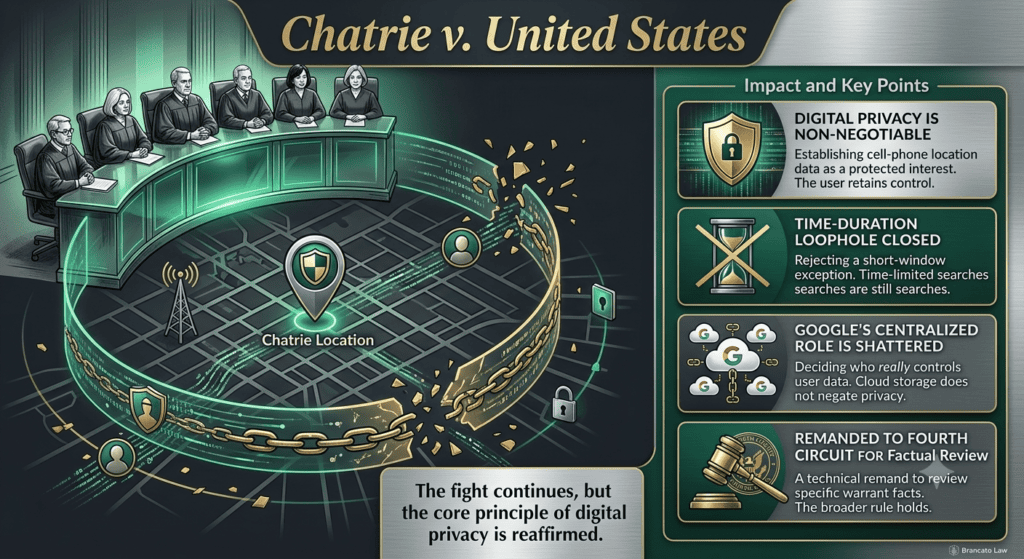
On June 29, 2026, the Supreme Court ruled 6–3 in Chatrie’s favor. Justice Elena Kagan, writing the majority opinion, held that individuals have a legitimate, constitutionally protected expectation of privacy in their cell phone location records — and that police conduct a Fourth Amendment “search” the moment they demand that information from a company like Google, regardless of how narrow or brief the request is.
The government had leaned on the two-hour window and the anonymization process as reasons the warrant shouldn’t count as a true “search.” The majority wasn’t persuaded. Kagan’s opinion made clear that the duration of the intrusion doesn’t change its nature — a look into someone’s private location history is a search whether it lasts two minutes or two hours.
Justice Neil Gorsuch agreed Chatrie should win, but for a different reason entirely: he argued that a person’s Location History is their own property — something the government seized rather than merely observed, placing it squarely inside the Fourth Amendment’s protection of a person’s “effects.”
Not every justice was on board. Justice Samuel Alito filed a blistering dissent, joined in part by Justices Clarence Thomas and Amy Coney Barrett (Barrett also authored her own separate dissent). Alito accused the majority of dressing itself up as a champion of digital privacy while actually triggering a much larger upheaval in Fourth Amendment law, going so far as to call the ruling an “irresponsible escapade.”
Importantly, the Court didn’t declare Chatrie’s specific warrant unconstitutional outright. Instead, it sent the case back down to the Fourth Circuit to determine whether this warrant, step by step, actually satisfied the probable cause and particularity requirements the Fourth Amendment demands.
The Aftermath: Google’s Quiet Pivot
While Chatrie’s case wound through the courts for years, Google made a move that may end up mattering just as much as the ruling itself. The company restructured how Location History is stored — shifting it off centralized servers and onto users’ individual devices.
The practical effect is enormous. Google can no longer hand over a neat, centralized database of everyone’s movements in response to a single warrant, because in most cases it simply doesn’t hold that data anymore. The company effectively engineered itself out of the geofence warrant business — not through a court ruling, but through architecture. It’s a quiet reminder that sometimes the most durable privacy protections come not from judges, but from the design decisions made in Silicon Valley boardrooms.
Conclusion: Does Your Digital Footprint Belong to You?
Chatrie v. United States extends a line the Court first drew in 2018’s Carpenter v. United States, which protected historical cell tower records from warrantless searches. But Chatrie goes further, reaching into the much more granular, much more revealing world of GPS-level Location History — and the reverse-search style of warrant that treats an entire neighborhood as a suspect pool.
The bigger question looming over this case isn’t really about one bank robber in Virginia. It’s about everyone else. Your emails live on a server. Your photos live in a cloud. Your calendar, your search history, your smart doorbell footage — all of it sits with a third party you technically “opted into.”
If a two-hour location pull counts as a search, what happens the next time the government wants a peek at any of that? Chatrie didn’t answer every question about digital privacy in America. But it made one thing very clear: just because you handed your data to a company doesn’t mean you handed it to the government too.
The question that remains is simpler, and far more personal: in an age where every app on your phone is quietly logging your life, does your digital footprint still belong to you — or did you sign it away the moment you tapped “I agree”?