Judge Penney Azcarate looked directly at the man standing before her and told him his crimes reflected something colder than rage. She had presided over the case for nearly two years. She had heard the 911 calls, seen the crime scene photographs, and listened to a jury of five men and seven women reach its verdict.
Now she was ready to speak.
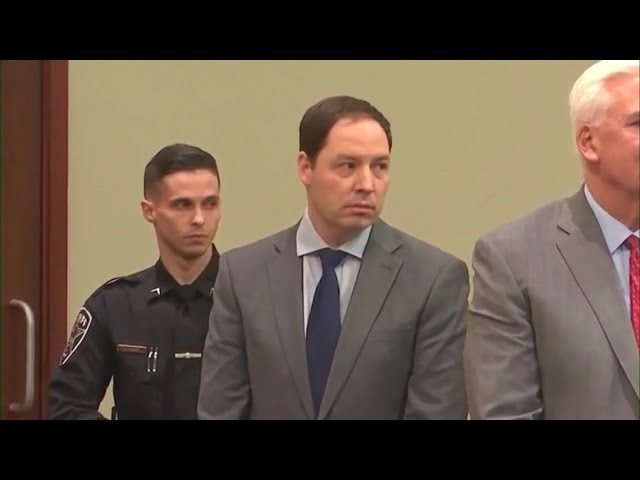
Brendan Banfield, a former IRS criminal investigator, stood in a Fairfax County courtroom on June 5, 2026, waiting to learn how the rest of his life would unfold. Months earlier, a jury had convicted him of murdering his wife, Christine Banfield, and a stranger named Joseph Ryan. The case had become known across Northern Virginia simply as the au pair affair trial, named for the young Brazilian nanny who helped carry out the plan and then became the prosecution’s star witness against him.
Azcarate did not mince words. Virginia abolished capital punishment in 2021, she reminded him, so life without parole was the harshest penalty the law allowed. She said his disregard for his wife was <cite index=”6-1″>”almost unfathomable.”</cite> Then she handed down that maximum sentence anyway.
The Brendan Banfield trial had already delivered a parade of stunning revelations by the time sentencing arrived: a fetish website used as bait, a stranger lured into a stranger’s home under false pretenses, bloodstains that told a different story than the defendant did, and a two-day stretch on the witness stand where Banfield tried and failed to convince a jury he was innocent. What follows is a chronological account of how a Herndon home invasion story fell apart under forensic scrutiny, and how a love triangle turned into one of Fairfax County’s most closely watched murder trials in years.
What Happened Inside the Herndon Home
The events that led to the Brendan Banfield trial began on February 24, 2023. Emergency dispatchers in Fairfax County received a chaotic string of 911 calls from a home in Herndon, Virginia. Juliana Peres Magalhães, the family’s live-in au pair, called at least three times, hanging up twice before finally staying on the line.
When officers arrived, they found a scene that seemed to confirm every parent’s worst fear about a home invasion gone wrong. Christine Banfield, a 37-year-old pediatric intensive care nurse, was suffering from multiple stab wounds to her neck. She was rushed to the hospital, where she later died. On the floor nearby lay Joseph Ryan, 39, a stranger from the Washington, D.C. area, dead from gunshot wounds. The couple’s 4-year-old daughter was found unharmed elsewhere in the house.
Banfield told police a simple story. He said Ryan was an intruder who attacked his wife with a knife, and that he shot Ryan in self-defense. For a while, investigators had little reason to doubt him. Banfield was a former federal law enforcement officer. He had spent his career investigating other people’s crimes, not committing his own.
That story would not survive the year that followed.
Background: A Marriage, an Affair, and an Au Pair
To understand how a suspected home invasion became a murder-for-hire plot, it helps to understand who was living inside that house. Brendan and Christine Banfield had been together for nearly two decades and married for around twelve years. Banfield later testified they were, in his words, “pretty inseparable,” even though both had a history of extramarital affairs stretching back years before Ryan’s death.
Juliana Peres Magalhães moved in with the family in October 2021 to work as their au pair. She was in her early twenties at the time. Within a year, according to her later testimony, she and Brendan Banfield had begun a sexual relationship, starting in August 2022. The two reportedly took a trip to New York together and exchanged romantic photographs in the months before the killings.
Magalhães testified that Banfield told her he wanted to build a life with her but felt trapped by the practical cost of divorce. A traditional split, he reportedly believed, would mean dividing assets and sharing custody of his young daughter. Investigators later said other women who’d had affairs with Banfield described a similar pattern: promises to leave his wife that never materialized, and at least one instance where he allegedly said things would be easier without her around.
By October 2022, prosecutors say, that frustration had turned into a plan. Rather than divorce Christine, Banfield and Magalhães allegedly decided to remove her from the picture entirely — and make it look like someone else had done it.
The FetLife Scheme Begins
Central to the case was a profile created on FetLife, a website built around sexual fetish and BDSM interests. Prosecutors say the profile was built to impersonate Christine Banfield and was used, at least in part, from her own devices, timed for moments when she was actually home. Investigators believe this was a deliberate choice, intended to make any future digital trail point toward her and not toward the two people actually behind the account.
The profile reportedly exchanged messages with several men over months before settling on Joseph Ryan. According to testimony, Ryan was chosen because he agreed to come to the house carrying a knife and rope, believing he’d been invited to take part in a consensual rape-fantasy roleplay. He had no idea he was walking into a home invasion staged specifically around him.
The Investigation and Arrest Timeline
What makes the Brendan Banfield trial unusual is how long it took investigators to build their case. Police did not immediately arrest Banfield. Instead, detectives spent months quietly working through digital forensics, forensic pathology, and inconsistencies in the accounts given by both Banfield and Magalhães.
The first break came in October 2023, roughly eight months after the killings, when Magalhães was arrested and charged with second-degree murder in Ryan’s death. During a search connected to that arrest, investigators discovered she had moved her belongings into the master bedroom closet of the Banfield home — evidence, prosecutors argued, of just how entangled her life had become with Brendan’s after his wife’s death.
Detectives also returned to the crime scene that October and found something that struck many observers as chilling: a framed photograph of Banfield and Magalhães sitting on the nightstand in the very bedroom where Christine had been killed less than a year earlier. Photos of Brendan and Christine together had reportedly been removed and replaced.
For nearly a year after Magalhães’s arrest, authorities monitored jailhouse phone calls between her and Banfield. During one call, prosecutors say, Magalhães told him she hoped he wasn’t only staying close to her out of fear she might turn on him. In September 2024, a grand jury indicted Brendan Banfield on charges of aggravated murder. Fairfax County Commonwealth’s Attorney Steve Descano told reporters that new forensic information had been <cite index=”21-1″>”instrumental in securing”</cite> the indictment, though he declined to detail it publicly at the time.
A year later, in October 2024, Magalhães struck a plea deal. She pleaded guilty to the reduced charge of involuntary manslaughter in exchange for cooperating against Banfield, with prosecutors recommending she receive credit for time already served. That deal set the stage for her eventual role as the Commonwealth’s central witness.
The Legal Charges, Explained

Banfield faced several distinct charges, each carrying its own legal weight. Understanding them helps explain why the case moved as slowly and carefully as it did.
Aggravated murder is Virginia’s most serious homicide charge. Under state law, a murder becomes “aggravated” rather than ordinary first-degree murder when specific factors are present — in this case, prosecutors pointed to the killing of more than one person as part of the same scheme. Since Virginia abolished the death penalty in 2021, a conviction on this charge carries a mandatory sentence of life in prison, and Banfield’s two aggravated murder counts merged into that single mandatory life term rather than stacking as separate life sentences.
Use of a firearm in the commission of a felony is a separate charge that applies whenever a gun is used to carry out another crime — here, the shooting of Joseph Ryan. It carries its own fixed prison term that runs consecutively, on top of whatever sentence is imposed for the underlying felony.
Child endangerment applied because the Banfields’ 4-year-old daughter was inside the home while the killings took place. Prosecutors argued that exposing a young child to that level of violence, even if she didn’t witness the act itself, met the legal threshold for endangering her welfare.
Taken together, these charges meant Banfield wasn’t just facing the possibility of life in prison. He was facing a mandatory life sentence plus additional consecutive years, guaranteeing that even a technicality on one charge wouldn’t meaningfully shorten his time behind bars.
Inside the State’s Case
Jury selection began January 12, 2026, and the trial stretched across several weeks in Fairfax County Circuit Court. Prosecutors, led by Deputy Commonwealth’s Attorney Jenna Sands, built their case around two pillars: the au pair’s direct testimony and physical forensic evidence that they argued corroborated her account independent of her credibility.
Digital Forensics and the Catfishing Trail
Detective Brendan Miller conducted the original digital forensics analysis in the case. His initial report concluded that Christine Banfield had control over her own devices before her death — a finding that, if accepted at face value, would undercut the theory that someone else was operating her accounts. But after Magalhães changed her account of events, Miller was asked to revisit his findings, and he was later transferred to a different unit within the department, a fact the defense would seize on repeatedly.
A second digital forensics expert, Harry Lidsky, previously of the Department of Justice’s Office of the Inspector General, peer-reviewed the data and offered his own analysis to the jury. The prosecution used this digital trail to argue that the FetLife account’s activity lined up with moments when Christine Banfield was home, supporting the theory that someone else was operating it under her identity.
Blood That Told a Different Story
Perhaps the most technical, and most damaging, testimony came from forensic bloodstain-pattern analyst Iris Dalley Graff. She walked jurors through crime scene photography, explaining how blood behaves differently depending on whether it was airborne, dripped, or transferred by contact with another surface.
Graff testified that finger-shaped transfer stains carrying Christine Banfield’s DNA were found on Joseph Ryan’s jeans, and that blood drops on his forearm appeared to have fallen from his wrist toward his elbow — patterns she said were more consistent with someone moving his body after death than with an active, frantic struggle. Prosecutors argued this supported Magalhães’s account that Banfield manipulated Ryan’s body after the killings to make it look like Ryan had attacked Christine.
“There were different positions as the blood was wet and flowing,” Graff told jurors, describing what the stains revealed about movement after the fact.
Notably, forensic analysis recovered no trace of Brendan Banfield’s DNA on the knife used to stab Christine — only DNA from Christine and Ryan. The prosecution’s theory addressed this by arguing Ryan had brought the knife to the house himself, at Banfield’s direction, believing it was a prop for a consensual scenario.
The Au Pair Takes the Stand
Juliana Peres Magalhães testified for roughly three days, describing in detail how the plan came together. She said Banfield first raised the idea of “getting rid of” his wife around October 2022, and that she initially assumed he was joking. She told the jury that Christine was home when she and Banfield secretly used Christine’s own laptop to build the fetish profile, specifically to leave a digital trail that would point toward Christine rather than themselves.
Magalhães testified that on the day of the killings, Banfield waited nearby at a McDonald’s, ordering food through the drive-thru while he waited for word that Ryan had arrived. Surveillance footage from the restaurant was shown to the jury to support the timeline. According to her account, once Ryan was inside, Banfield shot him and then stabbed Christine; when Ryan continued moving afterward, she said, Banfield told her to shoot him a second time, which she did with his personal firearm from a home safe.
Magalhães acknowledged she had changed parts of her story over the course of the investigation and struggled at times to recall specific dates. The defense would later make her shifting timeline a centerpiece of its cross-examination.
The Defense Counter-Theory
Defense attorney John Carroll built his case around a single, blunt argument: that Magalhães lied to save herself, and that Fairfax County investigators built their case around her story instead of the physical evidence. He called several current and former police witnesses to the stand, many of whom had been transferred off the case or left the department altogether, and suggested this reflected internal pressure to conform to a predetermined theory.
Carroll leaned heavily on Detective Miller’s original digital forensics findings, arguing that Christine Banfield’s device activity showed she was in control of her own accounts — directly contradicting the catfishing narrative. He also called defense forensic expert LeeAnn Singley, who testified that wounds on Ryan’s hand were consistent with him having stabbed someone repeatedly himself, offering jurors an alternative read of the same physical evidence the prosecution relied on.
The Dog on the 911 Call
One of the trial’s stranger moments came when the defense called forensic audio and video expert Nick Barreiro to analyze a roughly 1.5-second stretch of groaning captured on the 911 recording — a sound prosecutors argued was Joseph Ryan, still alive and dying. Barreiro testified that the groan was acoustically consistent with a bark or vocalization from Lily, the Banfield family’s dog, rather than a human voice.
The claim required the defense to introduce a recorded exemplar of Lily’s bark, provided by Banfield’s mother, and prosecutors challenged the foundation for that comparison sample before Barreiro’s testimony was allowed to continue. The Commonwealth later called its own audio expert, Detective Stephen Augustine, and a previously unknown witness who came forward only after Banfield’s own testimony, both of whom told jurors the sound was human, not canine.
Crucial Cross-Examinations
Banfield’s decision to testify in his own defense, over two full days in late January 2026, was widely described by legal observers as a high-risk move — and it produced some of the trial’s sharpest moments.
On direct examination, Banfield described coming home after Magalhães called to alert him about a stranger inside the house. He testified he found Ryan attacking Christine, drew his own firearm, and shot Ryan after Christine allegedly screamed <cite index=”11-1″>”Brendan, he has a knife!”</cite> He said he then rushed to his wife’s side, kicked the knife away, and applied pressure to her wounds on her own instructions while she was still conscious.
Prosecutors used cross-examination to challenge that account point by point. Sands questioned how Christine could have spoken clearly to guide Banfield’s first-aid efforts after already suffering six of the seven total stab wounds to her neck, and pressed him on why he never used a towel or blanket to slow the bleeding despite his claim of rendering aid. She also highlighted that Banfield never personally dialed 911, instead instructing Magalhães to make the call — behavior the prosecution suggested was inconsistent with a man desperately trying to save his wife’s life.
A rebuttal witness, Banfield’s own IRS supervisor Thomas Patrick Smith, testified that no work meeting had actually been scheduled for the morning of the killings, directly contradicting Banfield’s explanation for why he’d left for work early that day. Banfield also acknowledged under cross-examination that he had lied to police during the initial investigation, though he maintained the core of his self-defense story throughout.
Carroll, in turn, spent significant time attacking Magalhães’s credibility, reading aloud from letters she wrote from jail and pointing to inconsistencies between her early police statements and her eventual trial testimony. He argued to the jury that her account had been shaped by the promise of a lenient sentence, asking jurors directly whether they trusted a woman with a plea deal over his client.
The Verdict and the Fight to Undo It
After roughly nine hours of deliberation spread across two days, the jury returned its verdict on Monday, February 2, 2026: guilty on both counts of aggravated murder, guilty of the firearm charge, and guilty of child endangerment. Banfield reportedly showed little visible emotion as the verdict was read. Commonwealth’s Attorney Steve Descano told reporters afterward that the case was ultimately about <cite index=”11-1″>two neighbors who were murdered</cite> in Fairfax County, regardless of how much media attention the case’s more sensational details attracted.
Sentencing was initially scheduled for May 8, 2026, but was later moved. In the days before Banfield’s sentencing, his attorneys made one final attempt to undo the verdict entirely, filing a motion to set the conviction aside. On June 4, 2026, Carroll argued before Judge Azcarate that three trial errors — including how prosecutors referenced Banfield’s early silence with investigators and an alleged failure to correct false testimony from Magalhães — had improperly influenced the jury. Azcarate denied the motion, clearing the way for sentencing to proceed the very next day.
Sentencing Day and Its Aftermath
On June 5, 2026, Judge Azcarate handed down her sentence: life in prison without the possibility of parole for aggravated murder, plus five consecutive years for child endangerment and three consecutive years for the firearm charge, all without eligibility for good conduct credit or early release. She told Banfield the severity of his crimes reflected <cite index=”5-1″>something far deeper than anger or impulse.</cite>
Before sentencing, the courtroom heard from the people left behind. Joseph Ryan’s mother, Deirdre Fisher, described the moment she learned her son had been murdered as a devastating, primal shock, and pushed back against how Ryan had been portrayed during the trial, insisting he was a person with <cite index=”10-1″>a face, a name, and a life</cite>, not a disposable prop in someone else’s scheme. Christine Banfield’s sister, Danielle Hocker, told the court that Banfield’s own testimony had struck her as one of the most self-serving displays of narcissism she had ever witnessed, and that his actions reflected a desire for control rather than love.
Banfield addressed the court himself before the sentence was handed down, maintaining his innocence and insisting the investigation had been flawed from the start. He said he was not diminishing who Christine had been as a mother, wife, and nurse — but he continued to deny responsibility for her death.
Descano told reporters afterward that Banfield had once again tried to present himself as a victim in his own case, calling him a remorseless killer who received the sentence he deserved.
Juliana Peres Magalhães, meanwhile, had been sentenced separately in February 2026. Despite prosecutors’ recommendation of time served under her plea agreement, Azcarate rejected that leniency and sentenced her to the maximum penalty allowed for manslaughter — 10 years in prison — telling the court that she had willingly helped bring an innocent man to his death.
What the Case Leaves Behind
The Brendan Banfield trial drew national attention less for its underlying tragedy than for the strange mechanics of the plot itself: a fetish website used as bait, a family photo swapped out on a nightstand within a year of a murder, a bark analyzed against a dying man’s groan. But underneath the sensational details sat a more familiar story — a marriage that had quietly broken down, an affair that escalated into something far darker, and a young child who was in the house for all of it.
Legal observers who spoke with local outlets described Banfield’s post-conviction motion to overturn the verdict as a long shot from the start, and Azcarate’s swift denial bore that out. Barring a successful appeal, Banfield will spend the rest of his life in prison. Magalhães, having testified against the man she once hoped to build a future with, will serve her own decade-long sentence separately.
For Christine Banfield’s family and Joseph Ryan’s, the verdict closed one chapter without erasing what the trial forced them to relive in public. The 4-year-old girl who was found safe in her own basement while her mother was killed upstairs is older now. As Azcarate noted from the bench, there will come a day when she is old enough to understand exactly what was taken from her — and from a stranger named Joe Ryan, who walked into a house believing he’d been invited somewhere entirely different from where he actually ended up.