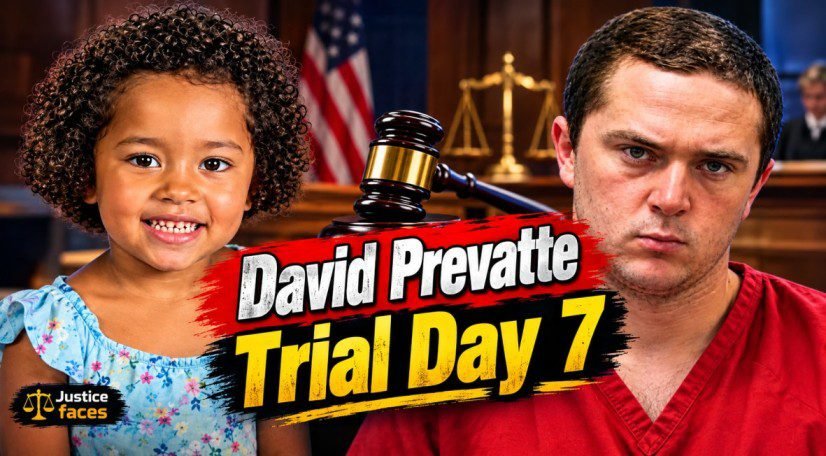
The state finished its case on Monday, October 12, 2026, in Pender County Superior Court in Burgaw, North Carolina. The day began with forensic DNA testimony and an investigator’s cross-examination. It ended with the state resting, a defense motion to dismiss, a ruling on one charge, and the defense resting.
David Prevatte, 27, is charged in the November 2017 death of his niece, Paitin Fields, who was five. Paitin arrived unconscious at Pender Memorial Hospital on November 13, 2017, and died three days later at Novant Health New Hanover Regional Medical Center. Prevatte has pleaded not guilty. Prosecutors allege she was strangled and sexually assaulted, and the defense denies that Prevatte harmed her. Allegations and expert interpretations are not proven facts until a jury decides.
Court TV numbers its coverage by testimony days, which makes October 12 Day 7. This report uses that numbering.
Lyndsey Sanney’s Testimony: What the DNA Evidence Showed
Lyndsey Sanney, a senior DNA analyst with Bode Technology, was the first witness. According to WECT, she testified that she found no male DNA on the remaining genital swabs. She said other swabs could neither identify nor exclude anyone, and that no semen was detected.
Court TV described the lack of usable DNA slightly differently. It reported that a small amount of male DNA was found on the victim’s genitals, but too little to compare to any person. The two accounts may describe different swabs, so readers should treat the exact sample breakdown as something the recording or transcript must settle.
Male-Specific DNA Testing Explained
Forensic labs use male-specific tests when a sample may contain a large amount of the victim’s own DNA and only a trace of someone else’s. These tests look at markers on the Y chromosome, so they can detect male DNA even when it is outnumbered. The published reports do not say which method Sanney used.

What the DNA Results Could and Could Not Establish
Results that “could neither identify nor exclude” anyone are inconclusive. That is different from an exclusion, which would mean the testing ruled a person out. Sanney was not reported to have testified that Prevatte was excluded.
A missing profile does not prove that no assault happened, because samples can be too small, degraded or collected too late. It also does not link anyone to the crime. The jury must weigh the DNA result together with everything else it has heard.
Eric Short’s Testimony and the Red Earbuds
Eric Short, an investigator with the district attorney’s office, took over the case in October 2020 after the original detective retired, according to WECT. He testified that the red earbuds found near Prevatte’s bed were the only collected item he believed matched the pattern of the mark on Paitin’s neck. WECT reported that he pointed to the cord, the hook and where the earbuds were found, along with other evidence, as reasons investigators focused on Prevatte.
Court TV added that the earbuds were on a table next to Prevatte’s bed with nothing nearby to plug them into. They carried Prevatte’s and Paitin’s DNA, according to testimony from earlier in the trial. The defense has argued that Paitin’s DNA is explained by her handling the earbuds, and by the events in the car and hospital. Also check David Prevatte Trial Day 2
Why Investigators Examined the Earbud Cord
Short’s testimony was an investigator’s observation and opinion, not a laboratory conclusion. He said the cord looked consistent with the neck mark. Court TV described his testimony as saying the headphones were “consistent with” the ligature marks, not that they were proven to be the weapon. The jury heard the medical examiner’s autopsy testimony earlier in the trial.
The prosecution says it believes the earbuds were the strangulation weapon, and the defense disputes that. Short’s testimony does not make it an established fact.
Missing Evidence and the Defense’s Questions
Defense attorney Luther Britt III used cross-examination to press on gaps. According to Court TV, Britt noted that the underwear Paitin wore to the hospital was never tested, and Short acknowledged that. Short added that the child’s own bodily fluids may have “damaged” any DNA that might have been recoverable.
Earlier in the trial, Lt. Daniel Wells testified that the hospital disposed of the underwear, so it was not recovered. WECT also reported that cross-examination covered untested areas of the earbuds. Court TV reported that Britt suggested prosecutors had identified the wrong weapon, noting the medical examiner initially believed a belt was used, and that investigators found no leashes in the home despite three dogs.
Missing evidence can matter because it limits what a jury can be shown. It does not by itself prove guilt, innocence or deliberate destruction. Nothing reported from Day 7 says the underwear was discarded in bad faith.
Britt also challenged the account of Paitin’s sister, S.F., who was seven when Paitin died and is now 16. Court TV reported that Short conceded S.F. did not mention seeing Prevatte near the couch in her first two interviews with detectives. WECT said cross-examination also covered statements from her interviews at the Carousel Center. Those interviews were played for jurors on earlier days, so Day 7 revisited them rather than introducing them.
The Prosecution Rests: What Happened Next?
When the prosecution rests, it is telling the court it has finished presenting evidence. The state’s case on Day 7 ended after Short’s testimony, according to WECT. The defense then moved to dismiss all charges.
A motion to dismiss at this stage does not ask whether the jury believes the state. It asks the judge whether the evidence, viewed in the light most favorable to the prosecution, is enough on each charge to let a jury decide. These arguments are typically heard without the jury present, though the reports do not describe where this one took place.
WECT reported that Prevatte said he did not wish to testify, and the defense rested. A defendant has an absolute right not to testify, and jurors are instructed they may not treat that choice as evidence of guilt.
Why the Judge Dismissed the Statutory Rape Charge
The judge dismissed the charge of first-degree statutory rape of a child by an adult. WWAY reported that this followed a defense motion citing a lack of DNA evidence. The reports do not give the judge’s reasoning, so none is offered here.
As a general legal point, North Carolina treats statutory rape and a statutory sexual offense as separate crimes. Statutory rape covers vaginal intercourse, while a statutory sexual offense covers other sexual acts. This explains how one charge can fall while another stands. It is not a description of the judge’s reasoning, and the statute text should be checked before publication.
A dismissal is a ruling that the state’s evidence was legally insufficient on that charge. It is not a jury finding about what happened. It does not establish that the underlying conduct never occurred, and it says nothing about the other charges.
Which Charges Remained After Day 7?
Prevatte was charged with first-degree murder, first-degree statutory rape of a child by an adult, and first-degree statutory sexual offense with a child by an adult. After the dismissal, first-degree murder and the statutory sexual offense charge remain. Reports describe only one charge as dismissed and describe closing arguments as upcoming, which is consistent with the other two going to the jury.
Remaining charges are not findings. The jury must still decide each one beyond a reasonable doubt.
What Happens Next in the NC v. David Prevatte Trial?
The defense rested on Day 7. According to WECT and WWAY, closing arguments were scheduled to begin Tuesday, October 13, 2026, at 9:30 a.m. at the Pender County Judicial Annex in Burgaw. This was the schedule announced at the time. At the time of writing, no reporting on those arguments or any verdict had been found.
Closing arguments are not evidence. Each side uses them to argue what the evidence means, and the judge then instructs the jury before deliberations begin.
Key Takeaways From Day 7
The DNA testimony did not produce a usable link between Prevatte and the evidence tested. Reports describe inconclusive or missing results, not an exclusion.
Short’s earbud testimony was an investigator’s opinion of consistency, not a scientific identification of a weapon. The defense challenged it on cross-examination with questions about the earlier belt theory, missing leashes and untested evidence.
The judge dismissed one of three charges, and the defense rested. The case was headed to closing arguments on October 13.
Frequently Asked Questions
What happened during Day 7 of the David Prevatte trial?
A DNA analyst and an investigator testified, the state rested, the defense moved to dismiss all charges, the judge dismissed one charge, and the defense rested.
Who was Lyndsey Sanney, and what did she testify about?
She is a senior DNA analyst with Bode Technology. WECT reported she found no male DNA on the remaining genital swabs, that other swabs could neither identify nor exclude anyone, and that no semen was detected.
What did investigators say about the red earbuds?
Investigator Eric Short testified that the earbuds near Prevatte’s bed were the only collected item he believed matched the neck-mark pattern. That is an investigator’s opinion, and the defense disputes it.
Why was the statutory rape charge dismissed?
WWAY reported the judge dismissed it after a defense motion citing a lack of DNA evidence. The judge’s full reasoning was not reported.
Which charges remained after Day 7?
First-degree murder and first-degree statutory sexual offense with a child by an adult. Neither has resulted in a verdict.
Did the judge find David Prevatte guilty?
No. The judge only ruled on whether the state’s evidence was legally sufficient on one charge. Guilt or innocence on the remaining charges is for the jury, and no verdict had been reported as of October 13, 2026.
When were closing arguments expected to begin?
Tuesday, October 13, 2026, at 9:30 a.m. in Burgaw, North Carolina, according to Day 7 reports.