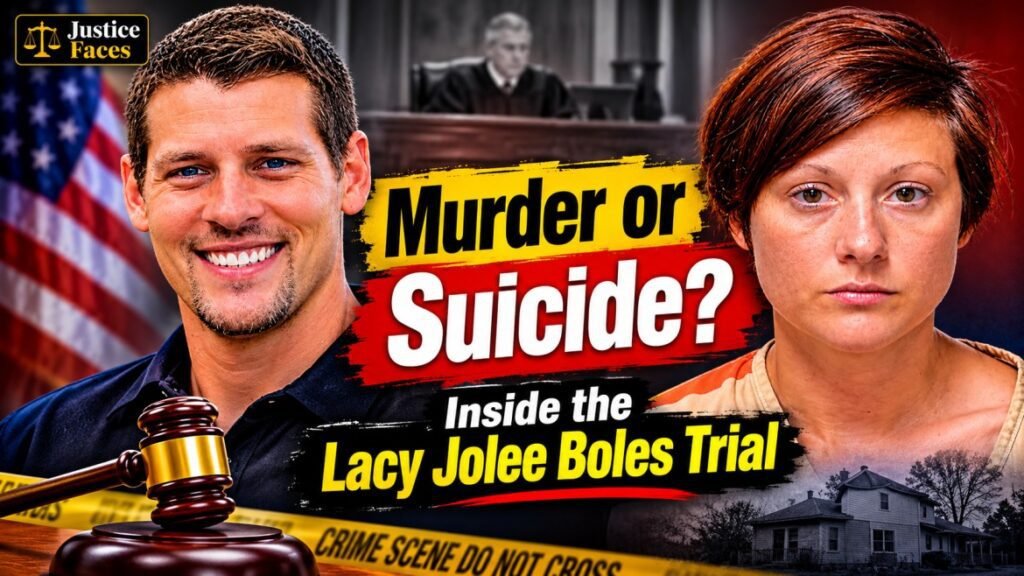
Murder or Suicide? Inside the Lacy Jolee Boles Trial
A man is dead in his own basement with a bullet through his left nostril. His wife says he did it to himself and that she grabbed for the gun when it went off. Prosecutors say she waited for him with a Swiffer mop propped against the door and then staged a suicide.
That is the core dispute in the Lacy Jolee Boles trial, now in its second week in Paulding County, Georgia. Boles, 43, has pleaded not guilty to malice murder, felony murder and aggravated assault in the December 2019 death of her husband, Daniel Akers, 36. She was arrested in June 2020, and the case took nearly seven years to reach a jury.
Days 4, 5 and 6 changed the shape of the trial. The defense went on offense, the State’s forensic witnesses admitted what their tests can’t prove, and a medical examiner gave Boles’ lawyer the sentence he had been working toward. By the end, the prosecution had rested.
If you’re catching up on the Georgia murder trial 2026 coverage, here is what happened and why it matters. The daily recaps we publish at JusticeFaces follow the same approach we used in our Faith Hedgepeth trial coverage: what was said, what it proves, and what it doesn’t.
Day 4 (November 16): The Defense Strikes Back
Brian Steel’s Cross-Examination of Detective Hardy
Defense attorney Brian Steel spent the day taking apart the State’s cover-up narrative. The prosecution had built that narrative on five points, including the movement of the gun, a left-hand versus right-hand discrepancy, and a safe key. Steel challenged them one at a time through Detective Hardy.
He also replayed the 911 call. His argument was that the call sounds like genuine terror and shock, not a rehearsed performance. A jury that hears panic is less likely to believe in a staged scene, which is why this mattered. The call and the first minutes after it were also central to the State’s opening, as WSB-TV reported.
What the Medical Examiner Was Never Told
The most damaging line of questioning concerned what detectives did not share with the medical examiner. According to the defense, the examiner never heard about:
- Akers’ financial struggles
- His probation violation and the possibility of jail time
- The unraveling of his marriage
- Signs of depression
Instead, the defense said, the examiner was allegedly told Akers was “extremely happy” and “advancing at work.” If that’s true, the homicide classification rested on a picture of Akers that the defense says was incomplete.
The timeline makes the point sharper. The GBI medical examiner’s report came back on May 29, 2020 and found the wound was not self-inflicted. Steel’s question to the jury is simple: what would a pathologist have concluded with the full story?
The Text Messages
The court also saw new text messages. They showed a strained marriage and a man who appeared to be struggling. They gave the defense’s suicide argument something it needs badly, which is a reason Akers might have been in crisis that night.
This is also the groundwork for the defense’s explanation of the Swiffer. Steel says Boles had texted Akers not to come home and used the mop as a warning system, not a trap. A mop against a door can be read either way, and the texts are what tip it toward the defense’s reading.
Tension in the Courtroom
The day ended with heat. The defense accused the prosecution of knowingly eliciting misleading testimony about Akers’ probation status. A prosecutor then invited Steel to “settle it outside” by the courthouse Christmas tree.
Judge Dean Bucci scolded both lawyers and warned them. TMZ’s account says the exchange began when Steel accused prosecutor Jason Treadaway of misleading the jury. Whatever happened outside, the jury had just watched the lawyers’ tempers flare over the question of what Akers’ probation record means.
Day 5 (November 17): The State’s Forensic Marathon
Gunshot Residue, Toxicology and a Critical Concession
The State’s own gunshot residue expert testified that a GSR test cannot tell you who fired a gun. It can show that residue is present. It cannot separate the shooter from someone standing close by.
That matters because Boles was in the basement during the shooting, by her own account. If both people could carry residue, the test can’t settle who held the weapon. The prosecution called the witness, and the defense got a favorable answer from the State’s own expert.
Two toxicologists followed. Akers’ blood alcohol level was 0.068, below the legal driving limit, and trace amounts of amphetamine were found. Neither finding explains the shooting, but together they show a man who had been drinking and had a substance in his system on a night when, the defense says, he was in distress.
The Phone and the Search History
A phone examiner read through Akers’ search history line by line. For the defense, a search history is a window into state of mind. For the State, it is one more piece of data that doesn’t directly show who pulled the trigger.
BlueStar and Firearms Analysis
Jurors also heard about BlueStar testing on the gun safe and the holster. BlueStar is a chemical reagent used to detect traces of blood. A GBI firearms examiner then testified about the weapon. Both witnesses were part of the State’s effort to show the scene didn’t match the suicide story.
What the Investigation Never Did
The cross-examinations drew out several tests that were never performed:
- No trigger DNA swab was taken
- Boles’ hands were never tested for residue
- The holster was not lab-tested
Every one of those gaps will likely appear in the defense’s closing. When a case rests on circumstantial evidence, the tests nobody ran become part of the argument.
The 2002 Evidence the Jury Never Heard
The defense tried to introduce a 2002 case involving Akers and a friend. The aim was to challenge the idea that he was unfamiliar with firearms. Judge Bucci ruled it inadmissible, so the jury will not hear it.
Three people who knew Akers also testified: a friend, his niece, and her husband. The State used them to show who he was, and the defense used them to probe the same question from another side. The full proceedings are available in the Day 5 transcript on Rev.
Day 6 (November 18): The Medical Examiner’s Concession
“I Can’t Rule Out That Possibility”
Dr. Keith Lehman, a GBI forensic pathologist, performed the autopsy and classified the death as homicide. He found no soot and no stippling. Those marks come from gunpowder burning and scattering at close range, so their absence told him the muzzle was at least a foot from the skin.
The bullet entered through Akers’ left nostril and traveled into his brain. That distance is the heart of the State’s medical case, because it argues against a self-inflicted contact wound.
Then Steel cross-examined him. He asked whether Dr. Lehman understood that this could have been a suicide with an accidental component, meaning someone trying to stop a person from killing themselves when the gun went off. Dr. Lehman answered:
“I can’t rule out that possibility.”
The Toy Gun Demonstration
Steel then had Dr. Lehman step down from the witness stand. Using a toy gun, Steel placed the tip of the barrel in his own nose and had the examiner grab his arm. It was a physical demonstration of how a weapon could discharge during a struggle.
Whether it persuaded anyone is for the jury to decide. But it gave jurors an image to hold alongside a pathologist’s words. A homicide ruling and an accidental discharge during a struggle are not the same thing to a jury, even if the wound looks the same.
The Strategy Behind the Concession
The defense’s approach is easy to see in hindsight. It never needed Dr. Lehman to say Akers killed himself. It needed him to admit that his forensic findings don’t rule out the defense’s account.
That’s a narrower and more realistic goal. The medical evidence says the muzzle was not touching the skin. It does not say who was holding the gun or why.
The State’s Last Witness
The prosecution’s final witness was a childhood friend of Akers. She testified that she saw him at a bar on the night he died. He was “smiling” and “happy” and drinking water because he planned to drive home.
After her testimony the State rested. The Day 6 transcript on Rev has the full record.
What Comes Next in the Boles Trial
The week left a trial built on contrasts. The State has a death ruled a homicide, a mop at a door, and inconsistencies about which hand held the gun. The defense has gaps in the forensic work and a medical examiner who couldn’t rule out a struggle.
The defense case begins when the trial resumes. Expect Steel to lean on the text messages, Akers’ legal and financial pressure, and the untested evidence. He will also have to explain the Swiffer to a jury that has heard it called a booby trap since opening statements.
The case has already survived delays, including a postponement over a prospective juror who researched the case online. The jury now has to answer a question that years of investigation haven’t settled. Was this a woman who ambushed her husband, or a woman who tried to save him and lost?
Behind the forensic terms is a family that lost a son, a husband and a father. And a woman faces life in prison on evidence that can’t tell us who held the gun. In the end, the jury will have to decide what reasonable doubt means when the one person who knows is gone.