
On January 15, 2013, New York’s chief judge announced that a Brooklyn justice would be sent to the Bronx to take on the worst felony backlog in the city. Fourteen months later, the same justice gave up her seat to argue about unpaid loans and damaged cars on daytime television.
Both of those people are Patricia DiMango. For nearly two decades she was a working criminal court judge in New York City, finishing as a New York State Supreme Court justice and the administrative judge for criminal cases in Brooklyn. Since 2014 she has been a television arbitrator, first on Hot Bench and now on Tribunal Justice, both created by Judy Sheindlin.
This Judge Patricia DiMango biography keeps those two careers separate, sets out what the public record shows about her family and background, and says plainly where that record stops. Questions about her husband, her age and her net worth get direct answers below, including the ones where the honest answer is that nobody outside her family has established the facts.
Who Is Judge Patricia DiMango?
Patricia Mafalda DiMango is a retired justice of the New York State Supreme Court in Kings County, which is the borough of Brooklyn. The name of that court confuses people. In New York, the Supreme Court is the main trial court, where felony cases are tried. The state’s highest court is the Court of Appeals.
According to her mediation firm biography, she was appointed to the New York City Criminal Court in 1995, became an Acting Supreme Court Justice in 1998, and was elected to the Supreme Court in 2002. Ballotpedia’s judicial record lists her retirement date as March 31, 2014.
Television came after all of that. She sat on Hot Bench from 2014 to 2022 and has been on Tribunal Justice since 2023. She also works as a private mediator in New York.
Quick facts
| Full name | Patricia Mafalda DiMango (Patricia M. DiMango in official records) |
| Born | Brooklyn, New York. Year widely reported as 1953. Exact date not confirmed by any official source |
| Raised | Dyker Heights, Brooklyn |
| Parents | Mafalda DiMango (1926 to 2018) and Dr. Anthony DiMango |
| Sibling | Joanne DiMango-Orr |
| Education | B.S. cum laude, Brooklyn College (class of 1973); M.A., Columbia University Teachers College; J.D., St. John’s University School of Law (class of 1980) |
| Before the bench | New York City public school teacher; Assistant District Attorney, Kings County; Special Assistant U.S. Attorney, Eastern District of New York |
| Judicial service | New York City Criminal Court, 1995 to 1998; Acting Supreme Court Justice, 1998 to 2002; Justice, New York State Supreme Court, Kings County, 2002 to 2014 |
| Final judicial post | Administrative Judge, Supreme Court, Criminal Term, Kings County |
| Television | Hot Bench (2014 to 2022); Tribunal Justice (2023 to present); Justice on Trial (2025) |
| Current work | Television arbitrator; mediator with Mediation Solutions of NY |
| Marital status | Not publicly confirmed |
| Children | None publicly documented |
| Net worth | No verified figure exists |
Patricia DiMango’s Early Life and Family Background

DiMango grew up in Dyker Heights, a residential neighborhood in southwest Brooklyn. Her family’s story is better documented than most biography pages suggest, because her mother was a public figure in her own right.
Mafalda DiMango was born in Salerno, Italy, on October 21, 1926, and came to Brooklyn as a small child. She attended P.S. 204, New Utrecht High School and Brooklyn College, then spent more than 30 years on the local school board and its successor council. When she died on August 2, 2018, at 91, the Brooklyn Home Reporter’s obituary identified her husband of 68 years as Dr. Anthony DiMango, a retired dentist, and her daughters as Patricia and Joanne DiMango-Orr, a retired educator. The auditorium at P.S. 204 carries her name.
The same reporting shows that both daughters attended P.S. 204 and that their mother led its parent-teacher association from 1963 to 1965. It was a household organized around schools. That is context, not a motive. Nothing on the record says why Patricia DiMango chose teaching first, and claims on other sites that she wanted to be a lawyer from childhood have no source behind them.
Patricia DiMango’s Education
She earned three degrees, in an order that says something about how her career unfolded.
- Brooklyn College. A bachelor’s degree, cum laude, in psychology and education. The college’s alumni magazine lists her as class of 1973.
- Columbia University Teachers College. A master’s degree in developmental psychology, completed while she was already working as a teacher.
- St. John’s University School of Law. A Juris Doctor. St. John’s identifies her as class of 1980, and her official biographies say she finished near the top of her class with academic awards and scholarships.

A psychology degree, a graduate degree in how children develop, and then law school is an unusual route to a criminal bench. It became relevant later. Reporters who watched her in court described a judge who spoke to defendants about their lives, not only their charges.
From School Teacher to Criminal Court Judge
After college DiMango taught in New York City public elementary schools. Her CBS Media Ventures biography says she concentrated on special education for children with emotional and cognitive needs.
Law school changed her direction. She spent five and a half years as an Assistant District Attorney in the Kings County District Attorney’s Office, the agency that prosecutes crime in Brooklyn. During that time she was cross-designated as a Special Assistant United States Attorney for the Eastern District of New York. In practice, that designation lets a local prosecutor handle cases in federal court.
She then worked as a law clerk to three Supreme Court justices in Brooklyn and Queens, and volunteered as a small claims arbitrator. That last detail is easy to skip, but small claims arbitration is exactly what she would later do on television.
She also taught law. Her biographies credit her with about ten years as an adjunct associate professor at St. John’s, covering criminal law, criminal procedure, legal writing and forensic psychology, followed by teaching at New York City Technical College. Neither biography dates this work, and one places it after her retirement from the bench, which does not fit the timeline. It is reported here without dates for that reason.
Patricia DiMango’s Judicial Career in New York
In 1995, Mayor Rudolph Giuliani appointed DiMango a judge of the New York City Criminal Court, which handles arraignments and misdemeanors. Three years later she was designated an Acting Supreme Court Justice, a status that allows a lower-court judge to preside over felony cases. In 2002 voters elected her to the Supreme Court outright.
Her official biographies describe her as the first Italian-American woman appointed to the Criminal Court and the first elected to her Supreme Court seat. Those statements appear in both the CBS and mediation-firm biographies. No independent court-system record confirming or contradicting them turned up in research for this article, so they are best read as widely repeated official claims.
The same biographies say she presided over trials involving the murders of young children, crimes against children and hate-crime killings, and that more than a dozen of her decisions were published. This article does not attach specific trials to her name beyond what the reporting cited here documents.
By the early 2010s she was the deputy administrative judge for criminal matters in Brooklyn. Inside the courthouse she had a nickname. Jennifer Gonnerman later reported in The New Yorker that people at the Brooklyn courthouse called her Judge Judy, before she had ever appeared on television.
For a sense of what a felony docket looks like in a working courtroom today, see our profile of Texas District Judge Raquel West.
Her Work in the Bronx and the Criminal Court Backlog
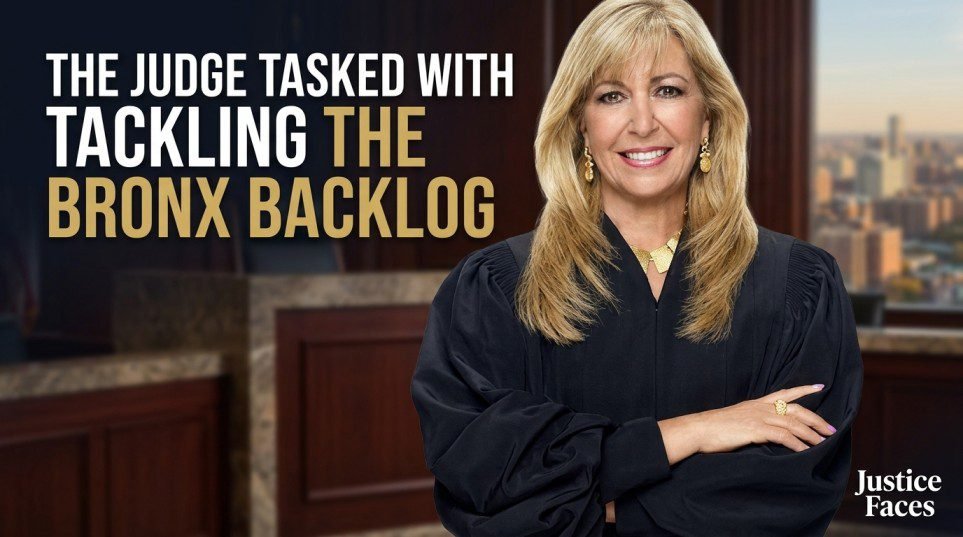
Why the Bronx was in trouble
New York’s court system expects a felony case to be resolved within about six months. By the end of 2012, the Bronx was nowhere close. Court administration figures reported by the Brooklyn Daily Eagle showed 3,690 Bronx criminal cases older than 180 days, and 931 older than two years. Brooklyn, a larger borough, had 150 cases past the two-year mark.
Delay on that scale is not an administrative inconvenience. Defendants who cannot make bail wait in jail, often on Rikers Island, without having been convicted of anything. Witnesses move away. Victims wait years for an outcome.
What DiMango was sent to do
On January 15, 2013, Chief Judge Jonathan Lippman announced that outside judges would be assigned to the Bronx temporarily. DNAinfo’s report explains that they would work through a new “blockbuster part” led by DiMango. A part is New York courthouse language for a courtroom and its calendar.
Her assignment was specific. She would take the oldest felony cases, try to negotiate guilty pleas where that was possible, and send the rest out for trial.
What the record shows
The numbers moved quickly. In October 2013, The New York World reported that she had closed just over 600 cases in nine months and that the count of cases older than two years had fallen from about 900 to under 500. That December, court officials said the oldest backlog had been cut by more than half and that the median age of a pending Bronx felony had dropped from 371 days to 273.
The method drew criticism from the start. Bronx public defenders told The New York World that her habit of addressing defendants directly put emotional pressure on people to plead guilty. DiMango rejected that. “I try to scare them straight,” she told the outlet, adding that she did not want to coerce anyone. Robin Steinberg of The Bronx Defenders had already called the use of visiting judges “window dressing” that left deeper causes of delay untouched.
The Kalief Browder case
One case from that courtroom became nationally known. Kalief Browder was arrested in May 2010, at 16, accused of taking a backpack. He was held on Rikers Island for roughly three years, much of it in solitary confinement, and was never tried.
Gonnerman’s account, republished by the Pulitzer Prize board when it was named a 2015 finalist, records that Browder had already appeared before eight judges when his case reached DiMango on March 13, 2013. She offered him a plea to two misdemeanors that would have sent him home that day on time served. He refused. “I want to go to trial,” he said.
On May 29, 2013, she told him prosecutors could no longer proceed and ordered his release. The charges were dismissed the following week. Browder died by suicide in June 2015.
Two things are true at once. The years of delay happened before DiMango ever saw the file, and the case ended in her courtroom. The plea she offered was also the tool her court was built to use, which is why the case is cited by both defenders and critics of the Bronx initiative. It is one case among roughly a thousand she handled that year, and it should not stand in for a whole career.
When the assignment ended she returned to Brooklyn as Administrative Judge for criminal matters, the senior supervisory post in that court. She would not hold it for long.
How Patricia DiMango Joined Hot Bench
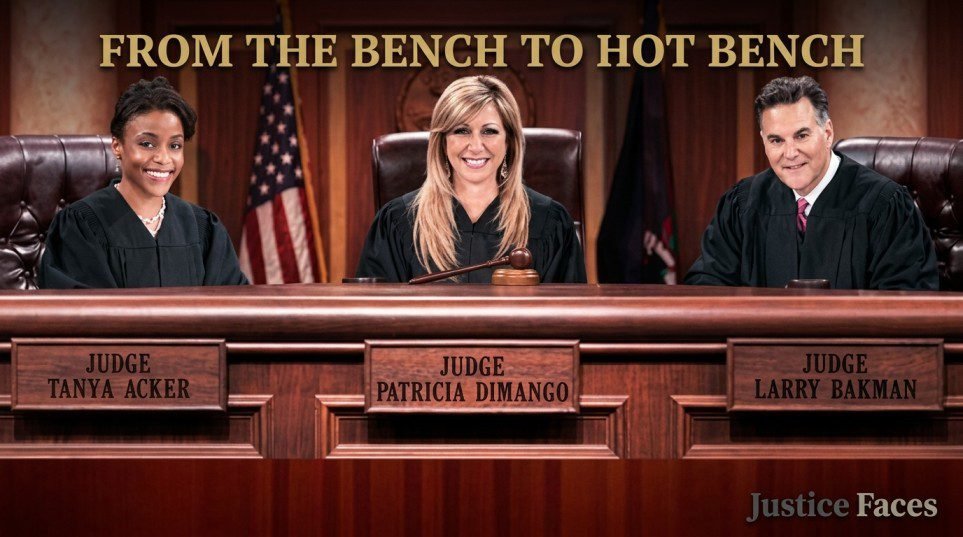
Judy Sheindlin built Hot Bench around an idea she picked up abroad: three judges hearing one case together, a format she had watched in an Irish courtroom. Our Judge Judy biography covers how that show grew out of her production company. The title is a legal term for a panel that questions the parties actively instead of sitting back.
She needed judges who could do that on camera. According to an alumni profile in Brooklyn College Magazine, Sheindlin called contacts in New York asking for a younger version of herself. A Queens Courier column from November 2014 names the contact as Dennis Quirk, head of the state court officers’ union, and gives her question: “Do you know of anyone like me in New York?” He suggested DiMango.
DiMango told the magazine she assumed the first call was a joke. Then Sheindlin rang herself. “This is the queen of TV and she was on my phone,” DiMango recalled. Asked to fly to Los Angeles that Thursday, she answered that she had cases to hear. They settled on Friday.
The move became public in January 2014. A New York Law Journal report, reproduced by St. John’s, noted that she had been Brooklyn’s administrative judge for criminal matters for about three weeks. She left the bench on March 31.
Hot Bench premiered in syndication on September 15, 2014. The first panel was DiMango, Los Angeles litigator Tanya Acker and defense attorney Larry Bakman. Former New York judge Michael Corriero replaced Bakman in 2016. The three heard each small claims dispute together, stepped away to argue it out on camera, and ruled by majority.
Is Patricia DiMango a real judge on television?
She was a real judge for 19 years. On television she is an arbitrator. The people who appear sign a contract agreeing to accept the panel’s decision, and the ruling binds them because of that contract, not because of any state court. Our explainer on how TV court shows legally work walks through the mechanics.
What sets her apart within the genre is where she came from. Like Greg Mathis, who left a Detroit district court for television, she gave up an actual judgeship. Other television judges, Cristina Perez among them, arrived from law practice.
DiMango stayed for eight seasons. She and Acker left in 2022, and new judges Yodit Tewolde and Rachel Juarez took their seats on October 31 of that year. Trade coverage at the time reported no dispute. The two were leaving for Sheindlin’s next show.
Patricia DiMango on Tribunal Justice

Amazon ordered that next show in April 2022 for Freevee, its free streaming service, under the working title Tribunal. It premiered as Tribunal Justice on June 9, 2023.
The panel was DiMango, Acker and Adam Levy, a former Putnam County district attorney who is also Sheindlin’s son. Petri Hawkins Byrd, the bailiff from Judge Judy, joined them.
The format will be familiar to anyone who watched Hot Bench. Three judges hear a real small claims dispute, deliberate in front of the cameras and decide by majority. The differences are mostly about delivery.
- Platform. Hot Bench is a broadcast show sold to local stations by CBS Media Ventures. Tribunal Justice is an Amazon original made for streaming.
- Schedule. Tribunal Justice arrives in seasons, with new episodes released each weekday while a season runs.
- Cast. Hot Bench continued with new judges. DiMango and Acker carried their on-screen partnership to the new series.
Season 2 followed in 2025, by which point Amazon had wound down Freevee and moved the series to Prime Video. Season 3 opened on March 2, 2026, according to TV Insider, and ran 80 episodes through June 19. Prime Video carries the show in the United States, the United Kingdom and Germany.
In 2025 the same three judges also appeared in Justice on Trial, a Sheindlin series for Prime Video that re-creates landmark cases. They served as its appellate panel.
Is Patricia DiMango still on Tribunal Justice?
As of November 10, 2026, she is part of the show’s most recent season and nothing indicates she has left. The panel itself has changed. In March 2026, CBS Media Ventures announced that Levy would front his own syndicated program, Adam’s Law, which began on September 14. He departed Tribunal Justice after Season 3.
No announcement of a fourth season or of a judge to replace Levy could be found. This page will be updated when one is made.
What Is Patricia DiMango Doing Now?
She is doing three things.
Television. She remains a Tribunal Justice judge, as described above.
Mediation. On November 13, 2023, Mediation Solutions of NY announced that she had joined its panel to handle matrimonial and family law disputes. She works virtually or from the firm’s New York City, Westhampton and Southampton offices. Mediation is not arbitration. A mediator helps two sides reach their own agreement and imposes nothing. One of the firm’s founders is A. Gail Prudenti, who as the state’s chief administrative judge publicly credited DiMango’s Bronx results in 2013.
Public appearances. She continues to give interviews and appear on podcasts about the law and her career.
She is retired from the bench. She is not retired.
Is Patricia DiMango Married? Husband and Relationship Status
Patricia DiMango’s marital status is not publicly established, and no reliable source identifies a husband.
Neither of her official biographies mentions a spouse. Local coverage of her family names her parents and her sister and does not refer to a partner, which settles nothing either way.
What circulates online is contradictory. Some sites say she has never married. Others describe a current marriage to an unnamed, supportive husband. Several say she was married once and divorced, and attribute that to a 2011 New York Times profile. JusticeFaces could not open that article to check the wording, so the claim is reported here as unconfirmed.
The ring that viewers ask about falls into the same category. She wears jewelry on camera. No statement from her or her representatives explains what any of it signifies, and guessing would not be reporting.
Does Patricia DiMango Have Children?
No children are publicly documented. Her biographies, her interviews and the reporting on her family do not mention any.
That is a statement about the record, not about her life. A person who keeps her private life private leaves no trail to confirm or rule out. Pages that describe her as a mother, or that explain why she “chose” not to have children, cite nothing.
Patricia DiMango’s Ethnicity, Age and Personal Background
Ethnicity
She is Italian-American. Her mother was born in Salerno, in southern Italy, and the family settled in a part of Brooklyn long associated with Italian immigration. Italian-American organizations have honored her repeatedly. She was Grand Marshal of the Brooklyn Columbus Day Parade in 2015 and the Italian Charities of America’s Woman of the Year in 2016.
How old is Patricia DiMango?
Her birth year is widely given as 1953, which would make her 73 in 2026. The exact date is not confirmed. Wikipedia lists May 19, on the strength of a biography website. Other pages say June 19. No court record, official biography or interview reviewed for this article states either.
The year itself is plausible. A 1973 college graduation and a 1980 law degree fit someone born in the early 1950s. On that basis she was about 61 when Hot Bench began and close to 70 when she left it.
Where does Patricia DiMango live?
She is a lifelong New Yorker whose mediation work is based in the state. During her Hot Bench years, when the show taped in Los Angeles, both her alumni magazine and the Queens Courier described her as bicoastal. Her current home is not public, and this article does not publish addresses or neighborhoods.
Patricia DiMango Net Worth: What Is Actually Known?
There is no verified net worth figure for Patricia DiMango. Numbers online range from $1 million to $3 million, and none traces to a filing, a contract or a named source.
It helps to separate the pieces.
- Judicial salary. This part is public. New York Supreme Court justices were paid $136,700 a year from 1999 until 2012. Raises then took the figure to $160,000 in 2012, $167,000 in 2013 and $174,000 on April 1, 2014. DiMango’s last day on the bench was the day before that final step.
- Television pay. Her contracts with CBS and Amazon are private. No reliable figure has been reported.
- Mediation income. Private, and dependent on how many cases she takes.
- Assets. Nothing is documented. Claims about property and cars on other sites are unsourced.
A long public-sector career followed by twelve years on national television suggests financial comfort. Putting a dollar figure on it would be invention.
Is Patricia DiMango Related to Judge Judy?
No. Their relationship is professional. Sheindlin created both of DiMango’s television shows and chose her for the first one.
The confusion has understandable sources. Both women are Brooklyn-born former New York judges with a blunt courtroom manner. DiMango carried the nickname Judge Judy before she was ever on television. And for three seasons she shared a bench with Sheindlin’s son.
Patricia DiMango’s Legacy Beyond Television
DiMango’s career has had five stages: teacher, prosecutor, judge, television arbitrator and mediator. The common thread is a preference for speaking to people directly and resolving disputes quickly.
That approach has admirers and critics, and the Bronx year gave both their best evidence. Court administrators point to hundreds of long-stalled cases finally closed. Public defenders point to the pressure that fast plea bargaining puts on people who have already waited years in jail. A fair account of her record holds both.
Television made her recognizable. It did not make her a judge. Any Judge Patricia DiMango biography that begins with Hot Bench starts nineteen years too late.
Frequently Asked Questions About Patricia DiMango
What court did Patricia DiMango serve in?
The New York City Criminal Court from 1995, then the New York State Supreme Court in Kings County, first as an acting justice and from 2002 as an elected one. She spent 2013 on assignment in the Bronx.
Why did Patricia DiMango leave Hot Bench?
She left after the 2021 to 2022 season to join Tribunal Justice, a new show from the same creator. No conflict was reported.
Which TV judge is not a real judge?
It depends on the show. On Tribunal Justice, DiMango is the only panelist who held a full-time elected judgeship. Acker served as a temporary judge in Los Angeles, and Levy was a prosecutor. Some online “judges” are actors, as our report on Judge Porter explains.
Does Patricia DiMango wear a wig, and what is the ring she wears?
No reliable source addresses either question, and she has made no public statement about them. JusticeFaces does not speculate about a person’s appearance.
Has Patricia DiMango won any awards?
Yes. Her official biographies list Brooklyn College’s Alumna of the Year award in 2012 and several Woman of the Year honors from New York court officers’ associations and civic groups.