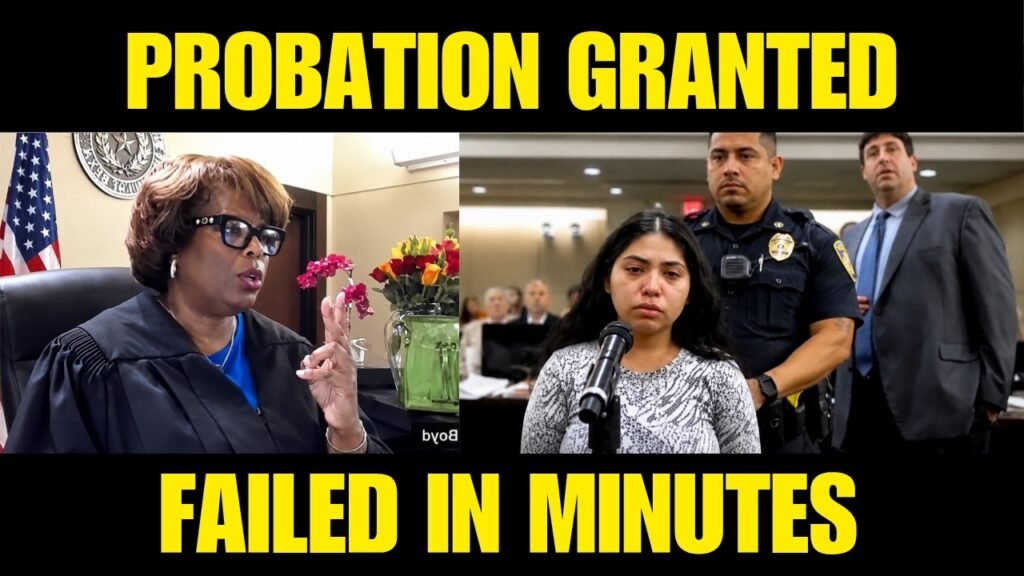
A plea agreement can offer a defendant an opportunity to avoid an immediate conviction, but that opportunity comes with conditions. In a reported hearing before Judge Stephanie Boyd in Bexar County, Texas, those conditions became the focus of an unexpected courtroom development involving a baseline drug test.
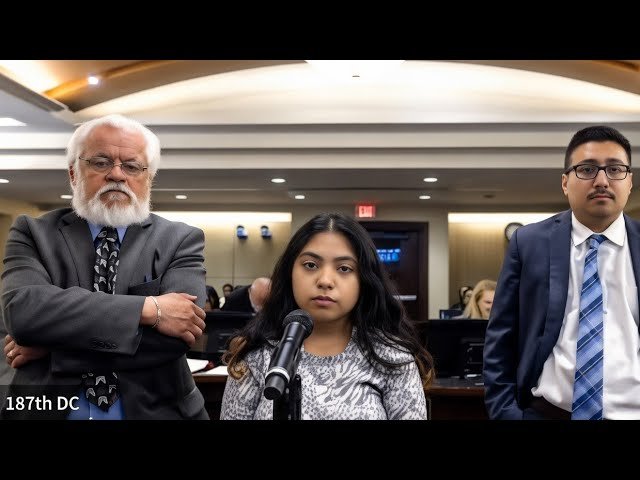
According to the supplied account of the proceedings, Gabriella Sanchez, who was 19 at the time, appeared before the court in connection with a second-degree felony charge of aggravated assault with a deadly weapon. The proposed resolution involved ten years of deferred adjudication community supervision, along with financial obligations and other conditions.
During the hearing, Sanchez reportedly disclosed marijuana use when questioned about drug testing. After the agreement was signed, a baseline test allegedly returned a positive result for cocaine as well. The result prompted further questions about her earlier disclosure and the conditions attached to the proposed arrangement.
The episode raises several important questions. What does deferred adjudication mean under Texas law? How can a drug-test result affect community supervision? And what happens when information disclosed during a plea hearing differs from a subsequent test result?
Understanding the answers requires separating the reported courtroom events from the legal consequences that might follow.
The Gabriella Sanchez Case: Charges and Courtroom Background
The supplied account identifies the proceeding as State of Texas v. Gabriella Sanchez, case number 2023CR3050A, with a related matter listed as 2023CR3051B.
The principal charge was aggravated assault with a deadly weapon, classified generally as a second-degree felony under Section 22.02 of the Texas Penal Code. The statute defines aggravated assault to include causing serious bodily injury or using or exhibiting a deadly weapon during an assault. Certain circumstances can elevate the offense to a first-degree felony. Read the official Texas Penal Code, Chapter 22.
The supplied article also names Jose Caceres, Miguel Rosas and Ashley Almeida as complainants and identifies restitution as part of the reported agreement.
However, the account does not establish the complete circumstances of the underlying alleged assault, the specific weapon involved or the full evidence relating to the complainants. Those details should not be inferred from the charge alone.
This distinction matters because a criminal charge describes the alleged offense, not every fact needed to reconstruct the incident.
Who Is Gabriella Sanchez?
According to the supplied hearing account, Sanchez was 19 years old when she appeared before Judge Boyd.

During the reported proceedings, she described her personal circumstances, including unemployment, financial dependence on her boyfriend and a difficult relationship with her parents. She also discussed an interest in performing arts and theater, along with money saved for college.
These details reportedly became relevant when the judge discussed the possibility of replacing community service with educational enrollment.
The account identifies Mick Aguilera as the attorney appearing for Sanchez in place of lead defense counsel Lorraine Efron. Casey Green represented the State of Texas.
The available account does not provide enough independently verified information to establish Sanchez’s broader personal history or the final outcome of her case. The focus here is therefore on the hearing as described, rather than assumptions about her character or intentions.
What Is Deferred Adjudication in Texas?
Deferred adjudication is a form of community supervision available in qualifying Texas criminal cases. Instead of immediately entering an adjudication of guilt, the judge may defer that determination and place the defendant under court-ordered supervision.
Under Article 42A.101 of the Texas Code of Criminal Procedure, a judge may grant deferred adjudication after receiving a guilty or no-contest plea, hearing the evidence and finding that the evidence substantiates guilt, subject to the law’s eligibility requirements. Read Chapter 42A of the Texas Code of Criminal Procedure.
The arrangement is conditional. A defendant must comply with the requirements imposed by the court throughout the supervision period.
Conditions can include drug testing, treatment, community service, restitution, restrictions on contact with specified individuals and other requirements permitted by law.
If the defendant successfully completes the supervision period without adjudication of guilt, the court generally dismisses the proceedings under the applicable statutory provisions. That does not mean the case automatically disappears from every public record.
What does a no-contest plea mean?
A plea of nolo contendere, commonly called a no-contest plea, allows a defendant to enter a plea without expressly admitting guilt in the same way as a guilty plea. In Texas, it can support deferred adjudication when the legal requirements are satisfied.
The precise consequences depend on the proceeding and applicable law. A no-contest plea should not be described as proof that every allegation has been independently established at a trial.
In Sanchez’s reported case, the supplied account states that she entered a no-contest plea and that the proposed agreement included ten years of deferred adjudication.
What conditions were reportedly included?
The supplied account lists the following proposed or agreed requirements:
- A $1,500 fine.
- Restitution for the three named complainants.
- 250 hours of community service.
- A substance abuse treatment evaluation.
- Anger management classes.
- A no-contact requirement involving the named complainants.
- Random monthly drug testing.
The account also states that Judge Boyd discussed the possibility of substituting full-time educational enrollment for the community service requirement.
These details should be checked against the signed order and hearing transcript before publication, particularly because the account describes a proposed educational alternative rather than conclusively establishing that the condition was formally changed.
Why Did Judge Stephanie Boyd Ask About Drug Use?

During the reported plea proceedings, Judge Boyd asked Sanchez what an immediate drug test would reveal.
According to the supplied account, Sanchez acknowledged marijuana use and said she did not use other substances. The judge reportedly explained that the supervision arrangement prohibited marijuana use.
Questions about substance use can be significant when a court is considering conditions of community supervision. A judge needs to understand relevant circumstances before imposing requirements that the defendant will be expected to follow.
But the distinction between a defendant’s statement, the judge’s explanation and the final written conditions is important. The exact terms of an order determine the obligations imposed in an individual case.
The original account states that the agreement was signed and that a baseline drug test was ordered before Sanchez left the courthouse.
A baseline test can document a person’s test results at the beginning of a supervision period. Its significance depends on the testing method, the substances tested, the applicable conditions and the circumstances in which the sample was collected.
The Reported Cocaine-Positive Result
The central development in the supplied account came when Sanchez was reportedly called back to the bench after the baseline test returned a positive cocaine result.
The account states that Sanchez denied using cocaine and maintained that she had used marijuana but no other drugs.
That created an apparent discrepancy between her earlier statement and the reported laboratory result. However, a positive result alone does not establish precisely how a substance entered a person’s system, whether the person knowingly consumed it or whether a particular statement was deliberately false.
Those questions require evidence and context. Depending on the circumstances, relevant issues might include the testing method, confirmatory testing, sample handling, possible exposure and the defendant’s explanation.
The supplied account says Judge Boyd discussed the possibility that an illicit drug supply could contain substances that a user did not knowingly consume.
That possibility should not be treated as an established explanation for Sanchez’s result. Without supporting evidence, it would be equally inappropriate to conclude that she knowingly used cocaine.
The legally relevant point is narrower: a reported positive test can raise questions about compliance, but its consequences depend on the evidence and the terms of the court’s order.
Can a Positive Drug Test Affect Deferred Adjudication?
Yes. A drug test may become relevant in determining whether a defendant has complied with court-ordered supervision, provided the result relates to an applicable condition and is properly considered in the proceedings.
Under Article 42A.108 of the Texas Code of Criminal Procedure, an alleged violation of deferred adjudication conditions can lead to proceedings in which the court considers whether to proceed with an adjudication of guilt on the original charge.
That does not mean every positive result automatically ends deferred adjudication.
The legal process may involve a violation allegation, a hearing and consideration of the evidence. The outcome depends on the circumstances, the governing law and the court’s determination.
If guilt is subsequently adjudicated, Article 42A.110 provides that punishment proceedings continue as though adjudication had not been deferred. The consequences can therefore be substantial.
For a second-degree felony, the general statutory punishment range is two to twenty years of imprisonment, with a possible fine of up to $10,000, subject to applicable statutory provisions and any factors affecting punishment. See the Texas Penal Code.
In Sanchez’s case, the supplied account does not establish that the State ultimately filed a motion to proceed with adjudication, that the court found a violation or that a prison sentence was imposed. Those outcomes should not be presented as facts without further records.
Judicial Discretion, Rehabilitation and Accountability
The reported hearing also illustrates a broader issue in criminal justice: how courts balance accountability with opportunities for rehabilitation.

According to the supplied account, Judge Boyd discussed Sanchez’s educational ambitions and considered whether college or trade-school enrollment could serve as an alternative to community service.
If accurately reflected in the transcript, that exchange would illustrate how a court may consider a defendant’s circumstances when determining appropriate supervision conditions.
At the same time, rehabilitation does not remove the obligation to comply with a court order. Deferred adjudication depends on the conditions imposed, and a court must address properly established violations according to the law.
Neither aspect should be reduced to a simple narrative of mercy or punishment. The legal framework allows for structured supervision, while also providing procedures for responding when compliance is disputed.
Readers interested in another example of deferred adjudication in a Texas courtroom can explore Justice Faces’ report, A Case Study in Felony Justice, Deferred Adjudication, and What Real Courtroom Accountability Looks Like. That article discusses a separate proceeding and should not be confused with the Sanchez case.
What Happened After the Hearing?
The supplied account leaves the final disposition of Sanchez’s case unresolved.
It describes the reported cocaine-positive result and discusses possible legal paths, including further proceedings or a revised supervision arrangement. However, it does not establish which, if any, of those possibilities ultimately occurred.
Without a subsequent court order, docket entry or reliable report documenting the outcome, it would be premature to say that Sanchez’s deferred adjudication was revoked, that guilt was adjudicated or that she received a prison sentence.
The distinction is particularly important in ongoing or incompletely documented criminal matters. A possible legal consequence is not the same as a court’s actual decision.
For readers following the proceedings, the most useful next step is to consult the relevant court records and any available subsequent hearing transcript.
The official 187th Criminal District Court page for Bexar County provides information about the court presided over by Judge Stephanie R. Boyd. It is a useful starting point for court-related information, although it does not by itself verify the specific events described in this article.
Frequently Asked Questions
Who is Judge Stephanie Boyd?
Judge Stephanie R. Boyd presides over the 187th Criminal District Court in Bexar County, Texas, according to the county’s official court page. Her courtroom proceedings concern criminal matters handled within that court’s jurisdiction.
What was Gabriella Sanchez charged with?
The supplied account identifies a second-degree felony charge of aggravated assault with a deadly weapon under Texas law. The complete facts of the underlying incident have not been independently established for this article.
What is deferred adjudication?
Deferred adjudication is a form of court-ordered community supervision in which a judge defers an adjudication of guilt, subject to statutory requirements and compliance with the imposed conditions.
Did Gabriella Sanchez test positive for cocaine?
The supplied account reports that a baseline drug test returned a positive cocaine result. The underlying laboratory report has not been independently verified here, so the result should be attributed to that account unless the original records are obtained.
Does a positive drug test automatically revoke probation in Texas?
No. A positive test does not, by itself, establish that deferred adjudication has been revoked. The applicable conditions, supporting evidence and legal proceedings matter.
Was Gabriella Sanchez sentenced to prison?
The supplied account does not establish a final prison sentence or a subsequent adjudication of guilt. A later court record would be needed to confirm the case’s disposition.
Conclusion
The reported Gabriella Sanchez hearing raises important questions about plea agreements, drug testing and the conditions attached to deferred adjudication in Texas.
A negotiated resolution can provide an opportunity to remain in the community, but it also creates obligations that the defendant must understand and follow. When a test result appears inconsistent with a statement made in court, the discrepancy may require careful examination rather than an immediate conclusion about intent or legal responsibility.
For Judge Stephanie Boyd’s reported proceedings, the key unanswered question is what happened after the baseline test. Until the subsequent court record is verified, the distinction between a reported test result, a possible violation and a final judicial decision must remain clear.
That distinction is central to accurate courtroom reporting: explain what the available record shows, identify what remains unknown and allow verified evidence, rather than dramatic assumptions, to determine the story.