A Pinellas County courtroom heard, for the first time in open court, the full timeline prosecutors say ends with a plastic surgeon killing the attorney who represented his opponents in a civil lawsuit. On September 14, 2026, the murder trial of Dr. Tomasz Kosowski began before Circuit Judge Joseph Bulone in Clearwater, Florida. There is no jury. Kosowski waived that right months earlier, which means Judge Bulone alone will decide whether the state has proven he killed Largo attorney Steven Cozzi.
Cozzi disappeared from his law office on March 21, 2023, and his body has never been found. Kosowski, an Ivy League-trained plastic surgeon, is representing himself at trial and faces the death penalty if convicted. Day one covered a formal inquiry into his decision to go without a lawyer, a lengthy prosecution opening statement, and the start of testimony from Cozzi’s husband, Michael Montgomery.
Case Background
The roots of this case sit in a civil lawsuit, not a criminal one. In May 2019, Kosowski sued the Laufer Institute of Plastic Surgery along with Dr. Laufer, Dr. Woolstein, and a former colleague named Jennifer Friend, alleging he had been wronged and demanding money.
Steven Cozzi, then a newer attorney at Blanchard Law in Largo, was assigned to the defense side of that lawsuit in 2018 after switching from family law. According to prosecutors, Cozzi became the lead attorney representing the wealthy corporate clients Kosowski was suing, and the litigation grew increasingly personal once Kosowski’s own lawyer withdrew in March 2022 and Kosowski began representing himself in the civil case as well.
By the time Cozzi vanished, prosecutors say, the case had produced discovery disputes serious enough that the presiding civil judge appointed a special master, along with motions from Kosowski specifically targeting Cozzi’s removal from the case. That backdrop, prosecutors argued, is where the motive for murder took shape.
What Happened During the Hearing
Before any testimony began, Judge Bulone conducted what is known as a Faretta inquiry, a formal on-the-record warning required whenever a defendant chooses to represent himself. The judge asked Kosowski a long series of questions about the disadvantages of self-representation, confirmed he understood the charges and potential penalties, and noted that Kosowski has standby counsel, attorneys Dani McNeil and Daniel Hernandez, available throughout the trial.
During that exchange, Kosowski corrected the judge on one point of his own biography. Judge Bulone referred to him attending “Dartmouth Law School,” and Kosowski clarified that he attended Dartmouth Medical School, not law school, before training as a plastic surgeon. He also told the court he holds a bachelor’s degree in biochemistry, a master’s in biomedical sciences, and an MBA.
The court then addressed several pretrial matters. A motion in limine limited any testimony from Judge Patricia Muscarella, who had presided over the underlying civil case, to her direct observations rather than her legal reasoning, citing judicial immunity. Prosecutor Mr. Vonderheid also confirmed that motions to suppress evidence, argued back in April 2025, had already been denied, and Judge Bulone noted that ruling is preserved for appeal regardless of the trial’s outcome.
With those issues resolved, both sides were offered the chance to make an opening statement. Assistant State Attorney Alexandra Spadaro delivered a lengthy opening for the prosecution. When his turn came, Kosowski declined to give one.
Key Testimony and Evidence
After a short recess, the state called its first witness: Michael Montgomery, Cozzi’s husband. His testimony on day one focused on establishing who Steven Cozzi was as a person before any evidence about his disappearance was introduced, a common prosecutorial strategy in cases without a recovered body.
Montgomery testified that he and Cozzi met online in 2018, married on October 17, 2020, and shared a home on Whitney Way in Clearwater at the time Cozzi disappeared. He described a close, trusting marriage, saying he never went through his husband’s phone and did not even know the passcode because he trusted him completely.
He also testified about Cozzi’s long-term sobriety, dating to September 2013, and his volunteer work mentoring other attorneys through a recovery-focused legal network. Montgomery described Cozzi as close with his parents, George and Lois, active as vice president of his homeowners association, and serving as chair of a diversity and inclusion committee for the St. Petersburg Bar. His testimony was ongoing when the transcript excerpt available for this article ends.
Spadaro’s opening statement previewed a much larger body of evidence the state intends to introduce over the coming days, including cell phone location data, surveillance video, DNA analysis, and physical items recovered during searches. None of that evidence was formally entered on day one. It was described to the court as a preview of what witnesses would establish later in the trial.
Prosecution’s Argument
Spadaro told the court that Cozzi, 41, vanished from his office bathroom on the morning of March 21, 2023, and that the evidence would show he was murdered there, his body loaded into a wagon, and ultimately disposed of at a landfill in Collier County. She argued the case built slowly out of the civil litigation, describing a pattern in which Kosowski repeatedly sought Cozzi’s removal from the lawsuit and grew personally hostile toward him.
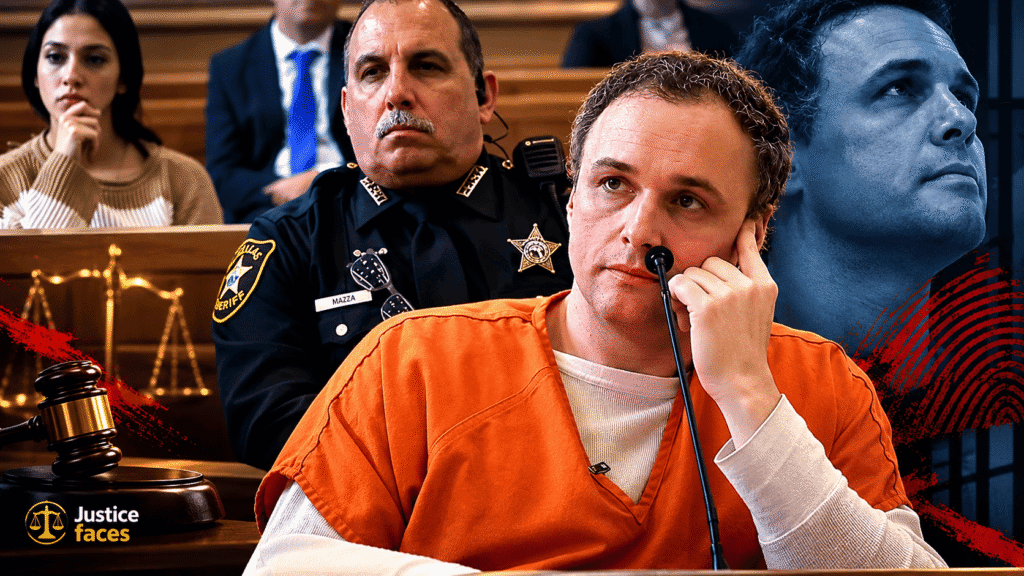
According to the state’s account, that hostility escalated into physical confrontation during a January 2023 deposition, when Kosowski allegedly followed Cozzi into the building’s small single-occupancy bathroom and called him a “scumbag.” Prosecutors say Kosowski then began surveilling Cozzi, including photographing his husband’s car outside their home in February 2023 and driving slow laps around the law firm’s parking lot while filming.
Spadaro also described a maintenance worker, Deborah Henrichs, who told investigators she found a man matching Kosowski’s description hiding inside an electrical closet at the building on March 14, 2023, dressed oddly and claiming to be dealing with a power outage that had not actually occurred. Prosecutors say a fingerprint lifted from inside that closet matched Kosowski, and that a wagon-style cart was later found hidden in the same space.
The state’s opening also covered cell phone searches it says Kosowski conducted in the days before Cozzi disappeared, including research into a paralytic drug called succinylcholine, and a minute-by-minute account of March 21, 2023, built from surveillance footage, door-alarm logs, and cell tower data. Spadaro told the court that a search of Kosowski’s car days later turned up Cozzi’s blood, a bag prosecutors described as containing a taser, brass knuckles, a crowbar, and a syringe, along with roughly $282,000 in cash and two passports.
Defense’s Argument
Kosowski did not present a defense theory on day one. He declined the opportunity to make an opening statement, and the trial’s first day did not include any cross-examination of witnesses, since Montgomery’s testimony was still underway with the prosecution when the available record ends.
That silence is itself notable given how the case has been framed publicly. Court filings from earlier in the case indicate the defense has raised the absence of a recovered body as a central issue, arguing that cause and manner of death cannot be established with certainty without physical remains. None of that argument was made on the record during day one, however, since Kosowski chose not to address the court beyond the procedural matters covered in the Faretta inquiry.
Judge’s Role and Key Statements
Judge Bulone’s role on day one was largely procedural but substantively important, since his questioning during the Faretta inquiry created the record that will make Kosowski’s self-representation legally binding for the remainder of the case. He repeatedly confirmed that Kosowski understood he would receive no special treatment from the court, that he would be held to the same evidentiary rules as a licensed attorney, and that a conviction could not later be appealed on the grounds of ineffective self-representation.
He also handled a series of last-minute discovery and scheduling issues raised by both the prosecution and Kosowski’s standby counsel before testimony began, including a proposed order limiting testimony from Judge Muscarella and paperwork memorializing the 2025 suppression rulings. None of Judge Bulone’s statements on day one addressed the merits of the case itself.
The Most Important Moments From the Hearing
A Defendant Corrects the Record
When Judge Bulone described Kosowski as a Dartmouth Law School graduate, Kosowski immediately corrected him, clarifying that his Dartmouth degree was in medicine. It was a small moment, but it underscored an unusual dynamic in this trial: a defendant with no legal training who has nonetheless chosen to argue his own capital case.
The Bathroom Confrontation
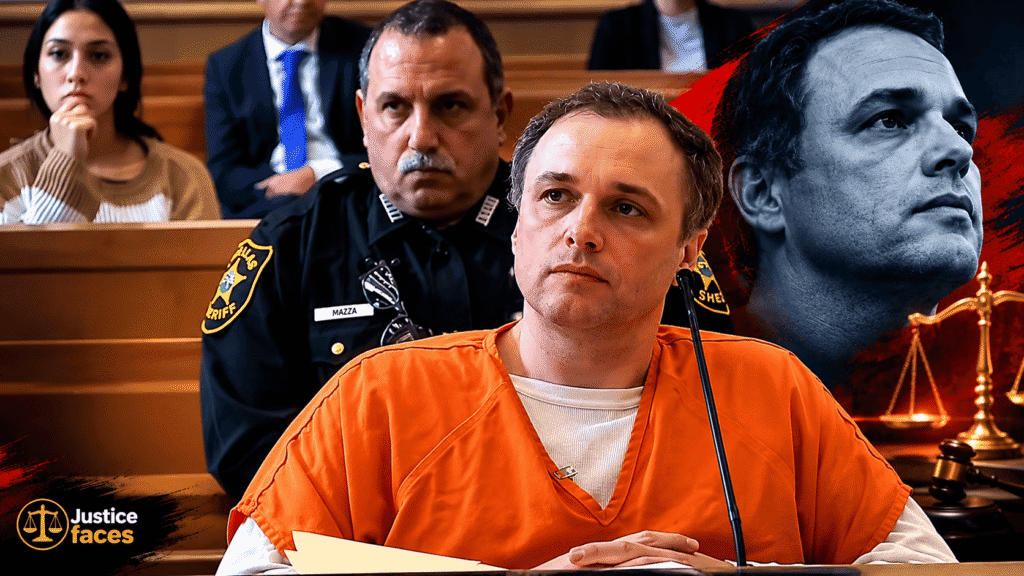
Prosecutors’ account of a January 2023 deposition break, during which Kosowski is alleged to have followed Cozzi into a cramped, one-stall bathroom and called him a “scumbag,” was one of the more pointed moments of the opening statement. Spadaro used it to argue that Kosowski was already familiarizing himself with the space where, prosecutors say, the killing would occur two months later.
No Opening, No Cross-Examination
Kosowski’s decision to skip an opening statement and remain silent through the start of Montgomery’s testimony set the tone for how he intends to run his defense, at least initially. Whether that reflects strategy or the practical limits of representing himself in a capital case is something only the coming days of trial will clarify.
Legal Issues Explained
Several legal concepts came up on day one that matter for understanding what follows. A Faretta inquiry, named after a 1975 U.S. Supreme Court case, is the process a judge must go through before letting a defendant waive counsel, ensuring the waiver is made knowingly and voluntarily. Kosowski also waived his right to a jury, meaning this is a bench trial in which Judge Bulone alone determines guilt.
Florida law does not require prosecutors to recover a body to prove murder. Under what is often called the corpus delicti rule, the state must instead prove three elements: that the person is dead, that the death was caused by the defendant’s criminal act, and that it was committed with premeditation. Spadaro explicitly walked the court through this standard near the end of her opening, signaling that the absence of Cozzi’s remains will be a central legal battleground throughout the trial.
The judicial immunity ruling limiting testimony from Judge Muscarella is also worth understanding. Judges generally cannot be questioned about the reasoning behind their rulings, only their firsthand observations, which is why the court granted a protective order in advance of her expected testimony.
What Happens Next
Day one closed with witness testimony still underway and much of the state’s evidentiary case, including DNA, cell phone forensics, and surveillance footage, still to come. Based on public reporting on the trial’s later days, the state went on to call additional witnesses covering digital evidence, forensic science, and the events surrounding the search for Cozzi, with Kosowski beginning to cross-examine witnesses only later in the trial. This article covers day one only; specific developments from later days are outside its scope.
Current Case Status
As of day one, Kosowski has been charged with first-degree murder and has not been convicted of any offense. He remains presumed innocent, and the case is being decided by a judge rather than a jury following his own waiver of that right. No plea, verdict, or ruling on guilt had been reached by the end of the day’s proceedings.
Frequently Asked Questions
What is the Tomasz Kosowski case about? Kosowski, a Florida plastic surgeon, is charged with first-degree murder in the 2023 disappearance and alleged killing of attorney Steven Cozzi, who represented Kosowski’s opponents in an earlier civil lawsuit.
Is there a jury in this trial? No. Kosowski waived his right to a jury trial, so Judge Joseph Bulone alone will decide the verdict.
Why is Kosowski representing himself? Kosowski chose to waive his right to court-appointed counsel. Judge Bulone conducted a formal Faretta inquiry on day one to confirm that decision was made knowingly and voluntarily, and standby counsel remains available to him throughout the trial.
Did the defense make an opening statement? No. Kosowski declined the opportunity to give an opening statement on day one.
Has Steven Cozzi’s body been found? No. His remains have never been recovered. Prosecutors argue Florida law does not require a body to prove murder, provided the state can establish death, causation, and premeditation by other evidence.
Who testified on day one? The only witness whose testimony began on day one was Michael Montgomery, Cozzi’s husband, who described their relationship, marriage, and Cozzi’s background.
What is Kosowski accused of doing? Prosecutors allege Kosowski killed Cozzi inside a law firm bathroom on March 21, 2023, moved his body using a wagon-style cart, and ultimately disposed of it at a landfill in Collier County.
What penalty does Kosowski face if convicted? Because he is charged with first-degree murder as a capital offense, a conviction would move the case into a penalty phase where the only two possible outcomes are death or life in prison without parole.
Conclusion
Day one of the Kosowski trial did not resolve any factual dispute, but it set the terms for everything that follows. A judge, not a jury, will weigh the evidence. A self-represented defendant chose silence over an opening statement. And prosecutors used their opening to lay out a detailed, months-long timeline they say proves premeditated murder despite the absence of a body, a theory the defense has not yet directly answered on the record.