
This report is based on Day 1 proceedings (November 11, 2026) in the ongoing Lacy Boles trial. Lacy Boles is presumed innocent unless and until proven guilty. Details may change as testimony continues.
Nearly seven years after Daniel Akers died from a gunshot wound in the basement of his Georgia home, a jury has finally heard the two stories it will have to choose between. The Lacy Boles trial opened on November 11, 2026, with prosecutors describing a planned killing dressed up as a suicide, and the defense describing a wife’s desperate attempt to stop one.
In this Day 1 breakdown of GA v. Lacy Boles, we cover both opening statements, explain the Georgia murder charges in plain English, look at why a mop and a “wrong hand” have become central pieces of evidence, and set out what the jury is expected to hear next.
Key Facts at a Glance
| Case | State of Georgia v. Lacy Jolee Boles (“Staged Murder Trial”) |
| Defendant | Lacy Jolee Boles, 43 |
| Victim | Daniel Akers, 36, her husband; worked for a sheet metal union |
| Charges | Malice murder, felony murder, aggravated assault (pleaded not guilty) |
| Incident date | Early hours of December 22, 2019 |
| Weapon | .22 caliber pistol |
| Key evidence | Swiffer mop placed by the door; which hand held the gun; 911 call |
| Prosecutor | Jason Treadaway |
| Defense attorney | Brian Steel |
| Bond | Free on $100,000 bond |
| Status | Trial ongoing; law enforcement and forensic witnesses expected |
The Prosecution’s Case: An “Ambush,” Then a Cover Story

Prosecutor Jason Treadaway told jurors that Boles “ambushed” and “executed” her husband after the couple argued about money. According to the state, Akers came home that night after stopping at a bar and a McDonald’s.
The prosecution says Boles shot Akers in the face with a .22 caliber pistol in the basement. The state then alleges she arranged the scene so it would look as if he had taken his own life.
Two pieces of evidence anchor the prosecution’s theory:
- The Swiffer mop. Prosecutors say a mop was set against the door as a kind of “booby trap” or alarm, so Boles would know the moment Akers walked in. The state presents this as evidence of planning, or premeditation.
- The gun hand. Boles told investigators Akers held the gun in his left hand. She also acknowledged that he was right-handed, and the gun was found near his right hand. The state treats this as a contradiction that undermines her account.
The Defense’s Case: A Suicide Intervention Gone Wrong

The Brian Steel defense offered jurors a very different picture. Steel, widely known for representing rapper Young Thug, told the jury the shooting was a tragic accident.
According to the defense, Boles followed Akers down to the basement and found him holding the gun to his mouth. Steel said Akers told her, “You can’t help me, no one can help me.” Boles then lunged for his arm, the defense says, and the gun went off as they struggled.
The defense also reframed the mop. In its account, the mop was a warning system, not a trap. Boles had texted Akers not to come home, and placed the mop by the door so she would know if he did.
To explain Akers’ state of mind, the defense pointed to pressures in his life:
- Financial difficulties
- A possible furlough from work
- The prospect of returning to prison for a parole violation
Legal Context: What Georgia’s Murder Charges Mean
Understanding the charges in the Lacy Boles trial helps explain why both sides are fighting so hard over small details. (See our explainer-style coverage of a recent Georgia murder appeal for how these charges play out after trial.)
Malice murder vs. felony murder
Under Georgia’s murder statute, O.C.G.A. § 16-5-1, malice murder means unlawfully causing another person’s death with “malice aforethought,” which can be express (a deliberate intent to kill) or implied from the circumstances. This is the charge where evidence of planning, such as the alleged mop alarm, matters most.
Felony murder works differently. It applies when someone causes a death while committing a felony, and the state does not have to prove malice. In a shooting case, the underlying felony is often aggravated assault under O.C.G.A. § 16-5-21, which covers assault with a deadly weapon. Prosecutors commonly charge both theories so the jury has more than one legal path to a verdict.
What “staging a scene” means as evidence
When prosecutors say a scene was staged, they are arguing that someone rearranged it to tell a false story. Staging is rarely proven by a single fact; it is usually built from circumstantial evidence, such as inconsistencies between a person’s account and the physical evidence. For comparison, read how prosecutors argued another alleged staged scene in the Caleb Flynn trial, and how an investigator testified about staging on Day 3 of that case.
Under the presumption of innocence, the burden stays on the state throughout. Boles does not have to prove the shooting was accidental.
Why the Key Evidence Matters
Opening statements are not evidence; they are each side’s road map of what it expects to prove. But the Day 1 openings showed exactly which facts both sides think will decide this Lacy Boles murder trial 2026.
The mop: premeditation or precaution?
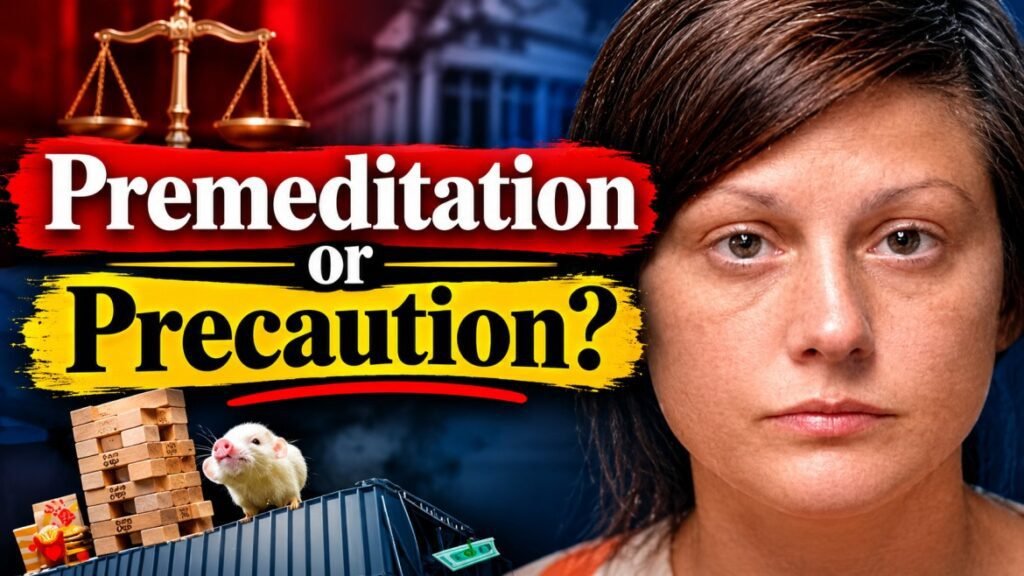
Both sides agree the mop was by the door. They disagree on why. For the prosecution, an alarm suggests Boles was waiting for Akers, which supports malice and planning. For the defense, a warning system paired with a text telling him to stay away suggests she wanted to avoid a confrontation, not start one. The jury may ultimately weigh that text message heavily.
The gun hand: inconsistency or confusion?
The state’s point is simple: a right-handed man described as holding a gun in his left hand, with the gun later found near his right hand, raises questions about Boles’ version. The defense theory of a struggle may offer an answer, since a gun can move during a fight over it. Expect forensic testimony on this point to be closely contested.
The 911 call
On the 911 call, Boles can be heard saying, “He shot himself.” The prosecution may present this as the start of a false narrative. The defense may argue it reflects what she believed in a moment of shock, consistent with a suicide attempt that ended in a struggle. How the jury hears her tone and words could matter. (We explored how 911 calls become evidence in an earlier case.)
Case Background and Delays
The Daniel Akers shooting happened in December 2019, and the Lacy Boles trial has taken years to reach a jury.
- COVID-19: The trial was first postponed because of the pandemic.
- June 2026 mistrial: A second attempt collapsed during jury selection when a prospective juror used ChatGPT to research the case and shared what they found with other potential jurors. Because jurors must decide cases only on evidence presented in court, the outside research tainted the panel and led to a mistrial. For more on how mistrials work, see our coverage of the Lindsay Clancy mistrial.
- Other charges: Boles was initially also charged with making false statements and tampering with evidence. A weapons charge was dropped because of a filing issue. Day 1 reporting did not make clear how the false-statement and tampering counts figure in this trial.
- Bond: Boles remains free on a $100,000 bond.
What to Watch Next in the Lacy Boles Trial
Jurors in the Lacy Boles trial are expected to hear from law enforcement officers and forensic experts. Key questions to follow:
- Scene evidence: What did first responders and investigators see, and does it support or undercut the staging allegation?
- Forensics: What can experts say about the wound, the gun’s position, and whether the physical evidence fits a struggle?
- The text message and mop: Will the timing of the text to Akers and the placement of the mop be shown in detail?
- The gun-hand question: Will experts address how the gun came to be near his right hand?
As testimony comes in, the competing stories of this staged murder trial Georgia case will either hold up or start to fray.
FAQ
What is Lacy Boles charged with? She faces malice murder, felony murder, and aggravated assault in the death of her husband, Daniel Akers, and has pleaded not guilty.
What happened on Lacy Boles Day 1? The Lacy Boles trial opened with both sides’ opening statements. The prosecution said Boles ambushed Akers and staged a suicide; the defense said the gun fired accidentally as she tried to stop him from shooting himself.
Why was the Lacy Boles trial delayed? It was first postponed due to COVID-19. A June 2026 attempt ended in a mistrial during jury selection after a prospective juror researched the case with ChatGPT and shared it with others.
Who is Lacy Boles’ lawyer? Brian Steel, a defense attorney known for representing rapper Young Thug.
Conclusion
Day 1 of the Lacy Boles trial set up a clear contest: a deliberate killing disguised as suicide, or a failed attempt to save a man in crisis. The same facts, a mop by the door, a gun near the wrong hand, and a frantic 911 call, can support either story depending on the evidence still to come. The forensic and law enforcement testimony ahead will test both versions, and the jury, not the opening statements, will decide which one the evidence supports.
Follow our court cases coverage for updates, and see another Day 1 opening statements breakdown for how trials typically unfold.
If you or someone you know is struggling with thoughts of suicide, help is available. In the U.S., call or text 988 or visit the 988 Suicide & Crisis Lifeline.